IAE Academy

IN THE EC SYLLABUS

Random processes, power spectral density and noise

A random process is a signal whose value at each time is a random variable, so it is described by averages rather than by a single waveform. This topic covers the autocorrelation function and its properties, the power spectral density as its Fourier transform, how a linear time-invariant system reshapes the PSD by , and the properties of white and Gaussian noise. Together they give the output noise power of a filter or a receiver.

6 previous-year questions · 6 solved · 6 practice questions

Random variables and random processes: the basics

A random process is a collection of random variables, one for each time . Fix and you get a random variable; fix an outcome of the experiment and you get one waveform, called a sample function. The set of all sample functions is the ensemble.

MEAN AND VARIANCE OF A RANDOM VARIABLE

Holds for any random variable. is the mean-square value (average power for a signal).

GAUSSIAN DENSITY

Fully described by mean and variance .

GAUSSIAN TAIL PROBABILITY

Convention used in these notes: . Also and .

Ensemble average is taken across the ensemble at a fixed time, for example . Time average is taken along one sample function over all time. A stationary process is ergodic if its time averages equal its ensemble averages, so one long record is enough to find its mean and power: the time-averaged DC value equals and the time-averaged power equals . An ergodic process must be stationary, but a stationary process need not be ergodic. For example, , with a random variable fixed for all time, is stationary, yet the time average of each sample function is the value happened to take, not .

TIME AVERAGE OF A SAMPLE FUNCTION

For an ergodic process, and .

Type

Condition

Remark

Strict-sense stationary (SSS)

All joint statistics unchanged by a time shift

Strongest condition

Wide-sense stationary (WSS)

is constant and depends only on

Only mean and autocorrelation matter

Relation

SSS implies WSS (if second moments exist)

WSS does not imply SSS, except for Gaussian processes

Autocorrelation function

AUTOCORRELATION OF A WSS PROCESS (REAL)

Depends only on the lag when is WSS. The process is real-valued here.

Properties of $R_X(\tau)$ for a real WSS process

  1. is the average power (mean-square value).

  2. : it is an even function.

  3. : the maximum is at .

  4. If and become uncorrelated as (no periodic component and no random DC level), then , which is the DC power.

  5. The variance is always . It equals only under the condition in the previous line.

  6. If contains a periodic component of period , contains a periodic component of the same period and does not settle to a constant as .

  7. The Fourier transform of must be non-negative everywhere, so not every even function is a valid autocorrelation.

RANDOM-PHASE SINUSOID

and are constants. A WSS process with zero mean and power . If is uniform over only , the mean depends on and the process is not WSS.

EXAM TIP

To read a mean and variance from a given that has no periodic part and settles to a constant: that constant is , and is the total power . The variance is the difference of the two. Only is found this way, so does not fix the sign of the mean.

Power spectral density and the Wiener-Khinchin theorem

The power spectral density shows how the average power of a WSS process is spread over frequency, with in Hz. It is the Fourier transform of the autocorrelation function. Power is normalised to a 1 Ω resistance throughout.

WIENER-KHINCHIN THEOREM

Applies to a WSS process. is two-sided, so it covers negative and positive frequencies.

POWER FROM THE PSD

Integrate over both sides of the spectrum. A nonzero mean contributes an impulse at .

Properties of $S_X(f)$

  1. for all .

  2. for a real process.

  3. is real.

  4. The units are watts per hertz (power normalised to 1 Ω).

In the table below, .

(a constant)

for , else

for , else

Random processes through LTI systems

Let a WSS input , applied for all time (steady state), drive a stable LTI system with real impulse response and frequency response . The output is also WSS, and a Gaussian input gives a Gaussian output.

OUTPUT MEAN

is the DC gain.

OUTPUT PSD

Only the magnitude of matters; phase has no effect on the output PSD.

OUTPUT AUTOCORRELATION

The Fourier transform of this is for real .

OUTPUT POWER

Total output mean-square value, including any DC part.

INPUT-OUTPUT CROSS-CORRELATION

Defined as . For the other order, and .

SUM OF TWO PROCESSES

Holds when and are jointly WSS and uncorrelated, with at least one of them zero-mean (for example, a signal plus independent zero-mean noise). Otherwise add the cross terms .

MODULATION BY A RANDOM-PHASE CARRIER

is WSS and is independent of . The output power is .

DIFFERENTIATOR

Follows from .

EXAM TIP

Procedure for a filtering question: (1) write ; (2) find ; (3) multiply to get ; (4) integrate for power, or inverse-transform for . Remember to integrate over negative frequencies too, or use a factor of 2 on the positive side.

White noise and noise bandwidth

Convention: white noise is zero-mean with a flat two-sided PSD (W/Hz) for all , with spectra in Hz. is then the one-sided PSD, defined for only.

WHITE NOISE

Samples at different instants are uncorrelated (independent if the noise is also Gaussian). Total power is infinite, so ideal white noise is a model that is used only after some filtering.

WHITE NOISE THROUGH AN IDEAL LOW-PASS OR BAND-PASS FILTER

is the passband gain and is the one-sided bandwidth in Hz (for a low-pass filter, ; for a band-pass filter, total width centred on ).

AUTOCORRELATION OF WHITE NOISE AFTER AN IDEAL LOW-PASS FILTER

Unity gain, passband , . is zero at , , so samples taken apart are uncorrelated (independent if the noise is Gaussian).

NOISE-EQUIVALENT BANDWIDTH

Width of an ideal filter of the same peak gain that passes the same white-noise power: . The peak is at for a low-pass filter and at the centre frequency for a band-pass filter; in Hz.

RC LOW-PASS FILTER WITH WHITE NOISE INPUT

Here with . The output is coloured noise.

THERMAL NOISE OF A RESISTOR

J/K, in kelvin, in Hz. is the open-circuit mean-square voltage of a resistor , and is the power it delivers to a matched load. Thermal noise is Gaussian and is white for frequencies well below (about Hz at 290 K).

EXAM TIP

The factor-of-two trap: with a two-sided PSD , the power in a bandwidth (Hz, positive side) is , not . Always check whether a question gives or .

Gaussian processes and narrowband noise

A process is Gaussian if every set of samples is jointly Gaussian. Such a process is completely described by its mean and autocorrelation. Therefore a WSS Gaussian process is also strict-sense stationary, and any linear operation (filtering by a stable LTI system, sampling, adding) on it gives another Gaussian result. Uncorrelated jointly Gaussian samples are independent.

Statement

True for

Remark

Uncorrelated implies independent

Jointly Gaussian variables only

False in general

WSS implies SSS

Gaussian processes

False in general

Output is Gaussian

Linear filtering of Gaussian input

Holds for any stable LTI filter

Noise at a receiver, after a band-pass filter of width around a centre frequency (with ), is narrowband noise. It can be written in terms of in-phase and quadrature components.

NARROWBAND NOISE REPRESENTATION

is zero-mean, WSS and band-pass. and are low-pass, zero-mean and jointly WSS; if is Gaussian, they are jointly Gaussian.

POWERS OF THE COMPONENTS

For white noise through an ideal band-pass filter of width (gain 1): each of the three powers equals .

SPECTRUM OF THE COMPONENTS

Holds for any band-pass spectrum confined to . For white noise through an ideal band-pass filter of width (gain 1), for . At the same instant, and are always uncorrelated (independent if Gaussian); if is also symmetric about , and are uncorrelated for every .

ENVELOPE AND PHASE OF NARROWBAND GAUSSIAN NOISE

For zero-mean Gaussian narrowband noise with , written as : the envelope is Rayleigh, and the phase is uniform and independent of the envelope. and . If a sinusoid of amplitude is added, the envelope becomes Rician: close to Rayleigh for , and close to Gaussian about for .

PREVIOUS-YEAR QUESTIONS

6 questions from the EC papers

Try each question first, then open the answer. We placed each question under a topic ourselves; the exam paper does not label topics.

See these papers in full: GATE ECE 2025 · GATE ECE 2024 · GATE ECE 2023 · GATE ECE 2020 · GATE ECE 2018

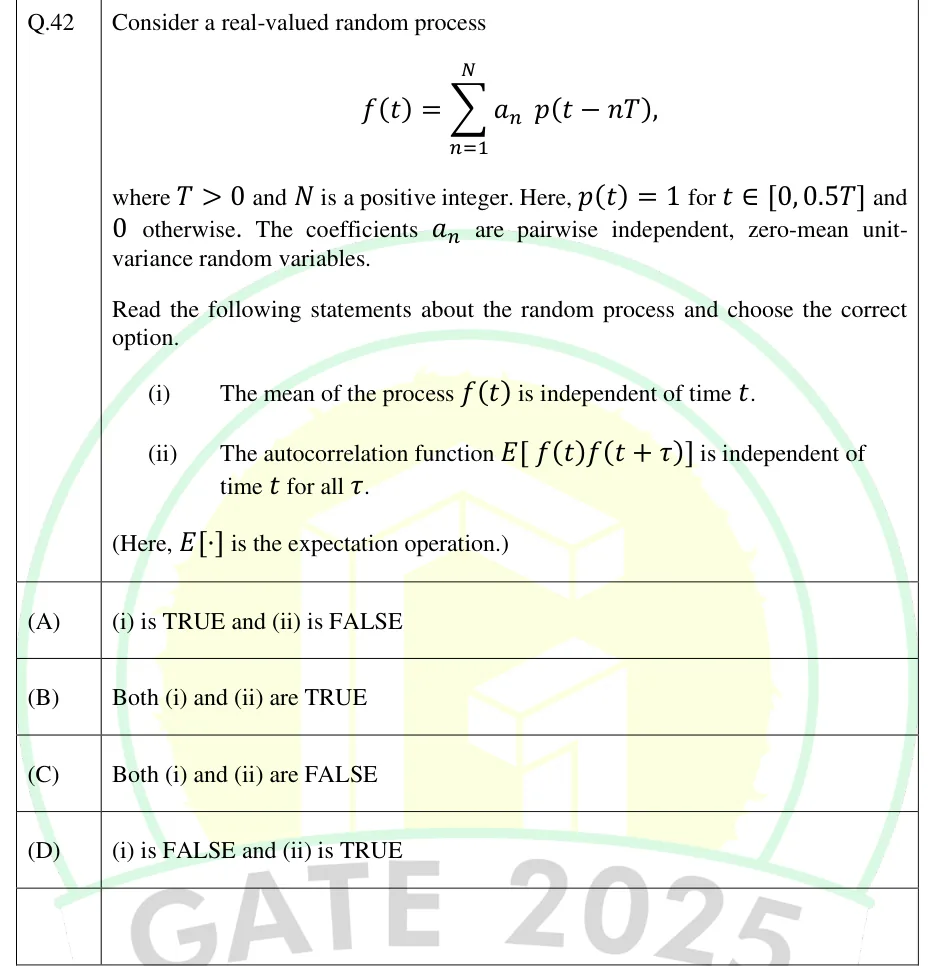
GATE 2025 EC Q.42

GATE 2025 · ECQ.42 · 2 marks · MCQ

Consider a real-valued random process f(t) = sum_{n=1}^{N} a_n p(t - nT), where T > 0 and N is a positive integer. Here, p(t) = 1 for t in [0, 0.5T] and 0 otherwise. The coefficients a_n are pairwise independent, zero-mean unit-variance random variables. Read the following statements about the random process and choose the correct option. (i) The mean of the process f(t) is independent of time t. (ii) The autocorrelation function E[f(t)f(t+tau)] is independent of time t for all tau. (Here, E[.] is the expectation operation.)

  1. (A)

    (i) is TRUE and (ii) is FALSE

  2. (B)

    Both (i) and (ii) are TRUE

  3. (C)

    Both (i) and (ii) are FALSE

  4. (D)

    (i) is FALSE and (ii) is TRUE

Answer and solution
See the question in the paper
GATE 2025 EC Q.42: answer and solution

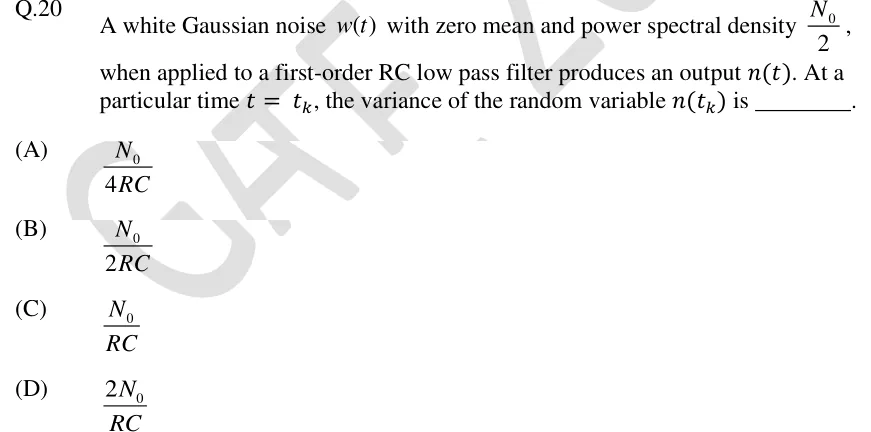
GATE 2024 EC Q.20

GATE 2024 · ECQ.20 · 1 mark · MCQ

A white Gaussian noise with zero mean and power spectral density , when applied to a first-order RC low pass filter produces an output . At a particular time , the variance of the random variable is ________.

  1. (A)

  2. (B)

  3. (C)

  4. (D)

Answer and solution
See the question in the paper
GATE 2024 EC Q.20: answer and solution

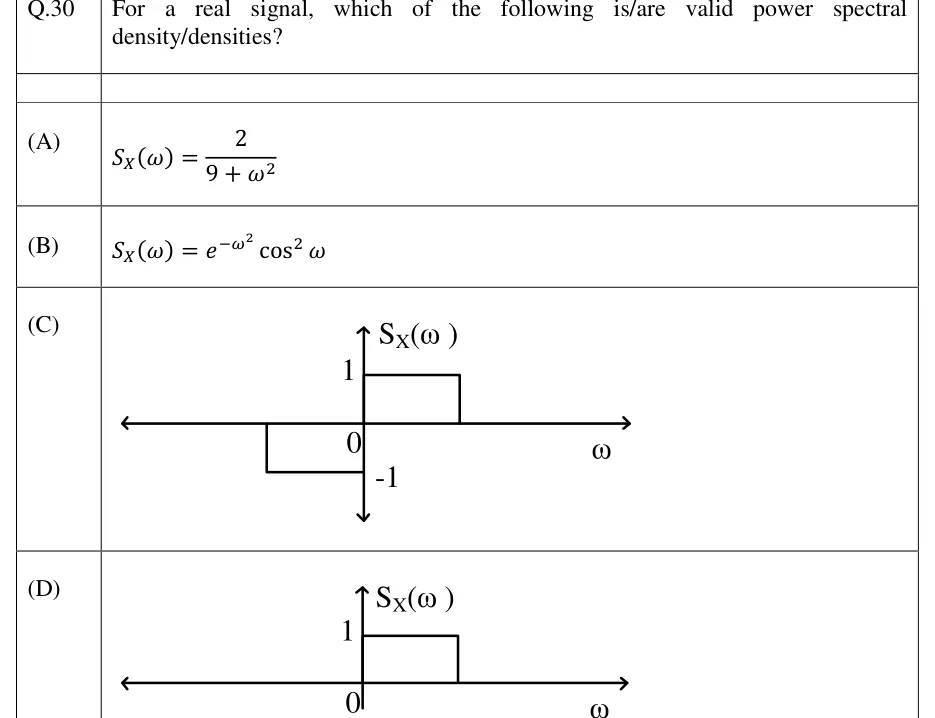
GATE 2023 EC Q.30

GATE 2023 · ECQ.30 · 1 mark · MSQ

For a real signal, which of the following is/are valid power spectral density/densities?

GATE 2023 EC question 30: Options (C) and (D) are plots of S_X(omega) against omega.Tap to open full size
Figure from the GATE 2023 EC paper. It is part of the question.
Figure description

Options (C) and (D) are plots of S_X(omega) against omega. (C): horizontal omega axis with arrows at both ends and vertical S_X(omega) axis. For omega > 0 there is a rectangular pulse of height 1 from omega = 0 to a positive omega value. For omega < 0 there is a rectangular pulse of height -1 (below the axis) from a negative omega value up to omega = 0. The levels 1 and -1 are labelled on the vertical axis. (D): same axes, with a rectangular pulse of height 1 from omega = 0 to a positive omega value only, and nothing for omega < 0 (the crop ends at the omega axis, with the lower half cut off).

  1. (A)

    S_X(omega) = 2/(9 + omega^2)

  2. (B)

    S_X(omega) = e^{-omega^2} cos^2(omega)

  3. (C)

    Figure — S_X(omega) equal to +1 on a band 0 < omega < omega_1 and equal to -1 on a band -omega_1' < omega < 0 (odd-shaped, taking negative values)

  4. (D)

    Figure — S_X(omega) equal to 1 on a band 0 < omega < omega_1 only, zero for omega < 0 (one-sided, not symmetric about omega = 0)

Answer and solution
GATE 2023 EC Q.30: answer and solution

PRACTICE

6 questions to test yourself

PRACTICE 11 mark · MCQ

Which of the following functions can be the autocorrelation function of a real wide-sense stationary process? Here for and otherwise, and for and otherwise.

  1. (A)

  2. (B)

  3. (C)

  4. (D)

Answer and solution

Answer: (D)

  1. An autocorrelation function must be even, have its maximum at , and have a non-negative Fourier transform. Below, .

  2. Option A is not even (the term is odd), so it fails.

  3. Option B is odd (it is times an even function), it is zero at but nonzero elsewhere, and it is unbounded, so it fails.

  4. Option C: the transform is , which takes negative values (for example for ), so it fails.

  5. Option D: the transform is , and the function is even with its maximum at . Answer D.

PRACTICE 22 marks · NAT

Zero-mean white noise with two-sided PSD W/Hz is applied to an ideal low-pass filter with gain in the passband kHz and zero gain elsewhere. Find the average output noise power in microwatts (W).

Answer and solution

Answer: (accepted range )

  1. W/Hz for Hz.

  2. W.

  3. This is W.

PRACTICE 32 marks · NAT

White noise with one-sided PSD W/Hz (two-sided ) is passed through a first-order RC low-pass filter with unity DC gain and 3 dB frequency kHz. Using the noise-equivalent bandwidth, find the output noise power in W. Take .

Answer and solution

Answer: (accepted range )

  1. For an RC low-pass filter, Hz.

  2. Output power W.

  3. Answer: W.

PRACTICE 42 marks · MSQ

Let be a real, zero-mean, wide-sense stationary process with autocorrelation and PSD . Which of the following statements are always true?

  1. (A)

  2. (B)

    for all

  3. (C)

    may be negative at some frequencies, provided its total integral is positive

  4. (D)

    If is also Gaussian, it is strict-sense stationary

Answer and solution

Answer: (A), (B), (D)

  1. A is true: a real WSS autocorrelation is even.

  2. B is true: the autocorrelation peaks at zero lag.

  3. C is false: the PSD is non-negative at every frequency.

  4. D is true: a Gaussian process is fixed by its mean and autocorrelation, so WSS implies SSS.

  5. Answer: A, B, D.

PRACTICE 51 mark · MCQ

A zero-mean Gaussian WSS process has . The probability that at a given instant is

  1. (A)

  2. (B)

  3. (C)

  4. (D)

Answer and solution

Answer: (B)

  1. Variance , so .

  2. (about ).

  3. Answer B.

PRACTICE 62 marks · NAT

A zero-mean WSS process has PSD W/Hz for kHz and zero elsewhere. It is multiplied by a carrier to give , where is uniform over and independent of . Find the average power of in watts.

Answer and solution

Answer: (accepted range )

  1. W.

  2. , so .

  3. Equivalently W.

  4. Answer: W.

OFFICIAL GATE 2027 SYLLABUS WORDING

Copied from the GATE 2027 syllabus; see all 2027 syllabi.

GATE EC

Random Processes: Autocorrelation and power spectral density, properties of white noise, filtering of random signals through LTI systems

Preparing in Kolkata? IAE Academy's course for GATE ECE.