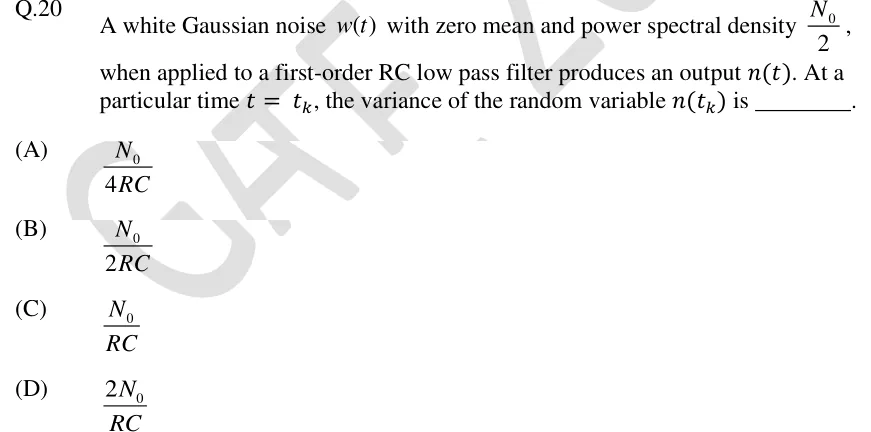
A white Gaussian noise with zero mean and power spectral density , when applied to a first-order RC low pass filter produces an output . At a particular time , the variance of the random variable is ________.
- (A)
- (B)
- (C)
- (D)

A white Gaussian noise with zero mean and power spectral density , when applied to a first-order RC low pass filter produces an output . At a particular time , the variance of the random variable is ________.
ANSWER
The variance of is , option (A).
Official answer: ASource: Official answer key, GATE 2024 EC (IISc Bengaluru)
The input has zero mean and the filter is linear and time-invariant, so the output also has zero mean. Hence , the output noise power.
The two-sided input PSD is . The first-order RC low pass filter has .
The output PSD is .
The output power is
Substitute , so . Since , we get .
Time-domain check: , so . This agrees with the frequency-domain value (Parseval).
Therefore , which is option (A).
KEY IDEA
For zero-mean noise through an LTI filter, variance equals output power. That power is the input PSD (two-sided ) times , which is for an RC low pass filter. This integral is the noise-equivalent bandwidth of the RC filter, Hz one-sided.
WATCH OUT FOR
Taking the 3 dB bandwidth in Hz as the noise bandwidth, or using the one-sided PSD over the wrong band. The noise-equivalent bandwidth is times the 3 dB bandwidth, and the integral must run over both positive and negative frequencies when the PSD is two-sided.
From the GATE 2024 EC paper. Every question of this paper · Download the full paper · All 6 Random processes questions, with notes