IAE Academy

GATE EC · IN

PCM, digital modulation and detection

This topic covers how an analogue signal becomes bits (sampling, quantisation, PCM, DPCM, delta modulation), how pulses are shaped to avoid inter-symbol interference, how bits ride on a carrier (ASK, PSK, FSK, QAM), and how the receiver decides which symbol was sent (matched filter, MAP, ML). GATE questions reduce to a few formulas used with care about conventions: SQNR, bit rate and bandwidth, roll-off, Eb/N0 and Q-function error probabilities, and decision thresholds.

15 previous-year questions · 15 solved · 5 practice questions

Sampling, quantisation and PCM

Pulse code modulation (PCM) has three steps: sample the message at , quantise each sample to one of levels, and encode each level as an -bit word. Conventions used here: a uniform mid-riser quantiser covers , and the quantisation error is uniformly distributed over one step.

STEP SIZE

Uniform quantiser with peak-to-peak range and levels.

QUANTISATION NOISE POWER

Error uniform on ; valid when the signal is large compared with and does not overload the quantiser.

SQNR FOR A GENERAL SIGNAL

Here is the average signal power and the quantiser's peak value.

SQNR, FULL-SCALE SINUSOID

Sinusoid of amplitude so and SQNR . Each extra bit adds about 6 dB. For a full-scale uniformly distributed signal () the SQNR is , i.e. dB.

PCM BIT RATE AND MINIMUM BANDWIDTH

Minimum (ideal Nyquist, sinc pulses) baseband bandwidth for binary PCM; with a raised-cosine pulse of roll-off it becomes . The first-null bandwidth of rectangular NRZ pulses is .

EXAM TIP

Time-division multiplexing channels, each sampled at with bits, gives (plus any framing bits), and a minimum bandwidth of .

EXAM TIP

depends only on , so if the signal power is dB below that of a full-scale sinusoid (amplitude ), the SQNR is dB below dB. Always check whether the question says "full-scale" or gives the signal's own peak value.

Companding, DPCM and delta modulation

A uniform quantiser gives the same noise power to loud and soft signals, so soft signals have poor SQNR. Companding compresses the signal before a uniform quantiser and expands it after, which gives small amplitudes finer effective steps. With and :

Μ-LAW COMPRESSOR

in the standard North American/Japanese system. In the limit , (no compression).

SQNR WITH Μ-LAW COMPANDING

Valid when . The SQNR then hardly depends on the signal level, which is the point of companding.

A-LAW COMPRESSOR

in the standard European system; linear for small inputs, logarithmic for large.

DPCM quantises the difference between the current sample and a prediction made from past (reconstructed) samples. The difference has a smaller variance than the signal, so fewer bits give the same SQNR, or the same bits give a better SQNR. Delta modulation (DM) is the one-bit extreme: the sampling rate is far above Nyquist and each bit says whether the staircase approximation steps up or down by .

DPCM PREDICTION GAIN

: signal variance, : prediction-error variance, : quantisation noise of the difference quantiser. In dB the gain adds to the SQNR of the same quantiser.

NO SLOPE OVERLOAD (DM)

For this is . If violated, the staircase cannot follow the signal (slope overload).

DM OUTPUT SNR, SINUSOID AT THE OVERLOAD LIMIT

Assumes amplitude (largest without slope overload), granular noise power spread evenly over , and an output low-pass filter of bandwidth . Doubling improves the SNR by about 9 dB.

Delta modulation errors

Error

Cause

Cure

Slope overload

Step too small, or too low, for the signal slope

Increase or (adaptive DM)

Granular noise

Step too large when the signal is nearly flat; staircase hunts around it

Decrease

EXAM TIP

Slope overload and granular noise pull in opposite directions. Fixing one worsens the other, which is why adaptive step size is used.

Line codes and inter-symbol interference

A line code maps bits to pulse amplitudes. Spectra are quoted for equally likely random bits with . The first-null bandwidth is the quick comparison at GATE level.

Line codes

Line code

Pulses

DC component

First-null bandwidth

Unipolar NRZ

1 = , 0 = 0, full bit width

Yes (and a discrete line at DC)

Polar NRZ

1 = , 0 = , full bit width

None for equiprobable bits

Unipolar RZ (50% duty)

1 = pulse for , 0 = 0

Yes (discrete lines at DC and odd multiples of )

Manchester

Transition in the middle of every bit

None

Bipolar (AMI), full-width pulses

0 = 0, 1s alternate

None

Inter-symbol interference (ISI) is the smearing of one symbol's pulse into neighbouring symbol slots, caused by a band-limited channel. With symbol period and overall pulse (transmit filter, channel and receive filter together), ISI is zero if the pulse is sampled at and for , with .

NYQUIST CRITERION FOR ZERO ISI

Equivalent to (normalised so ). Smallest bandwidth satisfying it: Hz, with , where (ideal, not realisable).

RAISED-COSINE PULSE BANDWIDTH

Baseband (one-sided) bandwidth for symbol rate . is the roll-off factor. At it is the ideal ; at it is .

MAXIMUM ZERO-ISI SYMBOL RATE

For a baseband channel of bandwidth . For a bandpass (double-sideband modulated) channel of bandwidth the limit is .

EXAM TIP

Do not mix baseband and passband. A raised-cosine pulse of roll-off needs at baseband but after double-sideband modulation onto a carrier.

Digital modulation schemes

Digital modulation changes the amplitude, phase or frequency of a carrier according to the bits. With symbols, bits go into each symbol, so and . Bandwidths below are null-to-null for rectangular pulses, which is for a linearly modulated scheme.

Digital modulation schemes

Scheme

What varies

Bits per symbol

Null-to-null bandwidth

ASK / OOK

Amplitude (OOK: carrier on or off)

1

BPSK

Phase or

1

BFSK

Frequency or

1

QPSK

Phase, four values 90 degrees apart

2

-ary PSK

Phase, values

Square -QAM

Amplitude on I and Q

BANDWIDTH EFFICIENCY (NULL-TO-NULL, PSK AND QAM ONLY)

With a raised-cosine pulse the passband bandwidth is , so . Not for FSK, whose bandwidth also depends on the tone spacing.

AVERAGE ENERGY, SQUARE M-QAM

is the minimum distance between adjacent points (per axis levels ), equiprobable points. -PSK has constant energy on a circle of radius .

MINIMUM TONE SPACING FOR ORTHOGONAL BFSK

The two tones must be orthogonal over one bit interval for the stated error probability to hold.

EXAM TIP

Gray-coded QPSK has the same bit-error probability as BPSK at the same , but needs half the bandwidth for the same bit rate. For PSK and QAM, going beyond saves bandwidth but needs more for a given BER. Orthogonal -FSK goes the other way: larger needs less and more bandwidth.

Detection: matched filter, MAP and ML

The channel adds white Gaussian noise with two-sided PSD . The receiver filters, samples once per symbol and compares the sample with a threshold. The best linear filter for a known pulse of duration is the matched filter.

MATCHED FILTER

Output sampled at . In the frequency domain . The peak SNR depends only on the pulse energy, not its shape. A correlation receiver (multiply by and integrate over ) gives the same output at the sampling instant .

For a decision between hypotheses (symbol ) and (symbol ) on the sample : MAP picks the hypothesis with the larger posterior probability, i.e. the larger . ML is MAP with equal priors, so it picks the larger likelihood . With Gaussian noise of the same variance under both hypotheses, ML is a minimum-distance rule: the threshold is the midpoint of the two signal points.

MAP THRESHOLD, TWO LEVELS IN GAUSSIAN NOISE

Sample with and noise under both hypotheses. For antipodal levels , it is . For equal priors the threshold is the midpoint (ML). A less likely moves the threshold toward .

Procedure for a detection question

  1. Write the received sample distribution under each hypothesis (mean and variance ). For a correlator whose reference is of energy , the signal part of the sample is and ; with a unit-energy reference the signal part is and .

  2. State the priors. Equal priors means ML; unequal means MAP.

  3. Set the likelihoods times priors equal and solve for the threshold .

  4. Find each error probability as a Gaussian tail, with and decided above : and .

  5. Combine: .

Error probability and BER

Convention: is the tail probability of a standard normal variable. is the energy per bit, noise PSD is two-sided, and detection is coherent with an optimum (matched-filter) receiver and equal priors. For two equiprobable signals at distance in signal space, .

BPSK AND QPSK (GRAY CODED) BIT ERROR PROBABILITY

Here for BPSK. QPSK is two independent BPSK streams on the I and Q carriers, so its per-bit error probability is the same.

COHERENT BFSK

Orthogonal tones, . This needs 3 dB more than BPSK for the same BER.

COHERENT ASK (ON-OFF), AVERAGE EB

Equal priors, threshold midway between the two received levels. Here is the average bit energy: the "1" has energy , the "0" none. If the same formula is written with the energy of the "1", use .

NON-COHERENT BFSK AND DPSK

For comparison: both are closed-form exponentials rather than functions.

LINK BETWEEN EB/N0 AND SNR

is the received signal power and the noise power in bandwidth . In dB: .

QPSK SYMBOL ERROR PROBABILITY

Exactly , where is the error probability of each of the two independent I and Q decisions ().

M-PSK AND SQUARE M-QAM SYMBOL ERROR (HIGH SNR)

For ; both reduce to the QPSK result at . With Gray coding, .

WORKED EXAMPLE

A binary PCM system quantises a full-scale sinusoid, bandlimited to 3.4 kHz, using 8 bits per sample at a sampling rate of 8 kHz. Find the bit rate, the minimum Nyquist baseband bandwidth of the PCM stream and the SQNR in dB.

Solution
  1. Bit rate: .

  2. Minimum bandwidth: .

  3. SQNR for a full-scale sinusoid: .

Answer: Bit rate 64 kb/s, minimum bandwidth 32 kHz, SQNR about 49.9 dB.

WORKED EXAMPLE

A BPSK signal , , with V, s and an integer multiple of , is received across a 1 ohm load in white noise of two-sided PSD with W/Hz. A coherent matched-filter receiver is used and the bits are equiprobable. Find and the matched filter's maximum output SNR for one bit.

Solution
  1. Bit energy: J.

  2. .

  3. .

  4. Matched filter maximum SNR (about 12 dB).

Answer: and maximum SNR (about 12 dB).

PREVIOUS-YEAR QUESTIONS

15 questions from the EC and IN papers

Try each question first, then open the answer. We placed each question under a topic ourselves; the exam paper does not label topics.

See these papers in full: GATE ECE 2026 · GATE ECE 2025 · GATE ECE 2024 · GATE ECE 2022 · GATE ECE 2020 · GATE ECE 2018 · GATE IN 2026 · GATE IN 2018

GATE 2026 EC Q.22

GATE 2026 · ECQ.22 · 1 mark · MCQ

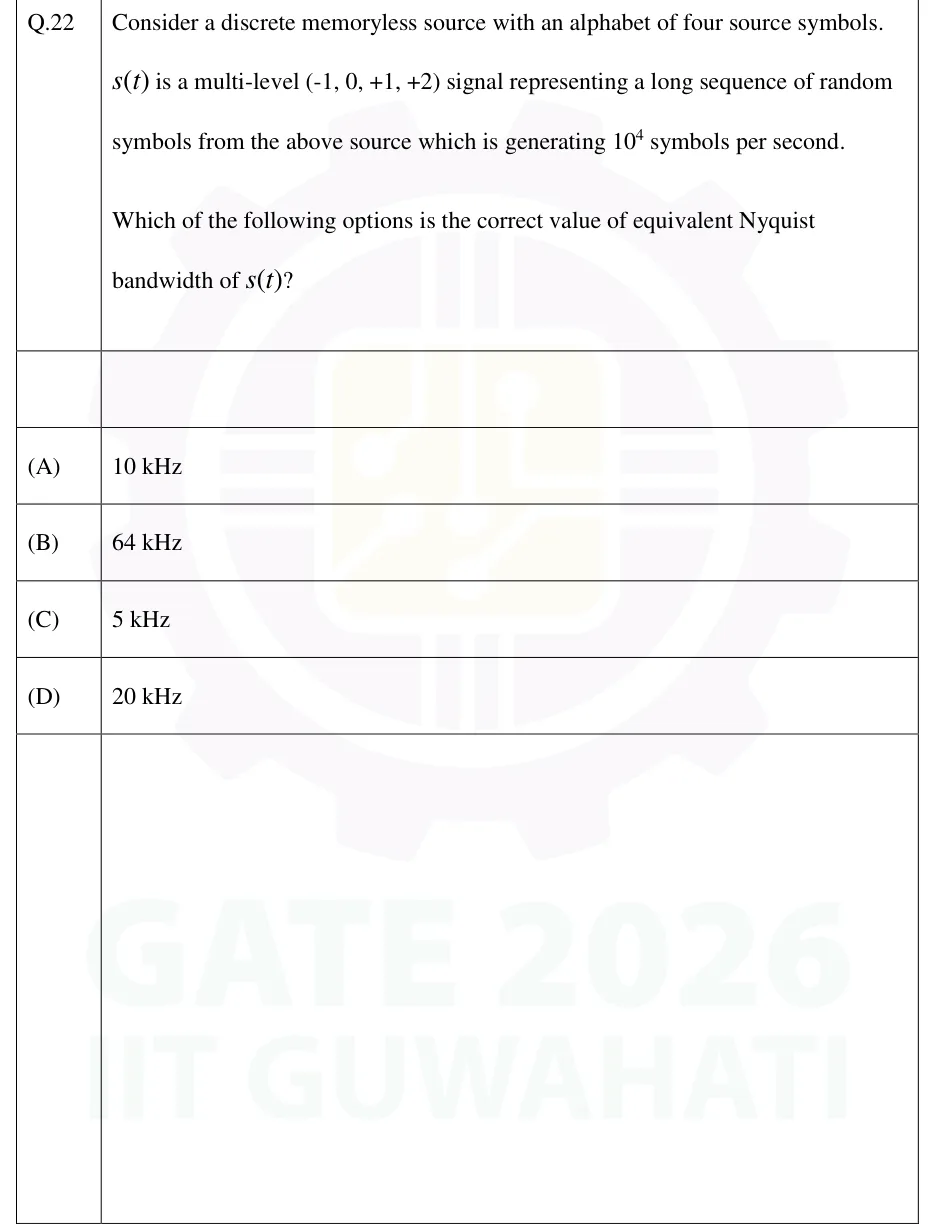
Consider a discrete memoryless source with an alphabet of four source symbols. s(t) is a multi-level (-1, 0, +1, +2) signal representing a long sequence of random symbols from the above source which is generating 10^4 symbols per second. Which of the following options is the correct value of equivalent Nyquist bandwidth of s(t)?

  1. (A)

    10 kHz

  2. (B)

    64 kHz

  3. (C)

    5 kHz

  4. (D)

    20 kHz

Answer and solution
See the question in the paper
GATE 2026 EC Q.22: answer and solution

GATE 2026 EC Q.32

GATE 2026 · ECQ.32 · 1 mark · NAT

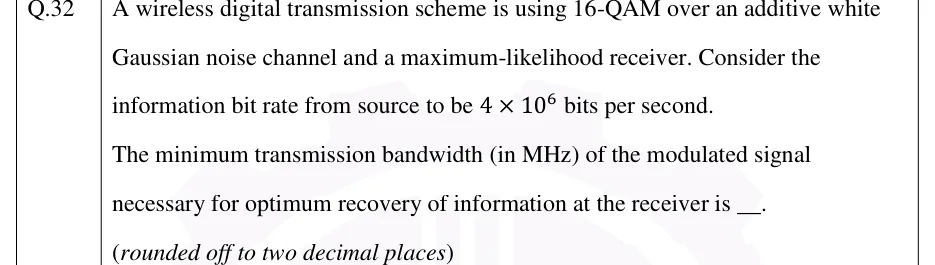
A wireless digital transmission scheme is using 16-QAM over an additive white Gaussian noise channel and a maximum-likelihood receiver. Consider the information bit rate from source to be bits per second. The minimum transmission bandwidth (in MHz) of the modulated signal necessary for optimum recovery of information at the receiver is ____. (rounded off to two decimal places)

Answer and solution
See the question in the paper
GATE 2026 EC Q.32: answer and solution

GATE 2026 EC Q.44

GATE 2026 · ECQ.44 · 2 marks · MCQ

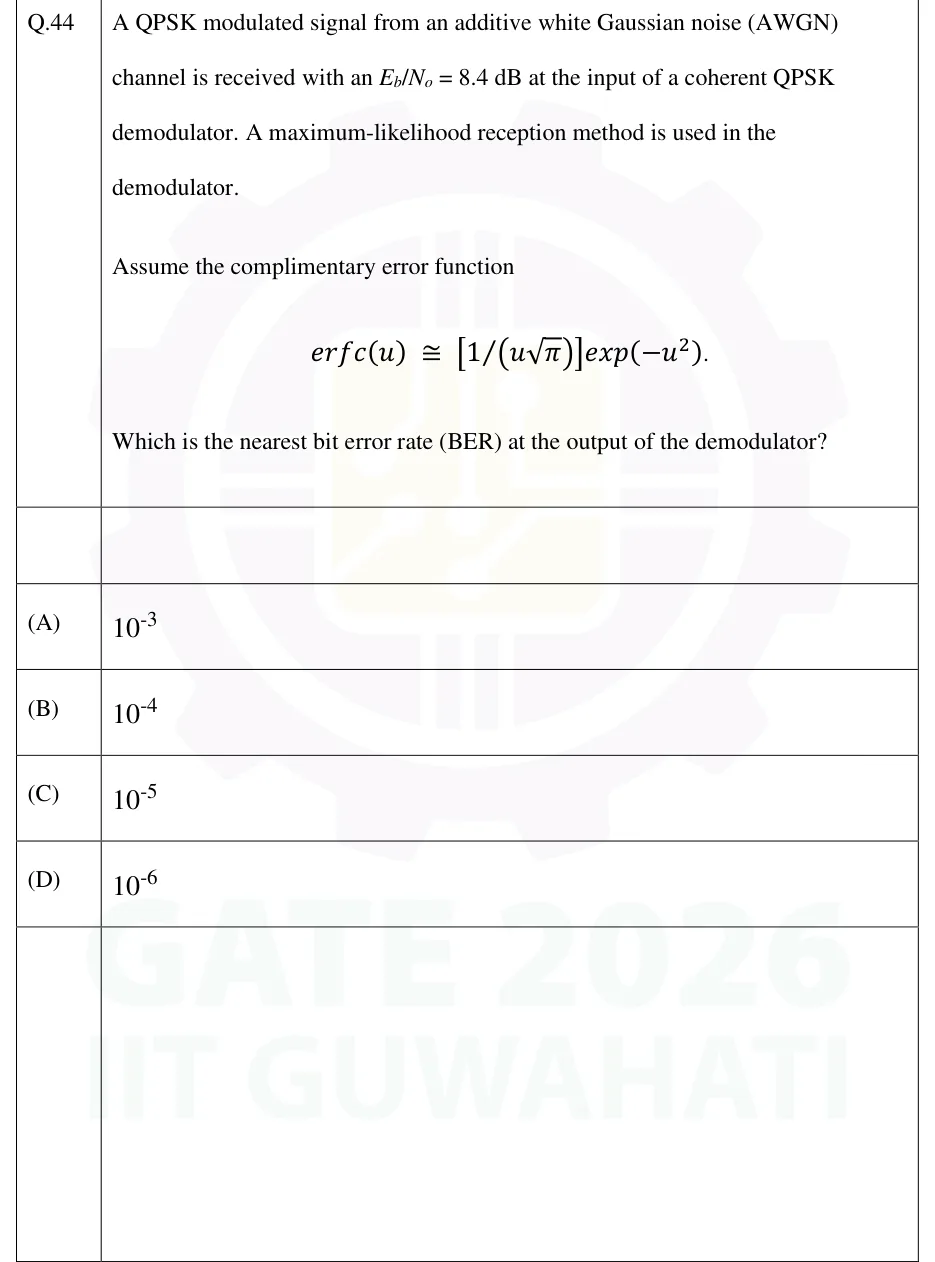
A QPSK modulated signal from an additive white Gaussian noise (AWGN) channel is received with an dB at the input of a coherent QPSK demodulator. A maximum-likelihood reception method is used in the demodulator.

Assume the complimentary error function .

Which is the nearest bit error rate (BER) at the output of the demodulator?

  1. (A)

  2. (B)

  3. (C)

  4. (D)

Answer and solution
See the question in the paper
GATE 2026 EC Q.44: answer and solution

GATE 2025 EC Q.41

GATE 2025 · ECQ.41 · 2 marks · MCQ

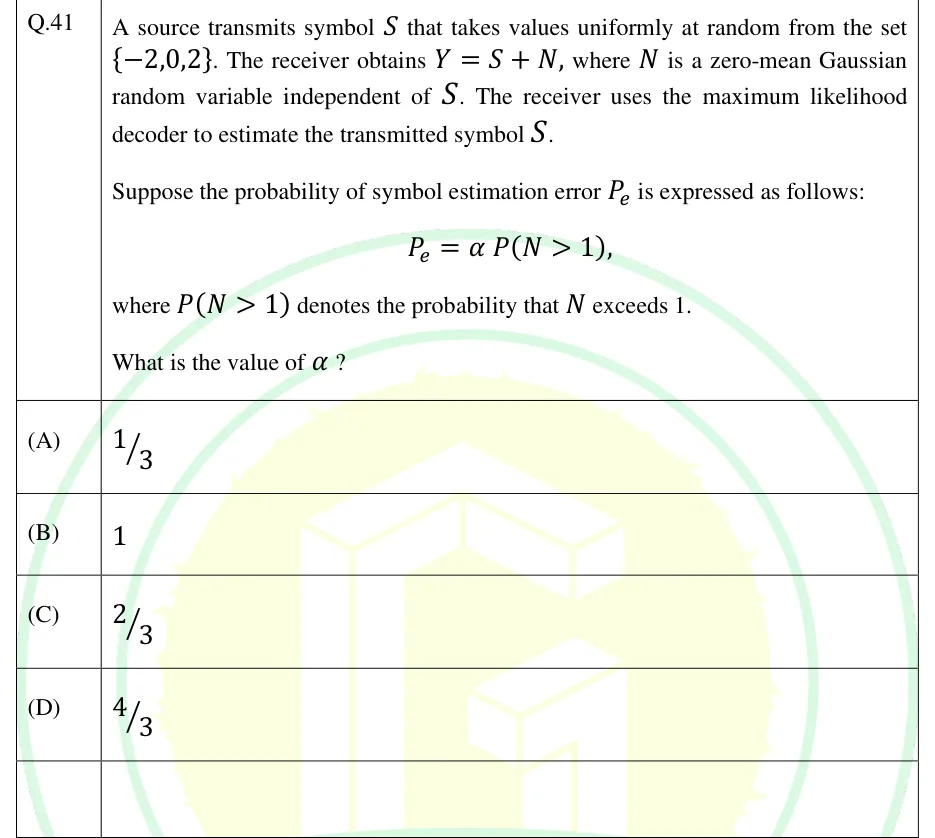
A source transmits symbol that takes values uniformly at random from the set . The receiver obtains , where is a zero-mean Gaussian random variable independent of . The receiver uses the maximum likelihood decoder to estimate the transmitted symbol . Suppose the probability of symbol estimation error is expressed as , where denotes the probability that exceeds 1. What is the value of ?

  1. (A)

  2. (B)

  3. (C)

  4. (D)

Answer and solution
See the question in the paper
GATE 2025 EC Q.41: answer and solution

GATE 2024 EC Q.14

GATE 2024 · ECQ.14 · 1 mark · MCQ

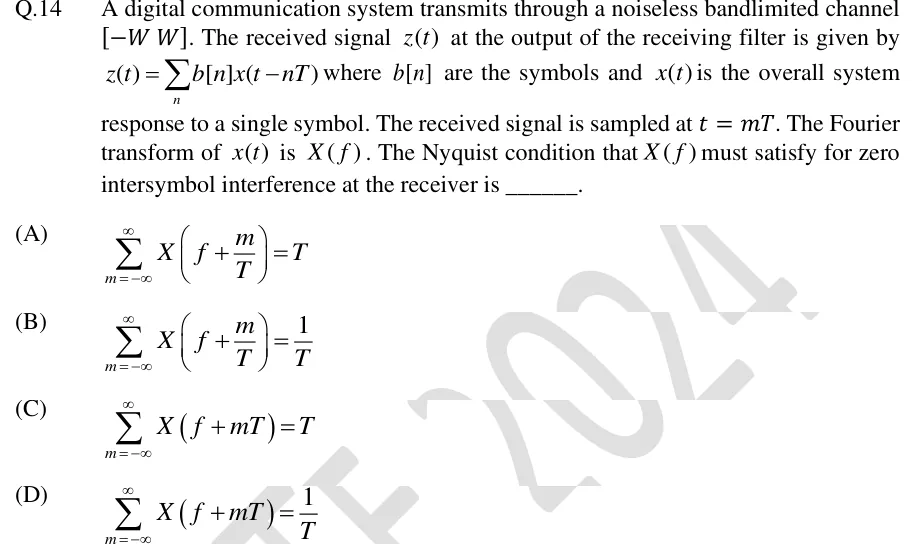
A digital communication system transmits through a noiseless bandlimited channel . The received signal at the output of the receiving filter is given by , where are the symbols and is the overall system response to a single symbol. The received signal is sampled at . The Fourier transform of is . The Nyquist condition that must satisfy for zero intersymbol interference at the receiver is ______.

  1. (A)

  2. (B)

  3. (C)

  4. (D)

Answer and solution
See the question in the paper
GATE 2024 EC Q.14: answer and solution

GATE 2024 EC Q.45

GATE 2024 · ECQ.45 · 2 marks · MCQ

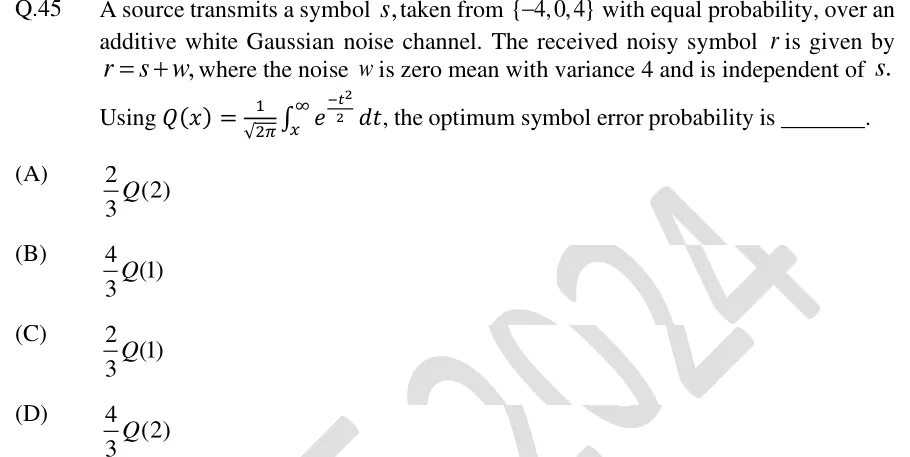
A source transmits a symbol , taken from with equal probability, over an additive white Gaussian noise channel. The received noisy symbol is given by , where the noise is zero mean with variance 4 and is independent of . Using , the optimum symbol error probability is ______.

  1. (A)

  2. (B)

  3. (C)

  4. (D)

Answer and solution
See the question in the paper
GATE 2024 EC Q.45: answer and solution

GATE 2024 EC Q.57

GATE 2024 · ECQ.57 · 2 marks · NAT

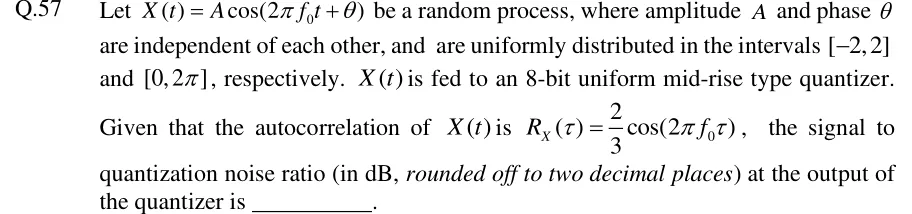
Let be a random process, where amplitude and phase are independent of each other, and are uniformly distributed in the intervals and , respectively. is fed to an 8-bit uniform mid-rise type quantizer. Given that the autocorrelation of is , the signal to quantization noise ratio (in dB, rounded off to two decimal places) at the output of the quantizer is ______.

Answer and solution
See the question in the paper
GATE 2024 EC Q.57: answer and solution

GATE 2022 EC Q.63

GATE 2022 · ECQ.63 · 2 marks · NAT

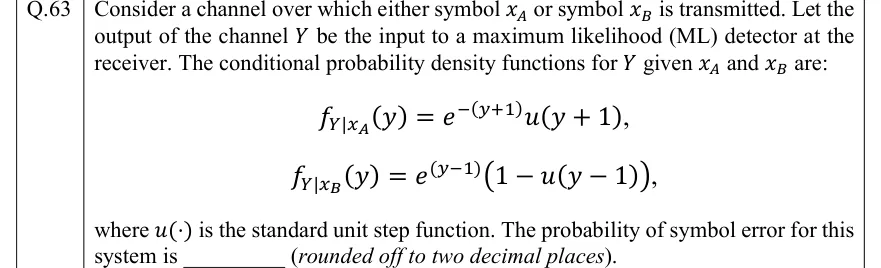
Consider a channel over which either symbol or symbol is transmitted. Let the output of the channel be the input to a maximum likelihood (ML) detector at the receiver. The conditional probability density functions for given and are: , , where is the standard unit step function. The probability of symbol error for this system is ________ (rounded off to two decimal places).

Answer and solution
See the question in the paper
GATE 2022 EC Q.63: answer and solution
Show the other 5 questions

GATE 2022 EC Q.64

GATE 2022 · ECQ.64 · 2 marks · NAT

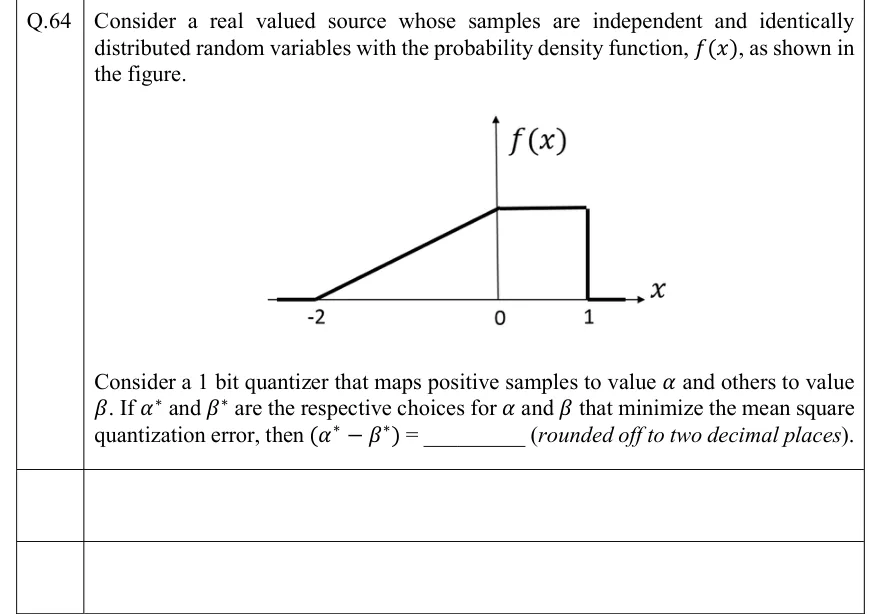
Consider a real valued source whose samples are independent and identically distributed random variables with the probability density function, f(x), as shown in the figure. Consider a 1 bit quantizer that maps positive samples to value α and others to value β. If α and β are the respective choices for α and β that minimize the mean square quantization error, then (α − β) = _________ (rounded off to two decimal places).

GATE 2022 EC question 64: Plot of f(x) versus x.Tap to open full size
Figure from the GATE 2022 EC paper. It is part of the question.
Figure description

Plot of f(x) versus x. f(x) is zero for x < -2. It rises linearly from 0 at x = -2 to a value h at x = 0 (the vertical f(x) axis), then stays constant at h from x = 0 to x = 1, where it drops vertically to zero. It is zero for x > 1. The height h is not labelled; the x-axis marks are -2, 0 and 1.

Answer and solution
GATE 2022 EC Q.64: answer and solution

GATE 2020 EC Q.48

GATE 2020 · ECQ.48 · 2 marks · NAT

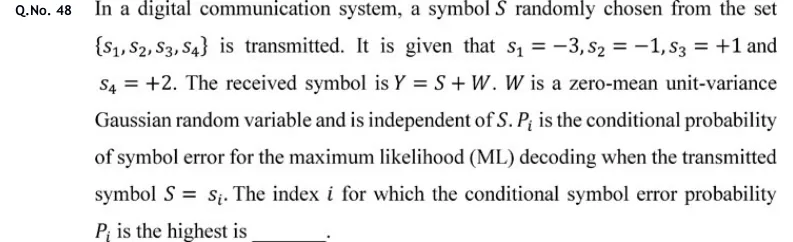
In a digital communication system, a symbol randomly chosen from the set is transmitted. It is given that , , and . The received symbol is . is a zero-mean unit-variance Gaussian random variable and is independent of . is the conditional probability of symbol error for the maximum likelihood (ML) decoding when the transmitted symbol . The index for which the conditional symbol error probability is the highest is ______.

Answer and solution
See the question in the paper
GATE 2020 EC Q.48: answer and solution

GATE 2018 EC Q.17

GATE 2018 · ECQ.17 · 1 mark · NAT

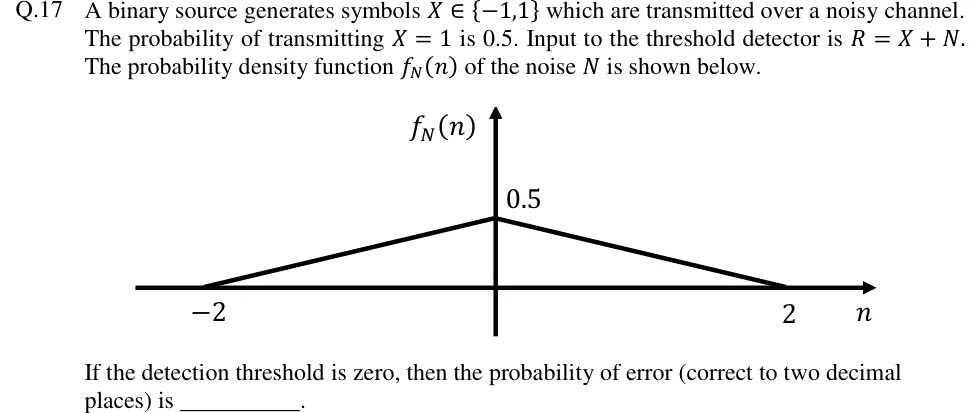
A binary source generates symbols which are transmitted over a noisy channel. The probability of transmitting is 0.5. Input to the threshold detector is . The probability density function of the noise is shown below. If the detection threshold is zero, then the probability of error (correct to two decimal places) is ______.

GATE 2018 EC question 17: Plot of f_N(n) versus n: a triangular pdf.Tap to open full size
Figure from the GATE 2018 EC paper. It is part of the question.
Figure description

Plot of f_N(n) versus n: a triangular pdf. Horizontal axis n with marked points -2 and 2; vertical axis f_N(n). The pdf is zero at n=-2, rises linearly to a peak of 0.5 at n=0, then falls linearly to zero at n=2 (symmetric triangle, zero outside [-2,2]).

Answer and solution
GATE 2018 EC Q.17: answer and solution

GATE 2018 EC Q.40

GATE 2018 · ECQ.40 · 2 marks · NAT

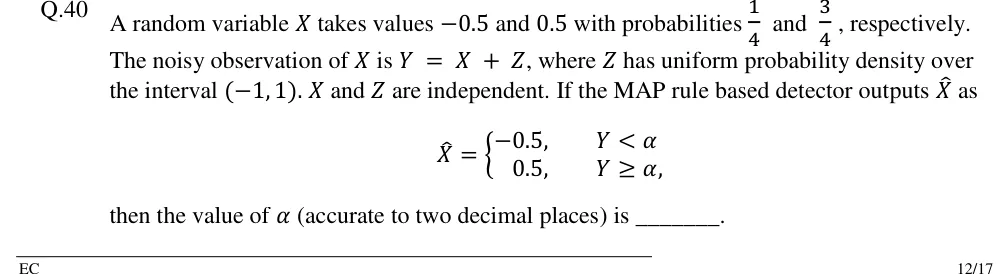
A random variable takes values and with probabilities and , respectively. The noisy observation of is , where has uniform probability density over the interval . and are independent. If the MAP rule based detector outputs as for and for , then the value of (accurate to two decimal places) is ______.

Answer and solution
See the question in the paper
GATE 2018 EC Q.40: answer and solution

PRACTICE

5 questions to test yourself

PRACTICE 11 mark · NAT

A full-scale sinusoidal signal is quantised by a uniform quantiser with bits per sample. The SQNR must be at least 70 dB. Using SQNR dB, find the minimum integer value of .

Answer and solution

Answer:

  1. Require , so .

  2. The smallest integer is (check: gives 67.98 dB, gives 74.0 dB).

PRACTICE 22 marks · NAT

A baseband binary-polar system sends symbols at 4800 baud through an ideal channel whose overall response is a raised-cosine pulse with zero ISI. The available baseband bandwidth is 3600 Hz. Find the largest roll-off factor that can be used.

Answer and solution

Answer: (accepted range )

  1. Baseband raised-cosine bandwidth: .

  2. , so .

  3. .

PRACTICE 32 marks · NAT

A rectangular pulse V for s (and zero elsewhere) is received in white noise of two-sided PSD with W/Hz (unit 1 ohm load). The pulse is passed through its matched filter. Find the maximum output SNR as a linear ratio.

Answer and solution

Answer: (accepted range )

  1. Pulse energy: J.

  2. Maximum SNR .

PRACTICE 42 marks · MSQ

Which of the following statements are correct for coherent detection in white Gaussian noise at the same and the same bit rate, with rectangular pulses and Gray coding where relevant?

  1. (A)

    Gray-coded QPSK and BPSK have the same bit error probability.

  2. (B)

    Coherent orthogonal BFSK has bit error probability , which is 3 dB worse than BPSK.

  3. (C)

    QPSK needs the same null-to-null bandwidth as BPSK.

  4. (D)

    16-QAM carries 4 bits per symbol.

Answer and solution

Answer: (A), (B), (D)

  1. A is true: QPSK is two independent BPSK streams, so for both.

  2. B is true: for orthogonal BFSK gives , i.e. 3 dB more for the same BER.

  3. C is false: QPSK halves the symbol rate, so its null-to-null bandwidth is half that of BPSK ().

  4. D is true: .

PRACTICE 52 marks · MCQ

A receiver sees where V for bit 1 and V for bit 0, and is zero-mean Gaussian with variance . The priors are and . The MAP receiver decides bit 1 if exceeds a threshold. The threshold is closest to:

  1. (A)

    0

  2. (B)

    0.347

  3. (C)

    -0.347

  4. (D)

    0.693

Answer and solution

Answer: (B)

  1. Use with .

  2. V.

  3. Positive, because bit 1 is less likely, so the decision boundary moves toward the +1 V point.

OFFICIAL GATE 2027 SYLLABUS WORDING

Copied from the GATE 2027 syllabus; see all 2027 syllabi.

GATE EC

Digital Communications: PCM, DPCM, digital modulation schemes (ASK, PSK, FSK, QAM), bandwidth, inter- symbol interference, MAP, ML detection, matched filter receiver, SNR and BER

GATE IN

pulse code modulation … amplitude, phase, frequency, quadrature amplitude, pulse shift keying for digital modulation and demodulation

Preparing in Kolkata? IAE Academy's course for GATE ECE or GATE IN.