IAE Academy

GATE 2024 EC Q.14: solution and answer

GATE 2024 · ECQ.14 · 1 mark · MCQ

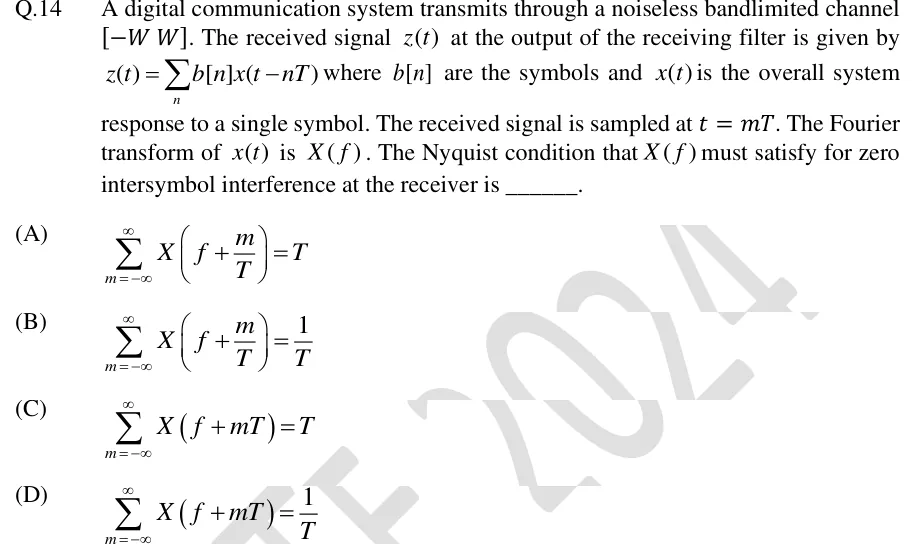
A digital communication system transmits through a noiseless bandlimited channel . The received signal at the output of the receiving filter is given by , where are the symbols and is the overall system response to a single symbol. The received signal is sampled at . The Fourier transform of is . The Nyquist condition that must satisfy for zero intersymbol interference at the receiver is ______.

  1. (A)

  2. (B)

  3. (C)

  4. (D)

See the question in the paper

Answer and solution

ANSWER

Option A: , the Nyquist zero-ISI criterion with the pulse normalised so that .

Official answer: marks to all candidatesSource: Official answer key, GATE 2024 EC (IISc Bengaluru)

  1. Sample the output at : .

  2. The second sum is the intersymbol interference. It vanishes for arbitrary symbols only if for every integer . Taking the usual normalisation , the time-domain Nyquist criterion is .

  3. Form the ideally sampled signal . Its Fourier transform is for all .

  4. Impulse sampling at spacing replicates the (two-sided) spectrum at multiples of the sampling rate :

  5. Set : . Since runs over all integers, replacing by gives

  6. The shifts are in frequency (multiples of the symbol rate), not , which rules out C and D. With the right-hand side is , not , which rules out B. The answer is option A.

KEY IDEA

Zero ISI means . Sampling at interval repeats the spectrum every Hz and scales it by . The sampled pulse is a single impulse, whose transform is 1, so the shifted copies must add up to the constant .

WATCH OUT FOR

Shifting the copies by instead of : the spectral copies sit at multiples of the symbol rate . Another slip is forgetting the factor in the sampling theorem, which leads to on the right-hand side (option B) instead of . The right-hand side assumes ; with a general it would be .

From the GATE 2024 EC paper. Every question of this paper · Download the full paper · All 15 Digital communication questions, with notes

More Digital communication questions