IAE Academy

GATE 2018 EC Q.27: solution and answer

GATE 2018 · ECQ.27 · 2 marks · MCQ

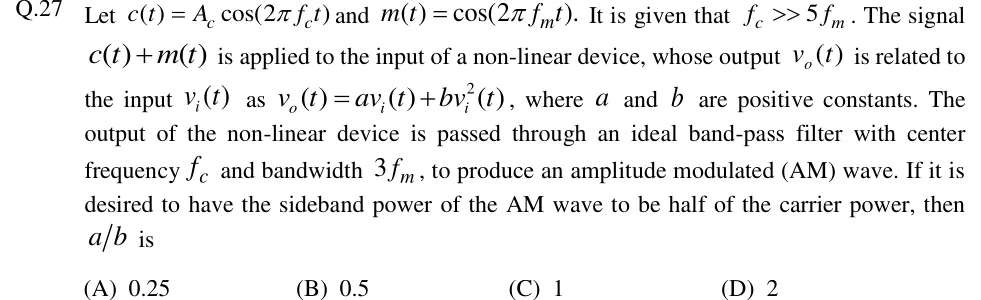
Let and . It is given that . The signal is applied to the input of a non-linear device, whose output is related to the input as , where and are positive constants. The output of the non-linear device is passed through an ideal band-pass filter with center frequency and bandwidth , to produce an amplitude modulated (AM) wave. If it is desired to have the sideband power of the AM wave to be half of the carrier power, then is

  1. (A)

    0.25

  2. (B)

    0.5

  3. (C)

    1

  4. (D)

    2

See the question in the paper

Answer and solution

ANSWER

, which is option (D).

Official answer: DSource: Official answer key, GATE 2018 EC (IIT Guwahati)

  1. Let and . The input to the device is , and .

  2. Expand the square: .

  3. Frequencies present in each term. The linear term has and . The term has DC and . The term has DC and . The cross term has .

  4. The ideal band-pass filter is centred at with bandwidth , so it passes . Because , the components at DC, and lie far below the pass-band and lies far above it. They are all rejected. The carrier at and the sidebands at (inside ) are passed.

  5. Filter output:

  6. This has the standard single-tone AM form with modulation index .

  7. For single-tone AM, the carrier power is and the total sideband power is . Hence .

  8. Setting gives (taking the positive value, since ). Then , so , which is option (D).

KEY IDEA

A square-law device turns the sum of a carrier and a message into an AM wave. The carrier-times-message cross term supplies the sidebands, so . Then use .

WATCH OUT FOR

Writing the modulation index as or and so missing the factor 2 from the cross term of the square. The amplitude of the message term is 1, so cancels. Another slip is using instead of for the sideband-to-carrier power ratio. A third is forgetting that and the filter bandwidth are what remove the unwanted terms.

From the GATE 2018 EC paper. Every question of this paper · Download the full paper · All 15 Analog modulation questions, with notes

More Analog modulation questions