IAE Academy

GATE BT

Cell growth, substrate utilisation and product formation

Cell growth kinetics describes how fast a culture grows, how much substrate it uses and how much product it makes. This page covers the batch growth curve and the specific growth rate, saturation models such as Monod, yield and maintenance coefficients, the Luedeking-Piret description of product formation, the classification of structured and unstructured models, and the elemental and electron balances that fix the stoichiometry of growth. Numerical problems on this topic come down to one of these relations, so learn each formula together with its conditions and units.

24 previous-year questions · 24 solved · 6 practice questions

Batch growth curve and specific growth rate

Conventions on this page. Concentrations are in g/L unless a C-mol basis is stated. Time is in h, so , and the dilution rate are in . is the natural log. Every yield is defined to be positive, e.g. , and always has the units of .

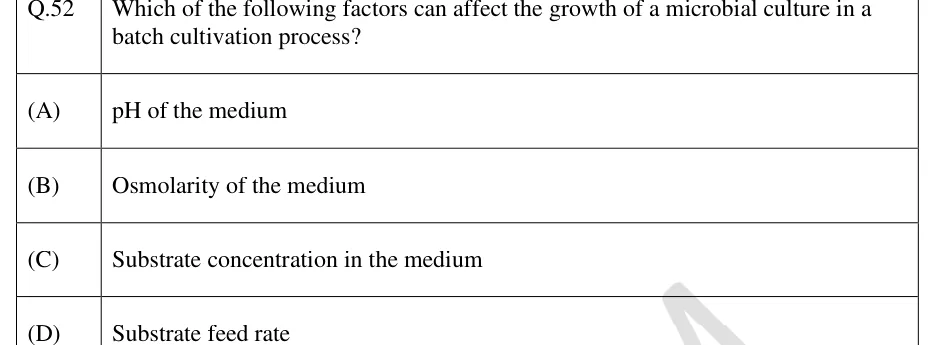
In a batch culture no nutrients are added and no culture is removed after inoculation. Only gases are exchanged (air in and exhaust gas out, for aerobes), plus acid or base if the pH is controlled. As substrate is used up and products build up, the biomass concentration (g dry cells/L) traces a characteristic curve. Growth is autocatalytic: the more cells there are, the faster new cells form. The natural measure of rate is therefore the specific growth rate , the rate of biomass formation per unit biomass, in .

Phases of batch growth, in order

  1. Lag phase: cells adapt to the new medium by making the enzymes and components they need, so . The lag is longer when the inoculum is old (taken from the stationary phase) or the medium differs from the pre-culture medium. It is shorter with a large, actively growing inoculum.

  2. Acceleration phase: a short transition in which rises towards its maximum.

  3. Exponential (log) phase: is constant, and when . Growth is approximately balanced: cell composition stays constant, so biomass and cell number grow at the same specific rate.

  4. Deceleration phase: falls because the limiting substrate runs low or inhibitory products accumulate. Growth is unbalanced while the cells restructure.

  5. Stationary phase: net growth is zero, either because growth and death balance or because the cells stop growing. Cells still use substrate (or their own reserves) for maintenance, and many secondary metabolites are made here.

  6. Death phase: the viable cell number falls. This is usually modelled as first order in the viable cell concentration.

Diauxic growth. When the medium holds two carbon sources, many organisms use the preferred one first, for example glucose before lactose in E. coli. The growth curve then shows two exponential phases separated by a second lag, during which the cells make the enzymes needed for the second substrate.

SPECIFIC GROWTH RATE

Definition, valid in any phase; units . is the biomass concentration (g/L). When death is negligible this is the growth rate itself; when death or endogenous decay is significant, the measured is the net rate (see below). The number-based rate uses the cell number concentration instead of .

EXPONENTIAL GROWTH AT CONSTANT SPECIFIC GROWTH RATE

Applies to the exponential phase only: constant , no lag inside the interval, death neglected ( at ). If death is significant, use the net rate in place of . Use the natural log. A plot of against is a straight line of slope .

DOUBLING TIME

Time for the biomass to double at constant (use if death is significant). The units follow : in gives in h.

NUMBER OF GENERATIONS AND GENERATION TIME

Based on cell NUMBER (cells/mL): after generations, . The relation holds for exponential growth at constant . The generation time equals the biomass doubling time only during balanced growth, when the mass per cell is constant.

DEATH AND NET GROWTH

In the biomass balance, () is a first-order constant for loss of biomass by death or endogenous decay, and is the net specific growth rate; in the stationary phase . In the death-phase expression, is the viable cell concentration, is its value when the death phase starts and is the time since then; there is the specific death rate of viable cells, which need not equal the biomass decay constant.

EXAM TIP

Check which log the axis uses before you take a slope. On a plot the slope is ; on a plot it is . A question that gives cell counts and asks for generations needs base 2: a rise from to cells/mL is 4 generations, because . Doubling time and generation time are interchangeable only when growth is balanced.

Monod kinetics and other unstructured growth models

The exponential-phase is constant only because substrate is plentiful. When a single substrate limits growth, rises with its concentration and levels off at . The Monod equation describes this saturation. It is empirical: it has the same form as the Michaelis-Menten equation but is not derived from a mechanism. , the saturation (half-velocity) constant, is the value of at which . It has the units of (g/L or mol/L). A smaller means the cells approach maximum growth at lower substrate levels.

MONOD EQUATION

Assumes one growth-limiting substrate, all other nutrients in excess, no inhibition and negligible death. is in ; and are in the same concentration units. At , .

LIMITING CASES OF THE MONOD EQUATION

Use these to simplify batch and chemostat problems. In batch culture with , growth stays near until the substrate is almost exhausted.

SUBSTRATE CONCENTRATION FOR A GIVEN GROWTH RATE

The Monod equation solved for ; valid only for . In a chemostat at steady state with sterile feed and negligible death, , so this gives the residual substrate concentration , which does not depend on the feed substrate concentration.

LINEAR FORMS FOR ESTIMATING MONOD PARAMETERS

Double-reciprocal (Lineweaver-Burk) plot: against , with intercept , slope and x-intercept . Second form: against , with slope and intercept . Third form: against , with slope and intercept . In the double-reciprocal plot the low- points (small , large ) lie far from the axis, and taking reciprocals magnifies their errors, so they dominate the fitted line.

LOGISTIC EQUATION

An unstructured model that needs no substrate balance: growth slows as approaches the carrying capacity . is the biomass at , and () is the specific growth rate when . The volumetric growth rate is highest at , so the curve is sigmoidal when .

Other unstructured growth models

Model

Specific growth rate

When it is used

Tessier

An alternative saturation curve. For the same and it lies above the Monod curve at every and approaches exponentially. Here at , not at .

Moser

Adds an exponent ; with it fits sigmoidal -against- data, and gives Monod. Here has units of (concentration).

Contois

Dense cultures, where falls as rises at the same (for example, growth limited by mass transfer in viscous broths or on insoluble substrates). is in g substrate per g biomass, so has the units of .

Andrews (substrate inhibition)

The substrate is inhibitory at high concentration (e.g. phenol), so passes through a maximum. As it reduces to Monod.

Product inhibition (non-competitive)

A product such as ethanol slows growth. At fixed , halves when .

Product inhibition (linear/power)

Valid for ; is linear inhibition. Growth stops completely at the critical product concentration .

ANDREWS SUBSTRATE INHIBITION: OPTIMUM SUBSTRATE LEVEL

Found by setting . Below , raising speeds growth; above it, raising slows growth. is always below .

INTEGRATED MONOD EQUATION FOR BATCH GROWTH

Batch culture from inoculation (, , ) to time , assuming Monod kinetics, constant yield, no lag, and negligible maintenance and death, so that . When and has not fallen close to zero, both correction terms are small and it reduces to .

WORKED EXAMPLE · WORKED EXAMPLE: MONOD GROWTH IN A BATCH FERMENTER

A yeast grows in batch culture on glucose, the only limiting substrate. Growth follows Monod kinetics with and g/L, and the yield is constant at g cells/g glucose. The culture starts at g/L and g/L with no lag, and maintenance and death are negligible. Find (a) the initial specific growth rate and the corresponding doubling time, (b) the maximum biomass concentration, and (c) the time to reach 90% of that maximum.

Solution
  1. (a) . This is essentially because .

  2. h.

  3. (b) At the end all the glucose has been used, so g/L.

  4. (c) The target is g/L. The substrate left at that point is g/L. That is still about 12 times , and there , so stays close to for almost the whole run.

  5. Approximation : h.

  6. Check with the integrated Monod equation: . Then , so h.

Answer: (a) and h; (b) g/L; (c) about 8.3 h (8.24 h taking , 8.35 h from the integrated Monod equation).

EXAM TIP

is an empirical fitted constant: unlike in Michaelis-Menten kinetics, it is not derived from a reaction mechanism. The algebra is the same, though, so the same linear plots apply. Check the units: always has the units of , and in the Contois model must have the units of .

Yield coefficients and maintenance

A yield coefficient converts one amount into another, such as grams of cells made per gram of substrate used, or grams of product per gram of substrate. Substrate and oxygen are consumed, so their changes are negative, and a minus sign keeps every yield positive. The overall yield is taken between two times (). The instantaneous yield is a ratio of rates (). The two are equal only if the yield stays constant over the interval.

YIELD COEFFICIENTS

Units are g/g, C-mol/C-mol or mol/mol; always state which. Here stands for the oxygen still available to the cells per litre of culture, which falls as it is consumed; it is not the dissolved-oxygen concentration. So is the biomass formed per unit of oxygen consumed. Yields taken over the same interval combine as ratios: and .

BIOMASS-SUBSTRATE BALANCE IN BATCH CULTURE

Assumes a constant yield and negligible maintenance. is reached when the limiting substrate is used up ().

SPECIFIC RATES

Rates per unit biomass, e.g. g substrate/(g cells·h). OUR is the volumetric oxygen uptake rate, e.g. mol /(L·h). The last relation uses the instantaneous observed yield and neglects death, since then . A volumetric rate is the specific rate times , e.g. .

PIRT MAINTENANCE MODEL

is the true (maximum) growth yield, the yield if no substrate went to maintenance. is the maintenance coefficient, in g substrate/(g cells·h), taken as constant; is the same for oxygen. Maintenance is energy spent on turnover of cell components, osmotic and ion gradients, and motility, not on making new cells.

OBSERVED YIELD WITH MAINTENANCE

Follows from (death neglected). A plot of against is a straight line with slope and intercept . In a chemostat at steady state with sterile feed and negligible death, , so the plot is against . Whenever , , and the gap widens as falls.

SUBSTRATE UPTAKE WHEN A PRODUCT IS ALSO MADE

The substrate is split three ways: new biomass, product and maintenance. Use this form when the product is made by a pathway separate from the cell's energy supply. If the product is itself the end product of energy metabolism (ethanol in anaerobic yeast culture), the substrate that forms it is the same substrate that supplies energy for growth and maintenance, so adding a separate product term counts that substrate twice.

EXAM TIP

Maintenance makes the batch yield change with time. When growth slows, a larger share of the substrate goes to maintenance and falls. As , all substrate uptake is maintenance and . If a question gives and does not mention maintenance, treat the yield as constant and use . Never mix g/g and C-mol/C-mol yields in one equation.

Product formation kinetics

Products are classified by when they appear relative to growth. A product that comes straight from energy metabolism is made in step with growth. A secondary metabolite is made mainly after growth stops. Many products fall in between. The Luedeking-Piret equation covers all three cases with two constants: links product formation to the growth rate, and links it to the amount of biomass present.

Classes of product formation

Class

When product appears

Luedeking-Piret form

Commonly cited example

Growth-associated

Together with growth; is proportional to

:

Ethanol by yeast under anaerobic conditions

Mixed

During growth, and continues in the stationary phase

and

Lactic acid by lactic acid bacteria

Non-growth-associated

Mainly in the stationary phase (idiophase)

:

Secondary metabolites such as penicillin

LUEDEKING-PIRET EQUATION

is the growth-associated coefficient (g P/g X). is the non-growth-associated coefficient (g P/(g X·h)). The two forms are equivalent when (death neglected). To find both constants, plot against : the slope is and the intercept is .

INTEGRATED LUEDEKING-PIRET EQUATION IN BATCH CULTURE

Death neglected. The exponential-phase form uses for constant . In the stationary phase, with constant from time , when the product concentration is , product rises linearly: .

EXAM TIP

Keep the two forms apart: is per unit biomass, while is per unit volume. For a growth-associated product (), and stays constant through the run. For a non-growth-associated product, output depends on how long a high biomass is held, not on how fast the cells grew. That is why such processes can use a growth stage followed by a separate slow-growth production stage.

Structured and unstructured, segregated and non-segregated models

Kinetic models are classified along two independent axes. The first is how the inside of a cell is described. An unstructured model treats biomass as one lumped variable , so the rate depends only on the surroundings (, , pH, temperature) and on . A structured model splits biomass into two or more components or compartments and writes a balance for each. Examples are RNA and protein pools, an active and a structural fraction, or a key enzyme. The rate then also depends on the cell's internal state.

The second axis is how the population is described. A non-segregated model (also called distributed, because the biomass is treated as a continuum spread through the medium) treats every cell as the same average cell. A segregated model treats the population as individuals that differ, for example in age, size, cell-cycle stage or plasmid content, and tracks how that property is distributed.

An unstructured model is adequate under balanced growth, when every cell component (mass, protein, DNA, cell number) increases by the same factor over the same interval, so composition stays fixed. The exponential phase of batch culture and the steady state of a chemostat come close to balanced growth. Transients are unbalanced and generally need a structured model; examples are the lag phase, a sudden change of substrate or dilution rate, and diauxic growth.

The four model classes

Class

How cells are represented

Typical use

Unstructured, non-segregated

One biomass variable; all cells identical

Balanced growth; the Monod, logistic and Luedeking-Piret models

Structured, non-segregated

An average cell with several internal components or compartments

Lag phase, shifts in substrate or dilution rate, diauxie

Unstructured, segregated

Cells differ in one property (e.g. age or size) but are otherwise black boxes

Cell-cycle or age-dependent behaviour, population distributions

Structured, segregated

Cells differ AND each has internal structure

Most realistic; most parameters, usually solved numerically

EXAM TIP

An unstructured model responds instantly to a change in the medium, because depends only on the present and . It therefore cannot predict a lag after a shift. The lag comes from the cell's internal state, which only a structured model tracks. 'Structured' refers to what is inside a cell; 'segregated' refers to differences between cells. Do not mix them up.

Elemental balances and degree of reduction

Growth is a chemical reaction, so atoms and electrons must balance. Write every organic compound on a one-carbon (C-mol) basis by dividing its formula by its number of carbon atoms: glucose, , becomes (30 g/C-mol). Cells are written the same way; a commonly used approximate formula is (24.6 g/C-mol). For aerobic growth with ammonia as the nitrogen source, the stoichiometry per C-mol of substrate is as follows.

GROWTH STOICHIOMETRY PER C-MOL OF SUBSTRATE

No extracellular product. is the biomass yield in C-mol cells per C-mol substrate. Here , , , and are formula subscripts, not the maintenance coefficient, the number of generations or the Luedeking-Piret constants. If a product is formed, add mol of product, with carbon atoms per molecule, to the right-hand side.

ELEMENT BALANCES

Four equations in five unknowns ( to ), so one more measured quantity is needed, usually or the RQ. The electron balance below replaces the H and O balances and is quicker.

DEGREE OF REDUCTION

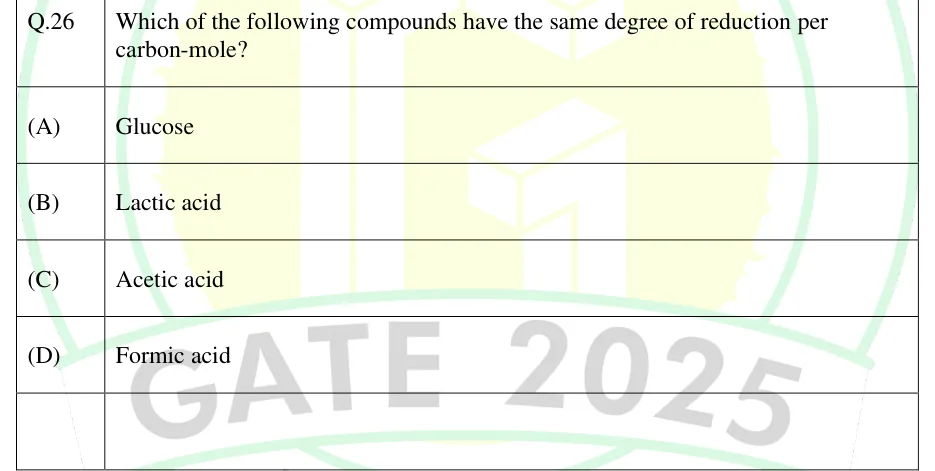
Available electrons per C-mol, counting C = +4, H = +1, O = -2 and N = -3 (ammonia as the nitrogen reference). The reference compounds , and all have . If nitrate is the nitrogen source, count N as +5; if is, count it as 0. One mole of accepts 4 electrons.

Degree of reduction of common compounds

Compound

C-mol formula

per C-mol

Glucose, acetic acid, lactic acid

4

Glycerol ()

4.67

Ethanol ()

6

Methanol

6

Methane

8

Formic acid

2

Biomass, as N source

4.2

Biomass, nitrate as N source

5.8

, ,

(reference compounds)

0

ELECTRON BALANCE

Per C-mol of substrate. , and are the degrees of reduction of substrate, biomass and product per C-mol, and is the C-mol of product formed. Electrons in the substrate end up in biomass, product or oxygen; , and the nitrogen source carry none, provided is computed with the valence of N for that source.

FATE OF AVAILABLE ELECTRONS AND YIELD LIMITS

, and are the fractions of the substrate's available electrons that go to biomass, product and oxygen. For a heterotroph growing on one organic carbon source (no fixation), the biomass yield in C-mol/C-mol can never exceed the carbon limit of 1 or the electron limit . The electron limit is reached only with no oxygen uptake and no product. The same reasoning bounds the product: .

RESPIRATORY QUOTIENT AND YIELD CONVERSIONS

RQ is the mol of formed per mol of consumed. and are masses per C-mol (g/C-mol). To express the coefficients to per mole of substrate instead of per C-mol, multiply them by the number of carbon atoms in the substrate; the g/g yields and the RQ do not change.

Procedure for a growth-stoichiometry problem

  1. Write the substrate, biomass and any product on a C-mol basis, and find their masses per C-mol.

  2. Convert the given yield to C-mol/C-mol: .

  3. Compute , (and ), using the correct valence for the nitrogen source.

  4. Use the electron balance to get the oxygen demand: .

  5. Use the carbon balance to get : . Use the nitrogen balance to get : (plus any N in the product).

  6. Use the hydrogen balance to get the water, , and the oxygen balance as a check.

  7. Work out what the question asks: RQ , , and multiply the coefficients by the carbon number for values per mole of substrate.

WORKED EXAMPLE · WORKED EXAMPLE: OXYGEN DEMAND OF AEROBIC GROWTH ON GLUCOSE

A bacterium grows aerobically on glucose, with ammonia as the nitrogen source and no extracellular product. The biomass formula is (ash-free), and the biomass yield is 0.50 g dry cells per g glucose. Using C = 12, H = 1, O = 16 and N = 14, find (a) the oxygen requirement in mol per mol glucose, (b) in g/g, and (c) the respiratory quotient.

Solution
  1. C-mol basis: glucose is with g/C-mol. For biomass, g/C-mol.

  2. Biomass yield in C-mol: C-mol cells per C-mol glucose.

  3. Degrees of reduction: and .

  4. Electron balance (no product): , so mol per C-mol glucose. Per mole of glucose (6 C): mol .

  5. g cells per g .

  6. Carbon balance: mol per C-mol glucose, so .

  7. Check with the O balance. The N balance gives . The H balance, , gives . O balance: left side ; right side . The equation balances.

Answer: (a) About 2.16 mol per mol glucose; (b) g/g; (c) RQ . 64% of the glucose electrons end up in biomass () and 36% go to oxygen.

EXAM TIP

Two quick checks. First, complete oxidation () needs per C-mol: 1 mol per C-mol of glucose, or 6 per mole. Second, if the question gives an ash fraction for the cells, one C-mol of dry cells weighs the formula mass divided by (1 - ash fraction); for 8% ash, g. Also remember that depends on the nitrogen source, so recompute it when the source is not ammonia.

EXAM TIP

The electron limit gives the theoretical maximum product yield directly. For ethanol from glucose, C-mol ethanol per C-mol glucose, i.e. 4 C-mol (2 mol) of ethanol per mol of glucose. That is g ethanol per g glucose, the yield of with no biomass formed.

PREVIOUS-YEAR QUESTIONS

24 questions from the BT papers

Try each question first, then open the answer. We placed each question under a topic ourselves; the exam paper does not label topics.

See these papers in full: GATE BT 2026 · GATE BT 2025 · GATE BT 2024 · GATE BT 2023 · GATE BT 2022 · GATE BT 2020 · GATE BT 2019

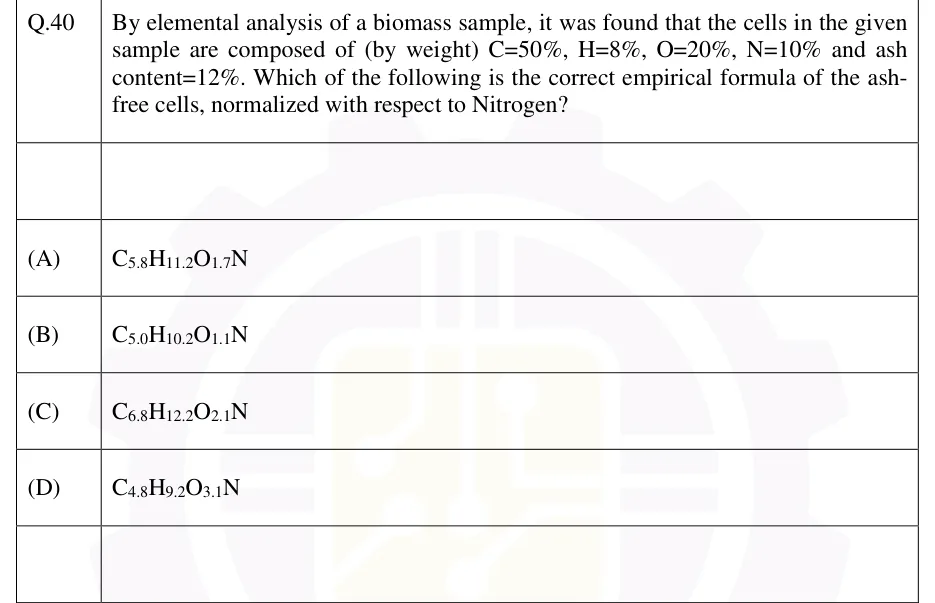
GATE 2026 BT Q.40

GATE 2026 · BTQ.40 · 2 marks · MCQ

By elemental analysis of a biomass sample, it was found that the cells in the given sample are composed of (by weight) C=50%, H=8%, O=20%, N=10% and ash content=12%. Which of the following is the correct empirical formula of the ash-free cells, normalized with respect to Nitrogen?

  1. (A)

  2. (B)

  3. (C)

  4. (D)

Answer and solution
See the question in the paper
GATE 2026 BT Q.40: answer and solution

GATE 2026 BT Q.55

GATE 2026 · BTQ.55 · 2 marks · NAT

A microbial culture (following Monod model for growth) has a maximum specific growth rate of 0.1 h, Monod constant of 1 mg L and endogenous decay rate of 0.1 day. At limiting substrate concentration of 23 g L, the net specific growth rate will be ________ day. (rounded off to one decimal place)

Answer and solution
See the question in the paper
GATE 2026 BT Q.55: answer and solution

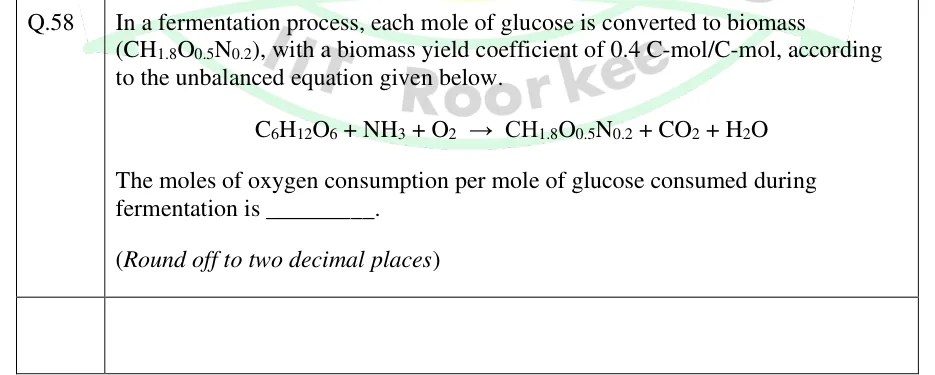
GATE 2025 BT Q.58

GATE 2025 · BTQ.58 · 2 marks · NAT

In a fermentation process, each mole of glucose is converted to biomass (), with a biomass yield coefficient of 0.4 C-mol/C-mol, according to the unbalanced equation given below.

The moles of oxygen consumption per mole of glucose consumed during fermentation is ________.

(Round off to two decimal places)

Answer and solution
See the question in the paper
GATE 2025 BT Q.58: answer and solution

GATE 2024 BT Q.58

GATE 2024 · BTQ.58 · 2 marks · NAT

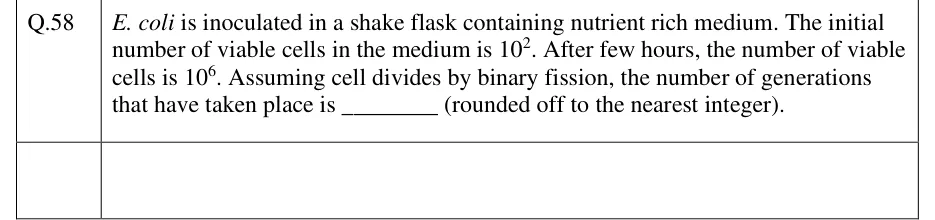
E. coli is inoculated in a shake flask containing nutrient rich medium. The initial number of viable cells in the medium is . After few hours, the number of viable cells is . Assuming cell divides by binary fission, the number of generations that have taken place is ________ (rounded off to the nearest integer).

Answer and solution
See the question in the paper
GATE 2024 BT Q.58: answer and solution

GATE 2023 BT Q.46

GATE 2023 · BTQ.46 · 2 marks · NAT

The following reaction represents biomass synthesis from hexadecane

where represents the biomass. The value of respiratory quotient (rounded off to two decimal places) is ________.

Answer and solution
See the question in the paper
GATE 2023 BT Q.46: answer and solution

GATE 2022 BT Q.16

GATE 2022 · BTQ.16 · 1 mark · MCQ

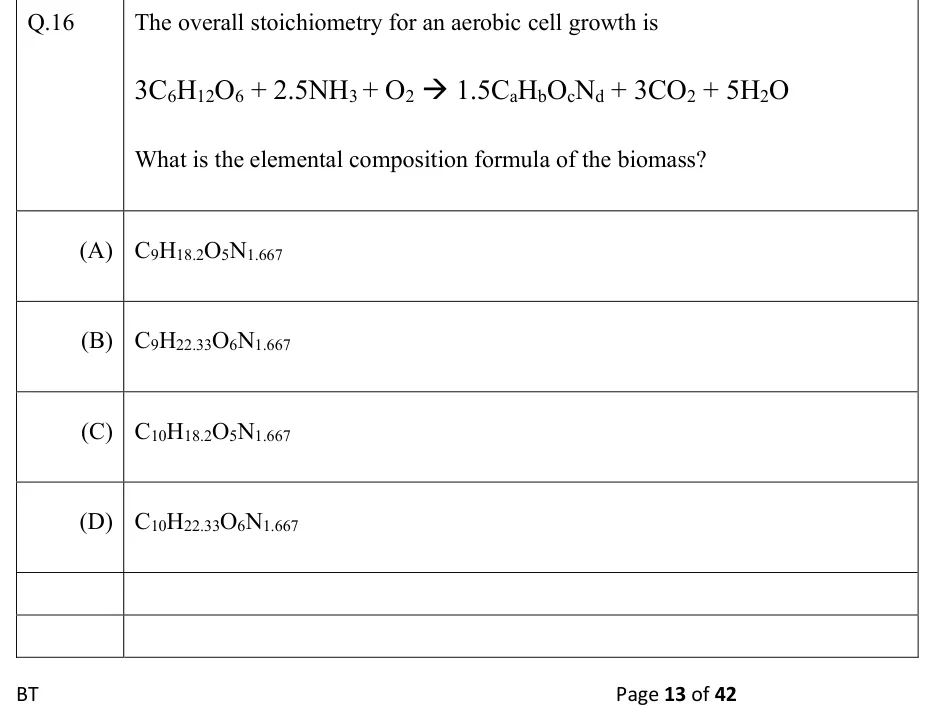
The overall stoichiometry for an aerobic cell growth is

What is the elemental composition formula of the biomass?

  1. (A)

  2. (B)

  3. (C)

  4. (D)

Answer and solution
See the question in the paper
GATE 2022 BT Q.16: answer and solution

GATE 2022 BT Q.28

GATE 2022 · BTQ.28 · 1 mark · NAT

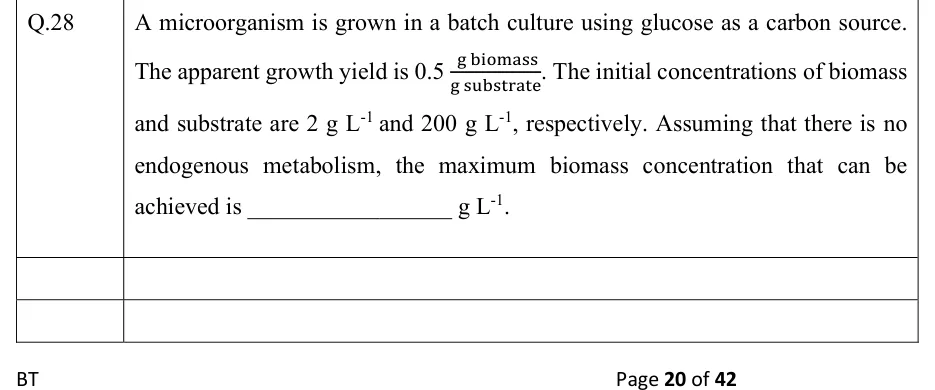
A microorganism is grown in a batch culture using glucose as a carbon source. The apparent growth yield is . The initial concentrations of biomass and substrate are and , respectively. Assuming that there is no endogenous metabolism, the maximum biomass concentration that can be achieved is ________ .

Answer and solution
See the question in the paper
GATE 2022 BT Q.28: answer and solution

GATE 2022 BT Q.57

GATE 2022 · BTQ.57 · 2 marks · NAT

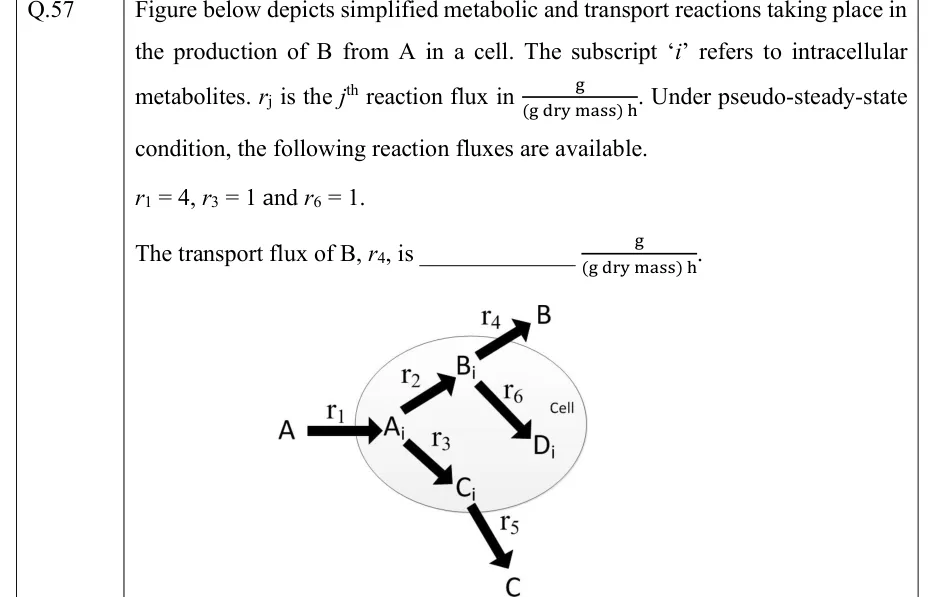
Figure below depicts simplified metabolic and transport reactions taking place in the production of B from A in a cell. The subscript '' refers to intracellular metabolites. is the reaction flux in . Under pseudo-steady-state condition, the following reaction fluxes are available.

, and .

The transport flux of B, , is ________ .

GATE 2022 BT question 57: A shaded oval labelled 'Cell' represents the cell.Tap to open full size
Figure from the GATE 2022 BT paper. It is part of the question.
Figure description

A shaded oval labelled 'Cell' represents the cell. Extracellular A (left, outside the cell) enters via arrow r_1 to intracellular A_i. From A_i, arrow r_2 goes up-right to B_i, and arrow r_3 goes down-right to C_i. From B_i, arrow r_4 goes up-right across the cell boundary to extracellular B, and arrow r_6 goes down-right to intracellular D_i (which stays inside the cell). From C_i, arrow r_5 goes down across the cell boundary to extracellular C. All arrows point in the direction of the flux.

Answer and solution
GATE 2022 BT Q.57: answer and solution

GATE 2022 BT Q.62

GATE 2022 · BTQ.62 · 2 marks · NAT

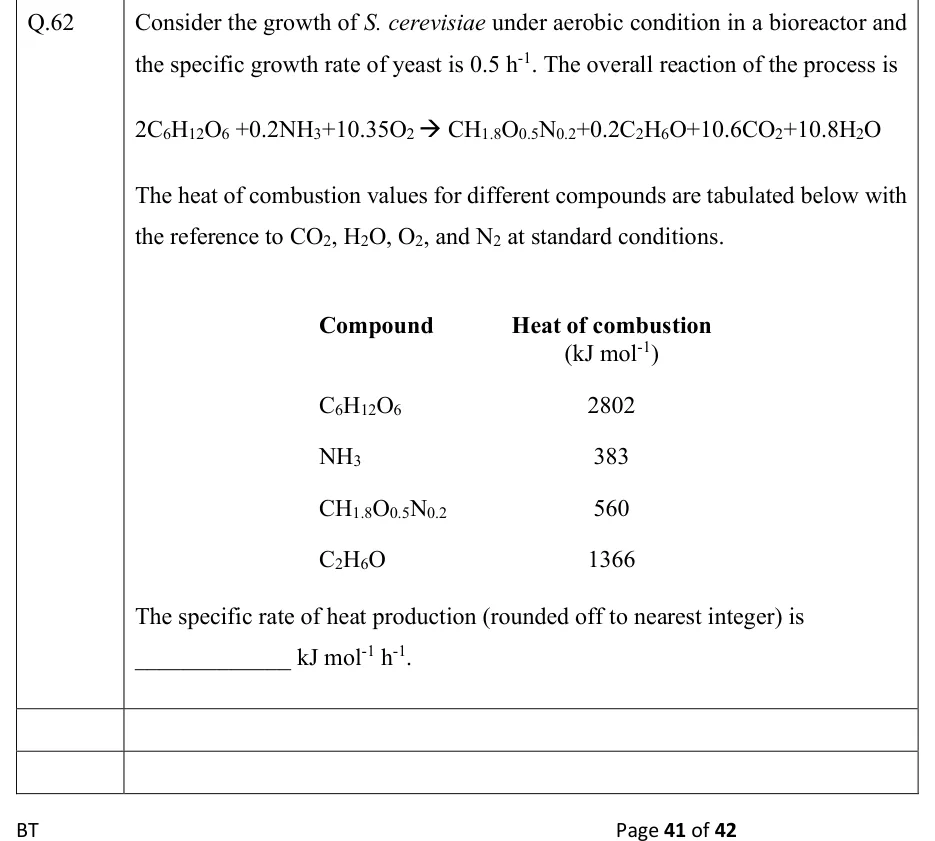
Consider the growth of S. cerevisiae under aerobic condition in a bioreactor and the specific growth rate of yeast is . The overall reaction of the process is

The heat of combustion values for different compounds are tabulated below with the reference to , , , and at standard conditions.

| Compound | Heat of combustion () |
|---|---|
| | 2802 |
| | 383 |
| | 560 |
| | 1366 |

The specific rate of heat production (rounded off to nearest integer) is ________ .

Answer and solution
See the question in the paper
GATE 2022 BT Q.62: answer and solution

GATE 2022 BT Q.65

GATE 2022 · BTQ.65 · 2 marks · NAT

A bacterial strain is grown in nutrient medium at 37 C under aerobic conditions. The medium is inoculated with cells from a seed culture. If the number of cells in the culture is after 10 hours of growth, the doubling time of the strain (rounded off to nearest integer) is ________ h.

Answer and solution
See the question in the paper
GATE 2022 BT Q.65: answer and solution

GATE 2019 BT Q.51

GATE 2019 · BTQ.51 · 2 marks · NAT

Yeast biomass () grown on glucose is described by the stoichiometric equation given below:

The amount of glucose needed for the production of of yeast biomass in a batch reactor with a working volume of 1,00,000 L is ________ kg (rounded off to the nearest integer).

Answer and solution
See the question in the paper
GATE 2019 BT Q.51: answer and solution

PRACTICE

6 questions to test yourself

PRACTICE 11 mark · NAT

During exponential growth, the viable cell count of a bacterial culture rises from to cells/mL in 4.0 h, with no cell death. The generation time, in minutes, is ________ (round off to the nearest integer).

Answer and solution

Answer: (accepted range )

  1. , so generations.

  2. h min.

PRACTICE 21 mark · MSQ

Which of the following statements about models of cell growth and product formation is/are correct?

  1. (A)

    An unstructured, non-segregated model represents the whole biomass by a single concentration variable , as the Monod model does.

  2. (B)

    A segregated model accounts for differences between individual cells, such as a distribution of cell age or size.

  3. (C)

    During balanced growth, when every cell component increases at the same specific rate, an unstructured model is an adequate description.

  4. (D)

    For a purely non-growth-associated product, in the Luedeking-Piret equation , so product formation stops in the stationary phase.

Answer and solution

Answer: (A), (B), (C)

  1. A: true. The Monod model uses one lumped biomass variable and treats all cells as identical.

  2. B: true. Accounting for cell-to-cell heterogeneity is what defines a segregated model.

  3. C: true. Cell composition is constant during balanced growth, so one variable describes the biomass fully.

  4. D: false. A non-growth-associated product has and , so it keeps forming at the volumetric rate when .

PRACTICE 32 marks · NAT

A bacterium grows aerobically on glycerol () as its sole carbon and energy source, with ammonia as the nitrogen source and no extracellular product. The biomass formula is , and the biomass yield is 0.50 C-mol cells per C-mol glycerol. The oxygen required, in mol per mol of glycerol consumed, is ________ (round off to 3 decimal places).

Answer and solution

Answer: (accepted range )

  1. Glycerol on a C-mol basis is , so (14 per molecule).

  2. .

  3. Electron balance per C-mol: , so mol per C-mol glycerol.

  4. One mole of glycerol is 3 C-mol, so the requirement is mol per mol glycerol (exactly ).

PRACTICE 42 marks · NAT

In a batch culture, cells grow exponentially at a constant from g/L to g/L, and the biomass then stays constant at 4.40 g/L for a further 10.0 h in the stationary phase. Product formation follows the Luedeking-Piret equation with g P/g X and g P/(g X·h). There is no product at the start, cell death is negligible, and the switch from exponential to stationary phase is abrupt. The product concentration at the end of the stationary period, in g/L, is ________ (round off to 2 decimal places).

Answer and solution

Answer: (accepted range )

  1. Exponential phase (constant ): g·h/L.

  2. Product in the exponential phase: g/L.

  3. Stationary phase (, so ): g/L.

  4. Total: g/L.

PRACTICE 51 mark · MCQ

Cell growth follows the Monod model, . Which one of the following statements is correct?

  1. (A)

    is the substrate concentration at which .

  2. (B)

    For , the specific growth rate is first order in .

  3. (C)

    has the same units as , i.e. .

  4. (D)

    A plot of against is a straight line of slope .

Answer and solution

Answer: (A)

  1. Put : , so A is correct.

  2. For , , which is zero order in , so B is wrong.

  3. is added to , so it has concentration units (g/L), so C is wrong.

  4. : the slope is and is the intercept, so D is wrong.

PRACTICE 62 marks · NAT

A chemostat with a sterile feed runs at steady state at two dilution rates on the same medium. The observed biomass yield on the limiting substrate is 0.40 g cells/g substrate at and 0.50 g cells/g substrate at . Assume the Pirt model with a constant true yield and a constant maintenance coefficient, and negligible cell death. The maintenance coefficient , in g substrate per g cells per hour, is ________ (round off to 3 decimal places).

Answer and solution

Answer: (accepted range )

  1. Pirt model: . With a sterile feed and no death, at steady state.

  2. At : . At : .

  3. Subtracting gives , so g/(g·h).

  4. (As a by-product, , so g/g.)

OFFICIAL GATE 2027 SYLLABUS WORDING

Copied from the GATE 2027 syllabus; see all 2027 syllabi.

GATE BT

Kinetics of cell growth, substrate utilization and product formation; Structured and unstructured models

Preparing in Kolkata? IAE Academy's course for GATE BT.