GATE 2026 BT Q.21
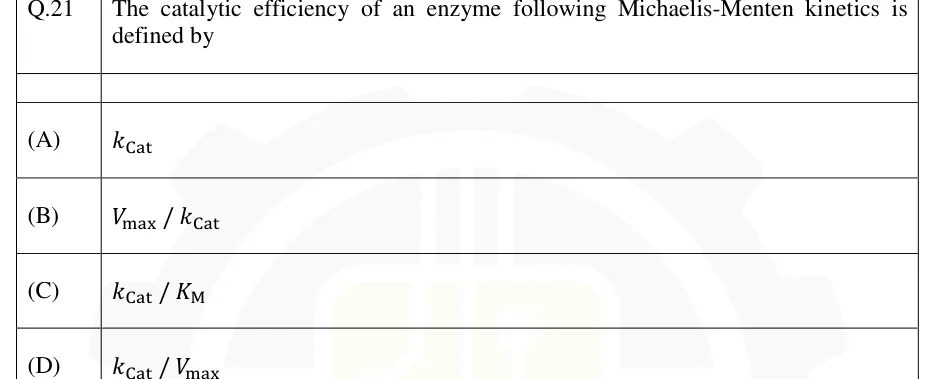
The catalytic efficiency of an enzyme following Michaelis-Menten kinetics is defined by
- (A)
- (B)
- (C)
- (D)

GATE BT
Rate laws, Michaelis-Menten and inhibition
Reaction kinetics expresses the rate of a conversion as a function of concentration and temperature. Enzyme kinetics applies this to enzyme-catalysed reactions through the Michaelis–Menten equation and its inhibited forms. The standard calculations are rate constants, half-lives and batch times from integrated rate laws; activation energies from the Arrhenius equation; and from linear plots; apparent parameters and rates with an inhibitor present; and identifying the inhibition type from how a plot changes.
9 previous-year questions · 9 solved · 5 practice questions
Consider a reaction in a well-mixed, constant-volume batch reactor. The rate of disappearance of A is (positive when A is consumed), and the rates of the different species are tied together by stoichiometry.
A rate law writes as a function of concentrations at a fixed temperature, usually in power-law form. The exponents are the orders with respect to each species, and their sum is the overall order . Orders are found by experiment. Only for an elementary (single-step) reaction must they equal the stoichiometric coefficients; for a non-elementary reaction they need not, and they can be fractional or zero.
RELATION BETWEEN SPECIES RATES
For , all rates on the same volume basis. A rate constant belongs to the species it is written for, so check whether a given refers to or to the overall reaction rate.
POWER-LAW RATE LAW
Constant-volume batch. does not depend on concentration; it varies with temperature. Its units are .
FRACTIONAL CONVERSION
Constant volume. is the initial concentration of reactant A.
EXAM TIP
The units of reveal the order: mol L s means zero order, s means first order, and L mol s means second order (any time unit in place of s). When a question gives with units, read them before choosing an integrated form.
Integrating the rate law for a constant-volume batch reactor gives concentration as a function of time. Each order has its own straight-line plot and its own dependence of the half-life (the time for to fall to ) on the starting concentration. The results below are for a single reactant with , where is defined for the disappearance of A, unless stated otherwise. All logarithms are natural logarithms.
ZERO ORDER
The rate does not depend on concentration. Valid only while : A is used up completely at and stays at zero after that.
FIRST ORDER
Equivalently , or in terms of conversion. The half-life does not depend on , and A never quite reaches zero.
SECOND ORDER (SINGLE REACTANT, OR EQUAL FEEDS)
Applies when , for example with defined on A, or with and (so throughout). The half-life is inversely proportional to .
SECOND ORDER, A + B → P WITH UNEQUAL FEEDS
Applies when with 1:1 stoichiometry, so . Requires .
NTH ORDER, INTEGRATED FORM
Any . Gives the zero-order result for and the second-order result for . For it holds only until A is used up, at .
NTH ORDER, HALF-LIFE
Any . The proportionality is the basis of the half-life method for finding the order.
REVERSIBLE FIRST ORDER, A ⇌ B
For with , constant volume. is the equilibrium concentration of A, and . The approach to equilibrium is first order with rate constant , not .
Order | Rate law | Integrated form | Straight-line plot | Half-life | Units of k |
|---|---|---|---|---|---|
0 | vs : slope | , proportional to | mol L s | ||
1 | vs : slope | , independent of | s | ||
2 | vs : slope | , proportional to | L mol s |
Integral method: assume an order and plot the matching linearised integrated form (table above). The order that gives a straight line is correct, and comes from the slope.
Differential method: estimate from the slope of the – curve at several points, then plot against . The slope is and the intercept is .
Initial-rate method: measure the initial rate at two starting concentrations of A, with all other concentrations held fixed; the order in A is .
Half-life method (single reactant, ): measure at two starting concentrations. Since , .
EXAM TIP
Half-life test: if doubling doubles , the reaction is zero order. If is unchanged, it is first order. If halves, it is second order.
EXAM TIP
For first order, the time to reach any fixed conversion, , does not depend on . Useful multiples: , and .
For a positive activation energy the rate constant rises with absolute temperature. Over a moderate range this follows the Arrhenius equation, where (the pre-exponential or frequency factor) has the same units as and is the activation energy.
The observed rate of an enzyme-catalysed reaction follows this rise only up to an optimum temperature. The catalytic constant of the active enzyme keeps rising with temperature, but thermal denaturation removes active enzyme, and above the optimum the loss outweighs the gain, so the observed rate (and ) falls.
ARRHENIUS EQUATION
in kelvin, , in J/mol. A plot of against is a straight line of slope .
ARRHENIUS, TWO TEMPERATURES
Eliminates . When and , .
TEMPERATURE COEFFICIENT Q10
in K. The ratio of rate constants for a 10 K (equivalently 10 °C) rise. It depends on , so a quoted holds only near its stated temperature.
FIRST-ORDER ENZYME DEACTIVATION
Loss of active enzyme at constant temperature with deactivation constant (e.g. in h), which itself follows the Arrhenius equation. Because , decays by the same exponential.
EXAM TIP
Convert °C to K before using the Arrhenius equation, and keep and in the same energy unit (J with , or kJ with ). To avoid losing precision on a calculator when the temperatures are close, compute as .
The simplest enzyme mechanism has one substrate forming one enzyme–substrate complex, which breaks down irreversibly to product: .
Enzyme is conserved, so , and the rate is . The unknown is removed by one of two assumptions, compared in the table below. Both give the same hyperbolic rate equation; only the meaning of differs. Both also take the free substrate concentration as equal to the total, which needs . Here is the initial rate, measured while product is negligible (no reverse reaction, no product inhibition) and .
Quasi-steady state | Rapid equilibrium | |
|---|---|---|
Assumption | after a brief initial transient | The binding step stays at equilibrium; product formation is too slow to disturb it |
Condition | (more precisely ) | |
Meaning of | Substrate concentration at half of ; not a pure measure of affinity | Dissociation constant of ES; a true measure of binding (smaller means tighter binding) |
Rate equation | Same |
MICHAELIS–MENTEN EQUATION
has concentration units, the same as [S] (mM, mol/L or g/L). and are concentration per time (e.g. µmol L min).
MICHAELIS CONSTANT (QUASI-STEADY STATE)
From . Because , is always larger than the dissociation constant .
MICHAELIS CONSTANT (RAPID EQUILIBRIUM)
Valid when . Only in this case is a true dissociation constant, so that a smaller means tighter binding.
MAXIMUM RATE AND TURNOVER NUMBER
(s) is the turnover number: substrate molecules converted per active site per unit time when the enzyme is saturated. is the molar concentration of active sites.
CATALYTIC EFFICIENCY
Units L mol s, a second-order rate constant. It compares substrates for the same enzyme. For the one-intermediate mechanism, , which is less than , so it cannot exceed the rate constant for enzyme and substrate meeting by diffusion, of the order of to L mol s.
LIMITING FORMS
At low substrate the reaction is first order in S with rate constant . At high substrate it is zero order.
SUBSTRATE NEEDED FOR A GIVEN FRACTION OF VMAX
At , . This is the working definition of under either assumption.
Enzyme amounts are often given as activity. One unit (U) converts 1 µmol of substrate per minute under stated conditions, and 1 katal = 1 mol s, so 1 U = 16.67 nkat. Specific activity is units per mg of protein.
EXAM TIP
is 0.5, 0.75, 0.8, 0.9 and 0.99 at , , , and . Raising the rate from 50% to 90% of takes nine times as much substrate.
EXAM TIP
does not depend on enzyme concentration, but is proportional to . Doubling the enzyme doubles and every rate, and leaves unchanged.
and can be estimated by rearranging the Michaelis–Menten equation into a straight line. Each rearrangement weights experimental error differently. Fitting against [S] by nonlinear least squares is the statistically preferred method. The linear plots are still useful for reading parameters off a graph and for diagnosing the type of inhibition.
LINEWEAVER–BURK (DOUBLE RECIPROCAL)
Plot against : slope , -intercept , -intercept .
EADIE–HOFSTEE
Plot against : slope , -intercept , -intercept .
HANES–WOOLF
Plot against [S]: slope , -intercept , -intercept .
Plot | y vs x | Slope | y-intercept | x-intercept | Error behaviour |
|---|---|---|---|---|---|
Lineweaver–Burk | vs | Distorts error the most. Taking reciprocals magnifies errors in the small rates at low [S], so those points dominate the fit, while high-[S] points bunch near the -axis | |||
Eadie–Hofstee | vs | appears on both axes, so an error in moves a point in both directions; less distortion than Lineweaver–Burk | |||
Hanes–Woolf | vs | When the error is mainly in , usually the most even weighting of the three; [S] appears on both axes but is usually known accurately |
EXAM TIP
Watch the signs: the Lineweaver–Burk -intercept is and the Hanes–Woolf -intercept is , both on the negative axis. If a question gives such an intercept as a positive number, it means the magnitude. On a Lineweaver–Burk plot, and .
A reversible inhibitor I binds non-covalently and is described by a dissociation constant: for binding to free enzyme, and for binding to the enzyme–substrate complex. Define and . Inhibitor binding is taken to be at equilibrium, [I] is the free inhibitor concentration (equal to the total when ), and EI and ESI are catalytically inactive. The general (mixed) rate law covers all three named cases.
MIXED INHIBITION, GENERAL RATE LAW
Competitive: . Uncompetitive: . Pure non-competitive: , so .
MIXED INHIBITION, APPARENT PARAMETERS
The inhibited reaction still follows the Michaelis–Menten form, with these apparent constants at a fixed [I].
COMPETITIVE INHIBITION
I binds only free E, competing with S for the active site. increases and is unchanged, so enough substrate overcomes the inhibition.
UNCOMPETITIVE INHIBITION
I binds only ES. and both fall by the factor , so their ratio is unchanged. The inhibition grows as [S] rises.
PURE NON-COMPETITIVE INHIBITION
I binds E and ES with equal affinity, at a site other than the active site. and is unchanged. The fractional inhibition is the same at every [S].
Type | I binds | Apparent Km | Apparent Vmax | Lineweaver–Burk lines (with vs without I) | Overcome by high [S]? |
|---|---|---|---|---|---|
Competitive | E only | (increases) | Unchanged | Meet on the axis (same intercept); inhibited line steeper | Yes |
Uncompetitive | ES only | (decreases) | (decreases) | Parallel (same slope); inhibited line has a higher intercept | No; inhibition is largest at high [S] |
Pure non-competitive | E and ES, | Unchanged | (decreases) | Meet on the axis at | No |
Mixed | E and ES, | (up if , down if ) | (decreases) | Meet left of the axis, at : above the -axis if , below it if | No |
FRACTIONAL INHIBITION (COMPETITIVE)
and are the rates with and without inhibitor at the same [S]. Setting gives . For pure non-competitive inhibition, at every [S], so . For uncompetitive inhibition, .
SUBSTRATE INHIBITION, RATE LAW
A second substrate molecule binds ES to form an inactive , with . At low [S] this reduces to Michaelis–Menten. At very high [S], , so the rate falls. On a Lineweaver–Burk plot the points curve upward near the axis.
SUBSTRATE INHIBITION, OPTIMUM
From . is the highest rate the enzyme can reach and is always below .
WORKED EXAMPLE · WORKED EXAMPLE: ONE INHIBITOR, THREE MECHANISMS
An enzyme has mM and µmol L min. An inhibitor at mM has a dissociation constant of 0.5 mM for each complex it forms. At mM, find the initial rate if the inhibitor is (a) competitive, (b) uncompetitive, (c) pure non-competitive. (d) For the competitive case, find the substrate concentration that restores the uninhibited rate at 6 mM.
Uninhibited: µmol L min.
, so wherever they apply.
(a) Competitive: mM, so µmol L min (44.4% inhibition).
(b) Uncompetitive: µmol L min (54.5% inhibition).
(c) Pure non-competitive: µmol L min (66.7% inhibition).
(d) Competitive, find [S] for : mM. Without inhibitor the rate of 72 occurs at ; with it, at , which is three times as much substrate.
Answer: (a) 40, (b) 32.7, (c) 24 µmol L min; (d) 18 mM.
EXAM TIP
The quantity that stays fixed tells you the type. Competitive keeps (same intercept). Uncompetitive keeps (same Lineweaver–Burk slope). Pure non-competitive keeps (same -intercept).
EXAM TIP
Names vary: some problems say 'non-competitive' for the mixed case with . If two different inhibition constants are given, use the general mixed form. If one constant is given for binding to both E and ES, the inhibition is pure non-competitive.
EXAM TIP
An irreversible inhibitor binds covalently and permanently removes active enzyme. The enzyme that remains has its normal , so the result is a lower with unchanged, the same pattern as pure non-competitive inhibition. It is told apart by not being reversed on dilution or dialysis, and often by inhibition that grows with the time enzyme and inhibitor are incubated together.
In a batch enzyme reactor the substrate falls over time, so the Michaelis–Menten rate changes continuously. Integrating from at gives the batch time directly. Assumptions: constant volume, constant enzyme activity (no deactivation), irreversible reaction and no product inhibition.
INTEGRATED MICHAELIS–MENTEN EQUATION
Natural log. in concentration per time; and [S] in the same concentration unit.
INTEGRATED FORM IN TERMS OF CONVERSION
Same assumptions. Gives the batch time for a target conversion .
LINEARISED PROGRESS CURVE
Fits and from a single batch run, under the same assumptions. Plot against : slope , -intercept .
Two limits check the result. If throughout, the log term is negligible and (zero order). If , the linear term is negligible and (first order with ). A competitive inhibitor held at constant [I] is handled by replacing with .
STEADY CONTINUOUS ENZYME REACTORS
is the space time (reactor volume over volumetric flow rate), with constant density and the same enzyme activity everywhere. is the feed and [S] the outlet concentration. A plug-flow reactor behaves like the batch reactor with replaced by . A CSTR runs entirely at the outlet concentration, so its rate is evaluated at [S] and it needs a longer for the same conversion.
WORKED EXAMPLE · WORKED EXAMPLE: PARAMETERS FROM DATA, THEN BATCH TIME
An enzyme at µmol/L follows Michaelis–Menten kinetics. Its initial rates are µmol L min at mM and µmol L min at mM. Find (a) and from a Lineweaver–Burk plot, (b) and , and (c) the time for 90% conversion when the same enzyme concentration acts on mM in a batch reactor.
Reciprocals: and , with in mM and in L min µmol.
Slope . Intercept , so µmol L min.
mM. Check: -intercept mM.
(b) µmol L min mol L s and mol/L, so .
L mol s.
(c) mM.
mM min, so min, about 3.78 h.
For comparison, the zero-order estimate min is about one-third too short.
Answer: (a) mM, µmol L min; (b) s, L mol s; (c) about 227 min (3.78 h).
EXAM TIP
Don't calculate batch time as (or as initial rate × time) unless [S] stays well above until the end. That shortcut ignores the slowdown as substrate runs out and always underestimates the time. Use the integrated equation.
PREVIOUS-YEAR QUESTIONS
Try each question first, then open the answer. We placed each question under a topic ourselves; the exam paper does not label topics.
See these papers in full: GATE BT 2026 · GATE BT 2025 · GATE BT 2024 · GATE BT 2023 · GATE BT 2022
The catalytic efficiency of an enzyme following Michaelis-Menten kinetics is defined by
You are characterizing a new enzyme isolated and purified in the laboratory. If the maximum velocity of the enzyme is 1800 and the total concentration of the enzyme in the reaction mixture is 1.5 , then the turnover number of the enzyme is ______ . (answer in integer)
A substrate is consumed in a zero order reaction such that its concentration falls from 42 g L to 14 g L in 4 hours. The total time taken for complete utilization of substrate will be ________ hours. (answer in integer)
Within the Michaelis-Menten framework, the ratio of when is ______. (Round off to two decimal places)
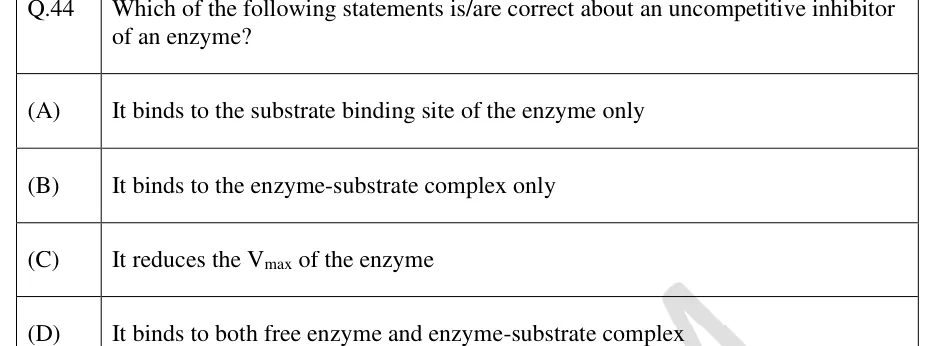
Which of the following statements is/are correct about an uncompetitive inhibitor of an enzyme?
It binds to the substrate binding site of the enzyme only
It binds to the enzyme-substrate complex only
It reduces the V of the enzyme
It binds to both free enzyme and enzyme-substrate complex
Temperature of a reaction with an activation energy value of is increased from to . If the value of the ideal gas constant () is , the ratio of the reaction rate constants (rounded off to two decimal places) is ________.
An enzyme (E) catalyzes the biochemical reaction with equal to . If the initial reaction velocity () is at the total enzyme concentration of and substrate concentration [A] of , the value of (in ) is ________.
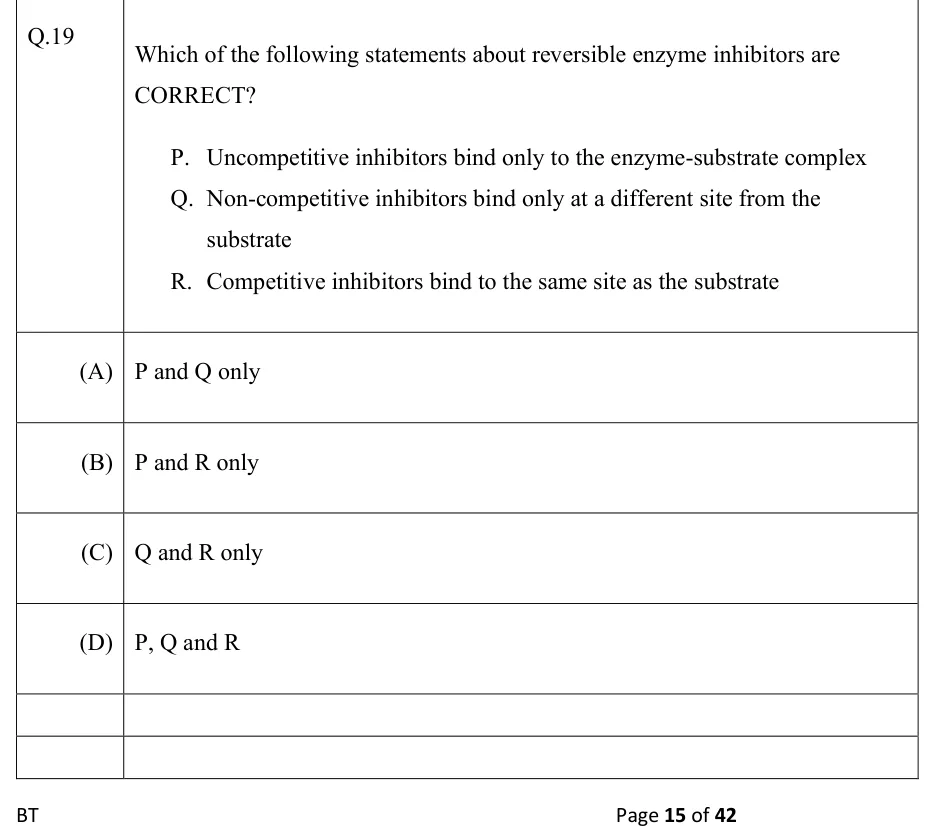
Which of the following statements about reversible enzyme inhibitors are CORRECT?
P. Uncompetitive inhibitors bind only to the enzyme-substrate complex
Q. Non-competitive inhibitors bind only at a different site from the substrate
R. Competitive inhibitors bind to the same site as the substrate
P and Q only
P and R only
Q and R only
P, Q and R
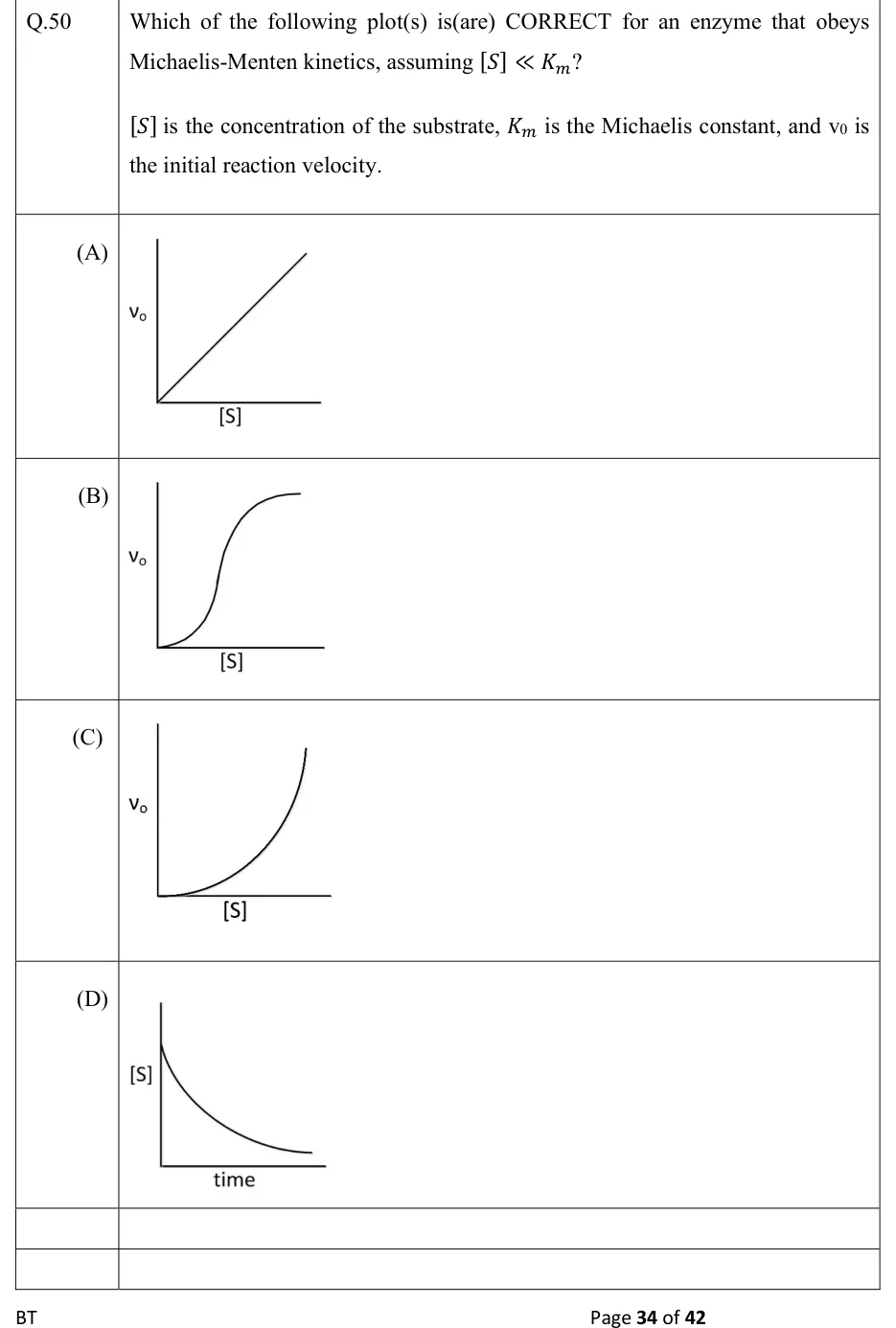
Which of the following plot(s) is(are) CORRECT for an enzyme that obeys Michaelis-Menten kinetics, assuming ?
is the concentration of the substrate, is the Michaelis constant, and is the initial reaction velocity.
 Tap to open full size
Each option is a sketch graph with no numbers on the axes. (A) Vertical axis v_0, horizontal axis [S]: a straight line that starts at the origin and rises at a constant slope. (B) Vertical axis v_0, horizontal axis [S]: a sigmoidal (S-shaped) curve that starts near the origin, stays flat at first, rises steeply in the middle and levels off to a plateau. (C) Vertical axis v_0, horizontal axis [S]: a curve that starts near the origin and bends upward (concave up), getting steeper as [S] grows, like a parabola or exponential. (D) Vertical axis [S], horizontal axis time: a curve that starts at a nonzero value on the [S] axis at time zero and falls, steeply at first and then more slowly, flattening out toward the time axis (a concave-up decay, like an exponential).
Figure — (vertical) against (horizontal): a straight line through the origin with a constant positive slope.
Figure — (vertical) against (horizontal): a sigmoidal curve, flat at first, rising steeply, then levelling off to a plateau.
Figure — (vertical) against (horizontal): a concave-up curve from near the origin that gets steeper as increases.
Figure — (vertical) against time (horizontal): a curve starting at a nonzero at time zero and decaying, steeply at first and then more slowly, toward the time axis.
PRACTICE
An enzyme is inhibited by its own substrate and follows with µmol L min, mM and mM. The highest initial rate that can be obtained by choosing [S] is ______ µmol L min (rounded to two decimal places).
Answer: (accepted range )
Divide numerator and denominator by [S]: . The rate is highest where the denominator is smallest, i.e. where , giving mM.
µmol L min.
Check: .
A reaction A → P is zero order in A with rate constant mol L h. It is run in a constant-volume batch reactor with mol/L. Which statement is correct?
h, and approaches zero only asymptotically
h, and A is completely consumed at h
h, and A is completely consumed at h
h, and approaches zero only asymptotically
Answer: (B)
Zero order: h.
reaches zero at h, so a zero-order reactant is used up in finite time. That rules out D.
Option A uses the first-order result , and option C uses the second-order result .
A first-order reaction has rate constant min at 300 K and activation energy 50 kJ/mol. Assume the Arrhenius equation holds, with J mol K. The half-life of the reaction at 320 K is ______ min (rounded to two decimal places).
Answer: (accepted range )
.
min.
min.
Without inhibitor, an enzyme follows Michaelis–Menten kinetics with parameters and . A reversible inhibitor is added at concentration , where is the dissociation constant of every enzyme–inhibitor complex the inhibitor forms (EI for a competitive inhibitor, ESI for an uncompetitive inhibitor, both EI and ESI for a pure non-competitive inhibitor). Which of the following statements is/are correct?
If the inhibitor is competitive, the apparent is and is unchanged.
If the inhibitor is uncompetitive, the apparent is and the apparent is .
If the inhibitor is pure non-competitive, the Lineweaver–Burk lines with and without inhibitor intersect on the axis.
If the inhibitor is uncompetitive, the fractional reduction in rate is greater at than at .
Answer: (A), (B)
, so the factor .
A: competitive inhibition gives with unchanged, so A is correct.
B: uncompetitive inhibition divides both and by 2, so B is correct.
C: pure non-competitive inhibition leaves unchanged and lowers . The lines share the -intercept and meet on the axis, not the axis, so C is incorrect.
D: for uncompetitive inhibition, . This tends to 1 (no inhibition) for and to 1/2 for , so the inhibition is larger at high [S] and D is incorrect.
An enzyme obeying Michaelis–Menten kinetics, with g/L and g L h, converts a substrate in a constant-volume batch reactor. The enzyme does not deactivate, the reaction is irreversible and there is no product inhibition. Starting from g/L, the time for the substrate concentration to fall to 2 g/L is ______ h (rounded to two decimal places).
Answer: (accepted range )
Integrated Michaelis–Menten equation: .
g/L.
h.
OFFICIAL GATE 2027 SYLLABUS WORDING
Copied from the GATE 2027 syllabus; see all 2027 syllabi.
GATE BT
Bioreaction Engineering: Rate law, zero and first order kinetics; (More advanced kinetic models, including Michaelis-Menten kinetics for enzyme reactions. Inhibition kinetics: Competitive, non-competitive, and uncompetitive inhibition in enzyme catalysis)
Preparing in Kolkata? IAE Academy's course for GATE BT.