Immobilising an enzyme on or inside a solid support lets it be retained, reused and run continuously, but substrate must then cross a liquid film and often diffuse through pores before it reacts, so the measured rate reflects a competition between reaction and mass transfer. That competition is captured by the Damköhler number (external film), the Thiele modulus and effectiveness factor (inside the particle) and the observable modulus (from measured rates). Numerical problems on this topic reduce to computing these groups with the right characteristic length and reference concentration, and to reasoning about how diffusion and partitioning distort apparent Km,Vmax, reaction order and activation energy.
2 previous-year questions · 2 solved · 5 practice questions
Immobilisation methods and what they change
An immobilised enzyme is confined to a solid support or a defined region so that it can be retained, reused and operated continuously, and so that the product stream leaves free of enzyme. The price is that substrate must reach the enzyme: first across the liquid film around the support (external mass transfer), and, if the enzyme sits inside a porous particle or gel, through the pores (internal diffusion). Every kinetic constant measured on an immobilised enzyme is therefore an apparent constant unless diffusion and partitioning effects have been shown to be negligible.
Method
How the enzyme is held
Advantages
Limitations
Adsorption
Physical forces (van der Waals, ionic, hydrophobic) on carriers such as ion-exchange resins, silica, alumina or activated carbon
Simple, mild and cheap; little loss of activity; carrier can be regenerated
Weak binding: the enzyme desorbs (leaches) with changes in pH, ionic strength, temperature or substrate concentration
Covalent binding
Covalent bonds between enzyme side-chain groups (e.g. amino groups) and an activated support, e.g. glutaraldehyde- or cyanogen-bromide-activated carriers
Strong attachment, essentially no leakage
Harsher chemistry can modify residues near the active site and lower activity; the support is usually not reusable
Entrapment
Enzyme or whole cells trapped in the lattice of a gel, e.g. calcium alginate, κ-carrageenan, polyacrylamide or agar
Mild; enzyme not chemically modified; suitable for whole cells
Pore-diffusion resistance; small enzymes can leak through large pores; large substrates cannot enter the gel
High enzyme loading; enzyme retained while small substrates and products pass
Membrane mass-transfer resistance; membrane fouling or rupture; unsuitable for large substrates
Cross-linking
Carrier-free: enzyme molecules joined to one another by a bifunctional reagent such as glutaraldehyde, forming cross-linked aggregates or crystals
No carrier, so high activity per unit volume; often improved stability
Cross-linking chemistry can reduce activity; aggregates can be mechanically weak; internal diffusion resistance
Why the observed rate of an immobilised enzyme differs from the free enzyme's
Conformational and steric effects — binding can distort the enzyme or block access to its active site. These change the enzyme's true constants (usually a lower Vmax;Km can change too, for example when a large substrate is sterically hindered), not merely the apparent ones.
Partitioning — a charged or hydrophobic support makes the substrate, product and H+ concentrations in the enzyme's microenvironment differ from those in the bulk liquid.
External mass transfer — substrate crosses a stagnant liquid film around the particle, so the surface concentration Ss is below the bulk concentration Sb.
Internal diffusion — inside a porous particle or gel, substrate is consumed as it diffuses inward, so enzyme near the centre sees less substrate than enzyme near the surface.
Immobilisation often improves thermal and operational stability, but that is a tendency, not a rule: each preparation has to be tested. The last three effects in the list change only the apparent kinetics; the enzyme's intrinsic constants are unchanged by them.
z = signed charge number of the substrate, ψ = signed electrostatic potential of the support (V), F=96485 C/mol, Rg=8.314 J mol−1 K−1,T in K. Assumes a uniform potential in the enzyme's microenvironment and Boltzmann partitioning; the effect is largest at low ionic strength, because added salt screens the charge. Same signs (zψ>0): substrate repelled, Km,app>Km. Opposite signs: substrate attracted, Km,app<Km. Partitioning alone leaves Vmax unchanged. More generally, any partition coefficient Kp=Slocal/Sb (electrostatic or hydrophobic) gives Km,app=Km/Kp with Vmax unchanged.
LOCAL PH NEXT TO A CHARGED SUPPORT
pHlocal=pHbulk+0.434RgTFψ
The same Boltzmann partitioning applied to H+ (z=+1), with 0.434=log10e and the same assumptions. A negatively charged (polyanionic) support has ψ<0, so the local pH is lower than the bulk pH.
EXAM TIP
pH-optimum shift, stated against the bulk pH: a polyanionic support concentrates H+ near the enzyme, so the bulk pH must be raised to reach the intrinsic optimum locally — the apparent optimum moves to higher pH. A polycationic support moves it to lower pH. The intrinsic pH optimum of the enzyme has not changed.
External mass transfer and the Damköhler number
Take the simplest case: enzyme attached to the outer surface of a non-porous support, following Michaelis–Menten kinetics per unit surface area. Substrate crosses a liquid film with mass-transfer coefficient kL from the bulk concentration Sb to the surface concentration Ss. At steady state the flux through the film equals the rate of reaction at the surface. The analysis assumes a uniform kL over the surface, enzyme spread evenly over it, and no partitioning.
Units used here: concentrations in mol/m3 (1 mol/m3 = 1 mmol/L), Vmax′ in mol m−2 s−1 (per unit surface area), kL in m/s.
FILM–REACTION BALANCE AT THE SURFACE
kL(Sb−Ss)=Km+SsVmax′Ss
Steady state; enzyme on the external surface only, no internal diffusion. Solve for Ss; the observed rate per unit area is either side of the equation.
Dimensionless. The maximum mass-transfer rate is kLSb, reached when Ss=0. Large Da favours film control, small Da favours reaction control (see the criteria below).
ks=Vmax′/Km (m/s) is the surface first-order rate constant. Film and reaction act as resistances in series. Note Da1=Da/κ: it uses Km in place of Sb.
Reading the Damköhler number
Reaction controlled when Da≪1+κ (so Da≪1 is always enough): Ss≈Sb,ηE≈1, observed rate ≈Vmax′Sb/(Km+Sb). The rate responds to enzyme loading and temperature, not to stirring.
Film (mass-transfer) controlled when Da≫1+κ:Ss≈0 and observed rate ≈kLSb, first order in Sb whatever the intrinsic kinetics. At high substrate (κ≪1) the condition is simply Da≫1; at low substrate (κ≫1) it becomes Da1=Da/κ≫1. The rate rises with stirring or flow velocity and not with enzyme loading.
Zero-order surface kinetics (Ss≫Km): rate =Vmax′ and Ss=Sb(1−Da). This is self-consistent only if Da<1 and the resulting Ss still satisfies Ss≫Km; otherwise use the full balance.
EXAM TIP
Read the definition a question gives. The name Damköhler number is also used for other rate ratios — the first-order group Da1=Vmax′/(KmkL) above, or reactor-scale groups such as k1τ (reaction rate against residence time τ). The regime boundaries above are stated for Da=Vmax′/(kLSb).
WORKED EXAMPLE
An enzyme is covalently attached to the outer surface of non-porous glass beads. Per unit bead surface area, Vmax′=4.0×10⁻⁴ mol m−2 s−1 and Km=5.0 mol/m3. The bulk substrate concentration is Sb=10 mol/m3 and the liquid-film mass-transfer coefficient is kL=2.0×10⁻⁵ m/s. Find the Damköhler number, the surface substrate concentration, the observed rate per unit area and the external effectiveness factor.
▸ Solution
Da=kLSbVmax′=(2.0×10⁻⁵)(10)4.0×10−4=2.0 and κ=Km/Sb=0.50.
Balance in dimensionless form: x2+(Da+κ−1)x−κ=0, i.e. x2+1.5x−0.5=0.
Positive root: x=2−1.5+2.25+2.0=2−1.5+2.0616=0.2808, so Ss=0.2808×10=2.81 mol/m3.
Observed rate =kL(Sb−Ss)=(2.0×10⁻⁵)(10−2.808)=1.44×10⁻⁴ mol m−2 s−1. The surface kinetics give the same value: 4.0×10−4×2.808/(5.0+2.808)=1.44×10−4.
Rate if the surface saw the bulk concentration: v(Sb)=4.0×10−4×10/15=2.67×10−4 mol m−2 s−1.
ηE=1.44/2.67=0.54. Here Da=2 is comparable with 1+κ=1.5, so neither the film nor the reaction can be neglected.
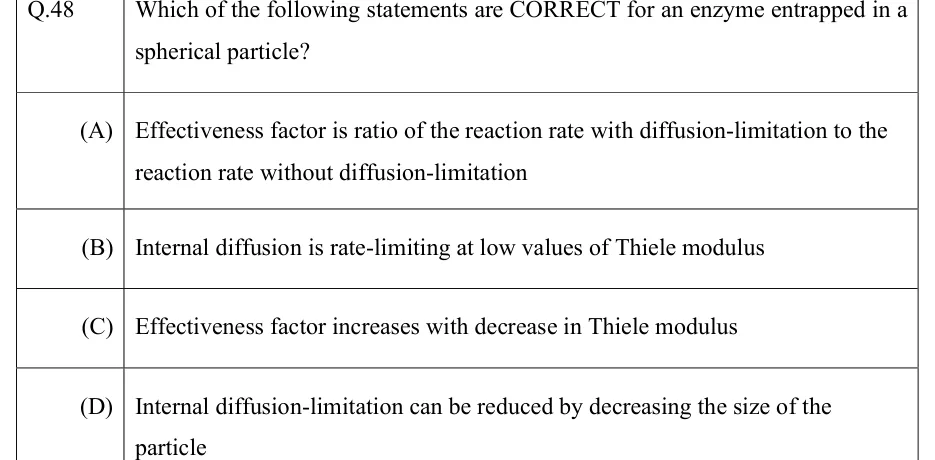
Internal diffusion: Thiele modulus and effectiveness factor
When the enzyme is spread through a porous particle or gel bead, substrate diffuses inward with an effective diffusivityDe (m2/s; lower than the free-solution value because of porosity and tortuosity) and reacts as it goes. The rate v(S) is written per unit particle volume (mol m−3 s−1). For first-order kinetics v=k1S with k1=Vmax/Km (s−1). The particle surface is at Ss; if the external film is negligible, Ss=Sb.
The standard analysis assumes steady state, an isothermal particle, enzyme spread uniformly through it, constant De, and no partitioning between the liquid and the particle (with a partition coefficient Kp, the concentration just inside the surface is KpSs).
STEADY-STATE DIFFUSION–REACTION BALANCE (SPHERE)
De(dr2d2S+r2drdS)=v(S),S=Ss at r=R,drdS=0 at r=0
Shell balance on a thin spherical shell with constant De; symmetry gives zero gradient at the centre. For a slab the left side is Ded2S/dz2 with z measured from the mid-plane.
EFFECTIVENESS FACTOR (INTERNAL)
η=rate if all the enzyme saw Ssobserved rate with internal diffusion=v(Ss)vobs
Referred to the surface concentration Ss, not the bulk. 0<η≤1 for first-order and Michaelis–Menten kinetics.
THIELE MODULUS, FIRST ORDER (CHARACTERISTIC LENGTH VP/AP)
ϕ2 compares the characteristic reaction rate with the characteristic diffusion rate. For a slab, L is the half-thickness when both faces are exposed (the full thickness when one face is sealed). R is a radius, not a diameter.
Geometry
Characteristic length
Exact first-order effectiveness factor
Concentration profile
Slab, both faces exposed
L (half-thickness)
η=ϕtanhϕ
SsS=coshϕcosh(ϕz/L), z from the mid-plane
Long cylinder
R/2
η=ϕI0(2ϕ)I1(2ϕ)
SsS=I0(2ϕ)I0(2ϕr/R)
Sphere
R/3
η=ϕ1(tanh3ϕ1−3ϕ1)
SsS=rsinh3ϕRsinh(3ϕr/R)
EFFECTIVENESS FACTOR, SLAB, FIRST ORDER
η=ϕtanhϕ,ϕ=LDek1
L = half-thickness with both faces exposed. Exact for isothermal first-order kinetics.
EFFECTIVENESS FACTOR, SPHERE, FIRST ORDER
η=ϕ1(tanh3ϕ1−3ϕ1),ϕ=3RDek1
R = particle radius. Exact for isothermal first-order kinetics.
SAME SPHERE RESULT, OTHER COMMON CONVENTION
η=ϕs23(ϕscothϕs−1),ϕs=RDek1=3ϕ
Gives identical numbers; only the modulus is defined without the factor 1/3. In this convention the large-modulus limit is η≈3/ϕs.
LIMITS (ANY SHAPE, MODULUS BASED ON VP/AP)
ϕ→0:η→1;ϕ≫1:η≈ϕ1(sphere: η≈ϕ1(1−3ϕ1))
Small ϕ: reaction is slow compared with diffusion and the whole particle sees Ss. Large ϕ: substrate is consumed in a thin shell near the surface and the core is starved. For a slab tanhϕ/ϕ is within 1% of 1/ϕ once ϕ≥2.65 (tanh3=0.995). A sphere converges more slowly — at ϕ=3,1/ϕ overestimates η by about 12% — hence the correction term, which is within 1% of the exact value for ϕ≥1.
EXAM TIP
Radius, not diameter: bead sizes are usually quoted as diameters, so halve first. Then check which modulus the question defines — with ϕs=Rk1/De the strong-limitation result is η≈3/ϕs, not 1/ϕs.
EXAM TIP
In the strong-limitation regime η∝1/ϕ∝1/R: halving the particle radius doubles η and doubles the rate per unit particle volume, while at small ϕ particle size hardly matters. With the enzyme spread uniformly and De unchanged, doubling the enzyme loading doubles k1, raises ϕ by 2, and raises the observed rate only by a factor of 2 when ϕ≫1.
Michaelis–Menten kinetics inside the particle
With v=VmaxS/(Km+S) the balance is non-linear and η depends on two groups: a Thiele modulus and β=Ss/Km. At β≪1 the kinetics are first order and the results above apply with k1=Vmax/Km. As β rises, the enzyme is saturated wherever S≫Km, so a fall in local concentration costs little rate: for the same Vmax,Km,De and particle size the effectiveness factor is higher than in the first-order case, and it tends to 1 as β→∞.
A generalised modulus folds the kinetics into one number. With it, the curves for different shapes and kinetics coincide at both ends (η→1 at small modulus, η≈1/Φ at large modulus) and nearly coincide in between.
GENERALISED THIELE MODULUS (ANY KINETICS)
Φ=ApVp2De∫0Ssv(S)dSv(Ss)
Constant De, isothermal particle. Reduces to ϕ=(Vp/Ap)k1/De for first-order kinetics. The lower limit of the integral is 0 for an irreversible reaction.
ϕ1 is the first-order modulus; ln is the natural logarithm. The factor multiplying ϕ1 tends to 1 as β→0 and to 1/2β as β→∞, and decreases steadily in between, so Φ falls as Ss rises.
The zero-order limit of Michaelis–Menten kinetics (β=Ss/Km≫1); the slab result is exact for truly zero-order kinetics. For Φ0>1 substrate is exhausted at a penetration depth δ=2DeSs/Vmax=L/Φ0 from each face, and the enzyme beyond it is idle. For a real Michaelis–Menten enzyme the rate tapers off smoothly near that front, so there the result is an approximation.
EXAM TIP
For an isothermal particle, an effectiveness factor above 1 needs kinetics in which a lower concentration gives a higher rate — substrate inhibition is the standard case. For first-order and Michaelis–Menten kinetics in an isothermal particle η≤1 always. (A strongly exothermic reaction in a non-isothermal particle can also give η>1.)
Observable modulus and combined resistances
The Thiele modulus needs the intrinsick1 or Vmax, which is exactly what cannot be measured on a diffusion-limited catalyst. The observable (Weisz) modulus uses the measured rate instead, so it can be computed from experimental data alone and tells you whether internal diffusion matters.
OBSERVABLE (WEISZ) MODULUS
ΦW=(ApVp)2DeSsvobs=ηϕ2
vobs = measured rate per unit particle volume. The identity ΦW=ηϕ2 holds for first-order kinetics with ϕ based on Vp/Ap.
Weisz guidelines (first-order kinetics; the thresholds are conventions, not sharp boundaries)
ΦW<0.3: internal diffusion limitation is weak; η≥0.83 for a sphere and η≥0.90 for a slab.
ΦW>3: strong internal limitation; η≤0.27 for a sphere (≤0.33 for a slab), and η approaches 1/ΦW as ΦW grows.
In between, compute ϕ and η properly — neither limit is safe.
OBSERVABLE MODULUS FOR A SPHERE, FIRST ORDER (EXACT)
ΦW=ϕcoth(3ϕ)−31
From ΦW=ηϕ2 with the exact sphere η. For large ϕ,ΦW≈ϕ−31.
EXTERNAL FILM PLUS INTERNAL DIFFUSION, FIRST ORDER
vobs=kLap1+ηk11Sb,ap=VpAp=R3(sphere)
Rate per unit particle volume, from kLap(Sb−Ss)=ηk1Ss. For isothermal first-order kinetics η does not depend on Ss, so the two resistances simply add.
SAME RESULT IN TERMS OF THE MASS-TRANSFER BIOT NUMBER
ηo1=η1+Bimϕ2,Bim=DekL(Vp/Ap)
First order, with ϕ based on Vp/Ap and ηo referred to Sb.Bim compares film transport with internal diffusion; the identity k1/(kLap)=ϕ2/Bim turns the series-resistance result into this form. If a question defines Bi=kLR/De for a sphere together with ϕs=Rk1/De, the second term is ϕs2/(3Bi). Large Bim: the film is negligible and ηo→η.
OVERALL EFFECTIVENESS FACTOR
ηo=v(Sb)vobs=ηEη,ηE=v(Sb)v(Ss)
Referred to the bulk concentration. It is the product of the external and internal factors because vobs=ηv(Ss).
WORKED EXAMPLE
An enzyme is entrapped uniformly in spherical gel beads of diameter 3.0 mm. Per unit bead volume, Vmax=0.020 mol m−3 s−1 and Km=2.5 mol/m3. The effective diffusivity of the substrate in the gel is De=5.0×10⁻¹⁰ m2/s and the substrate concentration at the bead surface is Ss=0.10 mol/m3. Find the Thiele modulus, the effectiveness factor, the observed rate per unit bead volume and the observable modulus.
▸ Solution
Ss/Km=0.04≪1, so treat the kinetics as first order: k1=Vmax/Km=0.020/2.5=8.0×10−3 s−1.
R=1.5×10⁻³ m, so R/3=5.0×10−4 m and ϕ=5.0×10−45.0×10−108.0×10−3=5.0×10−4×4000=2.0.
η=21(tanh61−61)=21(1.0000−0.1667)=0.417.
vobs=ηk1Ss=0.417×8.0×10−3×0.10=3.33×10⁻⁴ mol m−3 s−1, against 8.0×10⁻⁴ with no diffusion limitation.
0.3<ΦW<3: internal diffusion is significant, and the beads deliver only about 42% of the rate their enzyme would give if all of it saw the surface concentration Ss. Smaller beads would raise η.
When diffusion limits the rate, fitting the measured rates to Michaelis–Menten or Arrhenius forms returns apparent parameters that describe the particle, not the enzyme. The strong-limitation results below all follow from η≈1/ϕ.
OBSERVED RATE UNDER STRONG INTERNAL LIMITATION, FIRST ORDER
vobs≈ϕk1Ss=VpApk1DeSs
Valid for ϕ≫1. The observed rate scales with k1, hence with the square root of the enzyme loading (uniformly spread enzyme), and inversely with particle size.
APPARENT ACTIVATION ENERGY
Eapp=2E+ED≈2E
Strong internal diffusion limitation (ϕ≫1) in an isothermal particle, where vobs∝k1De.E = intrinsic activation energy of the enzyme reaction; ED = activation energy of diffusion, usually small. Under external film control the apparent value falls further, to the low value of liquid-film mass transfer.
APPARENT REACTION ORDER
napp=2n+1
Strong internal limitation (ϕ≫1), isothermal particle, intrinsic power-law order n (n>−1): first order stays first order and zero order appears as half order. A Michaelis–Menten enzyme that is saturated at the surface (β≫1) under strong limitation therefore shows vobs∝Ss1/2.
BULK CONCENTRATION AT HALF THE MAXIMUM RATE (EXTERNAL FILM, EXACT)
Sb,1/2=Km+2kLVmax′=Km(1+2Da1)
Surface-bound enzyme with Michaelis–Menten kinetics and a liquid film. The plateau is still Vmax′; half of it needs Ss=Km at the surface, and the film must then carry Vmax′/2, so kL(Sb−Km)=Vmax′/2. This bulk half-saturation concentration is what the measured curve shows as its apparent Km. Because the whole curve is not exactly Michaelis–Menten, a Km fitted by linearisation depends on the substrate range used.
What diffusion does to the measured Michaelis–Menten constants
Km,app>Km: at low substrate the rate is held down by diffusion, so half-saturation appears at a higher concentration.
Vmax,app→Vmax if the substrate concentration can be made high enough: the enzyme saturates, so η→1 inside a particle and the rate tends to Vmax′ at a surface. A loss of activity caused by immobilisation itself (conformational or steric) lowers the true Vmax as well.
A Lineweaver–Burk plot of diffusion-limited data curves instead of being straight; a straight-line fit to it gives apparent, not intrinsic, constants.
Partitioning on a charged support multiplies Km by exp(zFψ/RgT) without changing Vmax.
Controlling step
Observed rate responds to
Apparent order in substrate
Apparent activation energy
Reaction (kinetic) control: Da≪1,ϕ≪1
Enzyme loading (proportionally) and temperature
Intrinsic (Michaelis–Menten)
E
External film: Da≫1+κ
Stirring or flow velocity, through kL; not enzyme loading
First order in Sb
Low, that of liquid-film mass transfer
Strong internal diffusion: ϕ≫1
Particle size (rate per unit particle volume ∝1/R) and the square root of enzyme loading; not stirring
(n+1)/2
≈(E+ED)/2
EXAM TIP
Which concentration? The internal η is referred to Ss;ηE and ηo are referred to Sb. If a question says the external film is negligible, Ss=Sb and ηo=η.
EXAM TIP
Compare Da with 1+κ, not with 1 alone. At low substrate a value Da=10 with κ=Km/Sb=100 still gives ηE≈0.91: the surface is largely reaction controlled, because the relevant group is Da1=Da/κ=0.1.
EXAM TIP
Units: keep the rate per unit particle volume for internal diffusion and per unit external surface area for surface-bound enzyme. Converting a rate given per mass of support or per reactor volume needs the particle density or the solids volume fraction.
PREVIOUS-YEAR QUESTIONS
2 questions from the BT papers
Try each question first, then open the answer. We placed each question under a topic ourselves; the exam paper does not label topics.
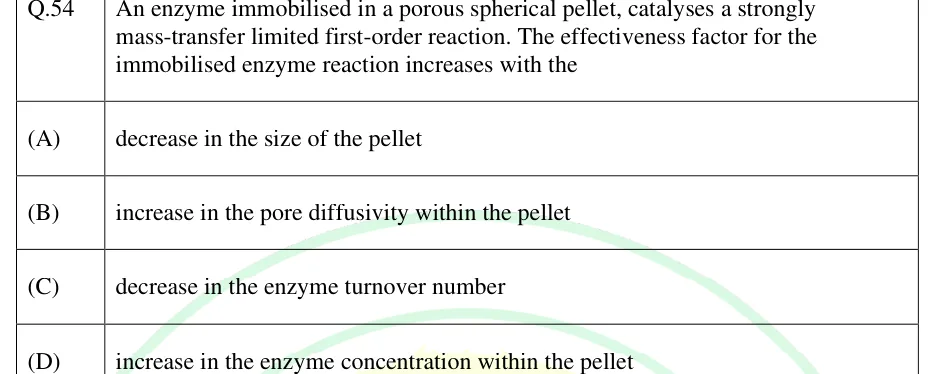
An enzyme immobilised in a porous spherical pellet, catalyses a strongly mass-transfer limited first-order reaction. The effectiveness factor for the immobilised enzyme reaction increases with the
(A)
decrease in the size of the pellet
(B)
increase in the pore diffusivity within the pellet
(C)
decrease in the enzyme turnover number
(D)
increase in the enzyme concentration within the pellet
An enzyme whose free form has its pH optimum at 7.0 is covalently immobilised on a support carrying a high density of negative charge, and is used in a buffer of low ionic strength. With the pH–activity curve plotted against the pH of the bulk solution, the optimum of the immobilised enzyme is expected to
(A)
shift to a pH below 7.0
(B)
shift to a pH above 7.0
(C)
remain at 7.0, because covalent binding does not change the active site
(D)
remain at 7.0, with a narrower pH–activity curve
▸ Answer and solution
Answer: (B)
A negatively charged support has ψ<0 and attracts H+:[H+]local=[H+]bulkexp(−Fψ/RgT)>[H+]bulk. At low ionic strength this charge is not screened by salt.
So the local pH near the enzyme is lower than the bulk pH.
For the enzyme to see its intrinsic optimum of 7.0 locally, the bulk pH must be above 7.0: the apparent optimum shifts to the alkaline side. Answer (B).
PRACTICE 22 marks · NAT
An enzyme is entrapped uniformly in spherical gel beads of diameter 6.0 mm. Per unit bead volume, Vmax=0.018 mol m−3 s−1 and Km=5.0 mol/m3. The effective diffusivity of the substrate in the gel is 4.0×10⁻¹⁰ m2/s and the substrate concentration at the bead surface is 0.050 mol/m3. The external film resistance is negligible. Assuming first-order kinetics and using the exact isothermal first-order effectiveness-factor expression for a sphere, the effectiveness factor is ______ (rounded off to three decimal places).
▸ Answer and solution
Answer:0.296 (accepted range ±0.004)
Ss/Km=0.01, so first order: k1=Vmax/Km=0.018/5.0=3.6×10−3 s−1.
R=3.0×10⁻³ m, so R/3=1.0×10−3 m and ϕ=3RDek1=1.0×10−34.0×10−103.6×10−3=1.0×10−3×3000=3.0.
Check with the other convention, ϕs=Rk1/De=9:η=(3/81)(9coth9−1)=24/81=0.296. The asymptote 1/ϕ=0.333 would overestimate it.
PRACTICE 32 marks · MSQ
An enzyme with first-order kinetics (rate constant k1 per unit particle volume) is immobilised uniformly in porous spherical beads of radius R. The Thiele modulus is defined as ϕ=(R/3)k1/De and the external film resistance is negligible. Which of the following statements is/are correct?
(A)
As ϕ→0, the effectiveness factor tends to 1.
(B)
When ϕ≫1 (large enough that ϕ/2 is also ≫1), halving the bead radius with everything else unchanged approximately doubles the effectiveness factor.
(C)
When ϕ≫1, the apparent activation energy is approximately equal to the intrinsic activation energy of the enzyme reaction.
(D)
When ϕ≫1, doubling the enzyme loading per unit bead volume (which doubles k1, with De unchanged) increases the observed rate per unit bead volume by a factor of about 2.
▸ Answer and solution
Answer: (A), (B), (D)
(A) Small ϕ: diffusion is fast compared with reaction, the whole bead sees Ss and η→1. Correct.
(B) For ϕ≫1,η≈1/ϕ and ϕ∝R, so halving R halves ϕ and, while ϕ/2 is still large, doubles η. Correct.
(C) Here vobs≈(3/R)k1DeSs, so Eapp≈(E+ED)/2, about half the intrinsic value. Incorrect.
(D) In this regime vobs∝k1, so doubling k1 multiplies the rate by 2≈1.41. Correct.
Answer: A, B, D.
PRACTICE 41 mark · NAT
An enzyme is attached only to the outer surface of non-porous beads. Per unit surface area, Vmax′=3.0×10⁻⁵ mol m−2 s−1 and Km=10 mol/m3. The bulk substrate concentration is 0.20 mol/m3 and the liquid-film mass-transfer coefficient is kL=1.0×10⁻⁶ m/s. Treating the surface kinetics as first order (substrate concentration much smaller than Km), the external effectiveness factor, defined as the observed rate divided by the rate the surface would give at the bulk concentration, is ______ (rounded off to two decimal places).
The balance kL(Sb−Ss)=ksSs gives Ss/Sb=1/(1+Da1).
ηE=Ss/Sb=1/(1+3)=0.25. (Solving the full Michaelis–Menten balance gives 0.255, inside the same answer range.)
PRACTICE 52 marks · NAT
Spherical beads of radius 1.5 mm contain an immobilised enzyme with first-order kinetics, k1=0.010 s−1 per unit bead volume. The internal effectiveness factor of the beads is 0.40 (independent of concentration, as for any isothermal first-order reaction). The liquid-film mass-transfer coefficient around the beads is 2.0×10⁻⁶ m/s and the bulk substrate concentration is 0.20 mol/m3. The overall effectiveness factor, defined as the observed rate per unit bead volume divided by k1 times the bulk concentration, is ______ (rounded off to two decimal places).
▸ Answer and solution
Answer:0.2 (accepted range ±0.005)
External area per unit bead volume: ap=3/R=3/(1.5×10−3)=2000 m−1, so kLap=2.0×10−6×2000=4.0×10⁻³ s−1.
Internal: ηk1=0.40×0.010=4.0×10⁻³ s−1.
Film flux equals reaction: kLap(Sb−Ss)=ηk1Ss, so Ss=kLap+ηk1kLapSb=8.0×10−34.0×10−3×0.20=0.10 mol/m3.
vobs=ηk1Ss=4.0×10−3×0.10=4.0×10⁻⁴ mol m−3 s−1.
ηo=vobs/(k1Sb)=4.0×10−4/(0.010×0.20)=0.20, which is the product ηEη=0.50×0.40.
Check with the Biot form: ϕ2/Bim=k1(Vp/Ap)/kL=0.010×5.0×10−4/(2.0×10−6)=2.5, so 1/ηo=1/0.40+2.5=5.0 and ηo=0.20.