IAE Academy

GATE BT

Ideal reactors

Batch, mixed flow and plug flow

Ideal reactors are the three limiting mixing patterns: the closed, well-mixed batch vessel, the continuous stirred tank (mixed flow, CSTR) and the plug flow tubular reactor (PFR). Their design equations connect reaction time, space time or volume to the conversion that a rate law delivers. Every calculation on this topic starts from the same three mole balances, whether it asks for a batch time, a CSTR or PFR volume for zero-order, first-order, nth-order or Michaelis–Menten kinetics, a size comparison between the two flow reactors, a chemostat steady state, or the effect of tanks in series or recycle.

2 previous-year questions · 2 solved · 6 practice questions

The three ideal reactors, space time and residence time

An ideal reactor is defined by how it mixes, not by its shape. A batch reactor is a closed vessel with perfect mixing. Its composition is the same everywhere at any instant and changes with time. A mixed flow reactor (CSTR, continuous stirred tank reactor) is analysed at steady state with perfect mixing, so the composition everywhere inside equals the exit composition. The whole reaction therefore runs at the lowest (exit) reactant concentration. A plug flow reactor (PFR) has no mixing along the direction of flow and complete mixing across it. Each fluid element passes through like a small batch reactor, and the reactant concentration falls steadily from inlet to outlet.

Conventions used throughout:

  • is the rate at which A disappears (mol L h or g L h). It is positive when A is consumed.
  • is the volumetric feed rate (L h), and is the molar feed rate of A.
  • is the fraction of the fed A that has reacted. The feed contains no converted A ( at the inlet) unless stated otherwise.
  • All logarithms are natural logarithms (), and first-order rate constants are in h.

Unless stated otherwise, the fluid is a liquid of constant density and the reactor is isothermal, which is the usual case for bioprocess media.

CONVERSION (CONSTANT DENSITY)

The fraction of fed A that has reacted. The concentration form holds only at constant density (liquid-phase systems).

SPACE TIME AND SPACE VELOCITY

The time needed to process one reactor volume of feed, measured at feed conditions (h). The space velocity is its reciprocal (h).

DILUTION RATE

The bioprocess name for the reciprocal space time of a continuous stirred vessel. is the volumetric feed rate (L h, the same quantity as ) and is in h.

MEAN RESIDENCE TIME

When the fluid density changes (for example, a gas-phase reaction that changes the number of moles), and differ. The design equations are written in .

EXAM TIP

A chemostat is a CSTR in which the reaction is cell growth, and is its reciprocal space time. With a sterile feed, no cell recycle and negligible cell death, the cell balance at a steady state with cells present gives , so the dilution rate you set fixes the specific growth rate. If is at or above the largest growth rate the cells can reach at the feed substrate concentration, the cells wash out.

CHEMOSTAT STEADY STATE (MONOD GROWTH)

Steady-state chemostat with Monod growth , a sterile feed, no cell death or maintenance, and a constant yield (g cells per g substrate). is the cell concentration (g L), written in lower case here so that it is not confused with conversion. , and are in g L; and are in h. The residual substrate does not depend on , and the cell productivity is (g L h). These results hold for ; at the only steady state is washout, and .

Design equations of the three ideal reactors

Each design equation is a mole balance on reactant A: input = output + disappearance by reaction + accumulation. A batch reactor has no flow, so only reaction and accumulation remain. A CSTR at steady state has no accumulation, and because its contents are uniform, the rate is evaluated once, at exit conditions. For a PFR at steady state, the balance is written over a thin slice and integrated along the length, because the rate changes from inlet to outlet.

BATCH REACTOR

is the moles of A charged. This is the reaction time needed to reach . It does not include the time to charge, empty or clean the vessel.

MIXED FLOW REACTOR (CSTR)

Steady state, with a feed that contains no converted A. The rate is evaluated at exit (f) conditions, which equal the reactor contents. The last form holds only at constant density.

PLUG FLOW REACTOR (PFR)

Steady state, with no mixing along the length and a feed that contains no converted A. The rate varies along the reactor, so it stays inside the integral. The concentration form holds only at constant density.

EXAM TIP

At constant density, the PFR equation written in is the same as the constant-volume batch equation written in . A batch-time result therefore gives the PFR space time directly (replace with ), and the reverse also works. It does not give the CSTR space time, except for zero-order kinetics, where the rate is constant and all three times are equal.

EXAM TIP

In a CSTR, use the rate at the exit concentration. Using the feed concentration or an average concentration gives the wrong volume. For a batch reactor's throughput, divide the product made per batch by the full cycle time: reaction time plus charging, emptying, cleaning and sterilisation.

Power-law kinetics in each reactor

Substitute the rate law into the design equation. For at constant density, . The CSTR equation is then algebraic. The batch and PFR equation is integrated from the feed (or initial) state to the exit (or final) state. The units of are (concentration) h, so is in h for a first-order reaction.

FIRST ORDER: BATCH AND PFR

For with in h. For a batch reactor, replace with . The dimensionless group is the first-order Damköhler number. The result does not depend on .

FIRST ORDER: CSTR

For at constant density and steady state. The result does not depend on .

SECOND ORDER ($-R_A = KC_A^2$)

Also covers products with and equimolar feed (), because the 1 : 1 stoichiometry then keeps . is in L mol h.

NTH ORDER ($N \NE 1$)

For at constant density. Setting gives the second-order results. For the PFR or batch result holds only while : the reactant is used up completely at a finite , where .

Kinetics

Batch () or PFR ()

CSTR ()

Zero order, (only while )

First order,

Second order,

EXAM TIP

For power-law kinetics, first order is the only order for which conversion does not depend on the feed concentration. If a question changes for a first-order reaction and asks for the new conversion at the same , the conversion does not change. At the same , in either flow reactor or a batch reactor, raising raises the conversion for and lowers it for .

Michaelis–Menten (enzyme) kinetics in each reactor

Take a soluble enzyme at a constant, uniform concentration , with no deactivation. Substrate S is then consumed at the Michaelis–Menten rate, where has the units of substrate concentration per time (g L h or mol L h) and has the same concentration units as S (g L or mol L). The design equations are the same as above, with A replaced by S and .

MICHAELIS–MENTEN RATE

stays constant only if the enzyme concentration is constant and the enzyme does not deactivate.

MICHAELIS–MENTEN: BATCH AND PFR

The integrated Michaelis–Menten equation. For a batch reactor, replace with . The first term is the zero-order part and the second is the first-order part.

MICHAELIS–MENTEN: CSTR

Steady state. The rate is evaluated at the exit substrate concentration .

Two limits are useful for checking answers:

  • When everywhere in the reactor, including at the exit, the rate is close to (zero order), and the CSTR and PFR sizes approach each other.
  • When everywhere, including at the inlet, the rate is close to . This is first order with (h), so the first-order results apply.

WORKED EXAMPLE

A soluble enzyme converts substrate S with Michaelis–Menten kinetics: g L h and g L. The enzyme concentration is constant and the enzyme does not deactivate. The feed is g L at L h. Find the reactor volume needed for 90% conversion in (a) a CSTR and (b) a PFR.

Solution
  1. Exit substrate: g L.

  2. (a) CSTR. Rate at exit: g L h. Then h, and L.

  3. (b) PFR: g L. Then h, and L.

  4. Ratio: . The gap is smaller than for a first-order reaction at the same conversion (3.91), because stays at or above throughout (from at the inlet to at the exit). The kinetics are therefore partly zero order, and zero-order kinetics give equal volumes.

Answer: CSTR: 180 L. PFR: about 113 L.

EXAM TIP

With substrate inhibition, , the rate is highest at . Above that concentration the rate falls as rises. In that range a CSTR, which operates at the lower exit concentration, can need less volume than a PFR.

Comparing CSTR and PFR: the Levenspiel plot

Plot against . To read volume directly, plot against instead. From the design equations:

  • For a CSTR, is a rectangle of width and height at the exit.
  • For a PFR, is the area under the curve from 0 to .

The shape of the curve therefore decides which reactor is smaller.

LEVENSPIEL PLOT AREAS

Both reactors have the same feed and the same exit conversion. Multiply by to get volumes.

  1. Positive order (): the rate falls as A is used up, so rises with . The rectangle is larger than the area under the curve, so . The gap grows with conversion and with reaction order.

  2. Zero order: is a horizontal line, so the rectangle equals the area and .

  3. Rate rising with conversion (a negative apparent order, for example substrate inhibition above the rate maximum): falls with , so .

  4. Autocatalytic reactions, including microbial growth (the rate rises as product or cells accumulate): with some product or cells in the feed, falls to a minimum at the maximum-rate point and then rises. For exit conversions up to that point a CSTR is always the smaller reactor; at high enough conversion the PFR is smaller. For high conversion, the smallest total volume comes from a CSTR operating at the maximum-rate point followed by a PFR.

  5. If the feed of an autocatalytic reaction contains no product or cells (for example, a sterile feed for cell growth), the rate at a PFR inlet is zero and a PFR alone cannot run the reaction. A CSTR, or a PFR with recycle, supplies the product or cells from inside the reactor.

CSTR-TO-PFR VOLUME RATIO

Same feed and same conversion, constant density. Neither ratio depends on , and the second-order ratio does not depend on either.

(PFR)

(CSTR)

0.50

0.693

1

1.44

0.90

2.303

9

3.91

0.99

4.605

99

21.5

EXAM TIP

The reverse comparison, at equal volume (equal ), also favours the PFR for . For a first-order reaction with , the PFR gives and the CSTR gives .

Reactors in series and with recycle

PFRs in series behave as one PFR of the total volume. CSTRs in series behave differently. Each tank runs at its own exit concentration, so a chain of tanks steps the concentration down in stages, and at a fixed total volume its behaviour approaches plug flow as the number of tanks grows.

N EQUAL CSTRS IN SERIES, FIRST ORDER

First order, constant density, with equal tanks each of space time . The total space time is . For unequal tanks, multiply the stage factors: .

SIZE OF EACH TANK FOR A TARGET CONVERSION

First order, with equal CSTRs in series reaching an overall conversion .

TANKS-IN-SERIES LIMIT

Infinitely many equal tanks with a fixed total reproduce a single PFR of the same .

  1. Any number of PFRs in series equals one PFR of the total volume. For PFRs in parallel, split the feed so that is the same in every branch; any other split gives a lower overall conversion for positive-order kinetics.

  2. For a first-order reaction, the final conversion from a given set of reactors in series does not depend on their order.

  3. For two CSTRs in series and a fixed overall conversion, two equal tanks give the minimum total volume for a first-order reaction. For the smaller tank should come first, and for the larger tank should come first.

  4. Given one PFR, one small CSTR and one large CSTR to connect in series: for keep the reactant concentration high, so use PFR, then small CSTR, then large CSTR. For keep it low and use the reverse order: large CSTR, then small CSTR, then PFR.

A PFR with recycle returns part of the exit stream to the inlet. The recycle ratio is = (volumetric flow returned to the inlet)/(volumetric flow leaving the system). is a plain PFR and behaves as a CSTR, so recycle covers the whole range between the two ideal reactors. Recycle suits autocatalytic reactions, because the returned product raises the rate at the inlet.

PFR WITH RECYCLE (GENERAL)

is based on the fresh feed , which contains no converted A. is the conversion at the reactor inlet after mixing with the recycle stream.

PFR WITH RECYCLE, FIRST ORDER

First order, constant density, with based on the fresh feed. gives the PFR result, and gives .

EXAM TIP

In recycle problems, uses the fresh feed. The flow through the reactor itself is . If you put into and also keep the factor in the formula, the recycle is counted twice.

WORKED EXAMPLE

A liquid-phase first-order reaction A → P has h. The feed rate is L h, and 90% conversion is required. Find (a) the batch reaction time, (b) the PFR volume, (c) the volume of a single CSTR, and (d) the total volume of two equal CSTRs in series.

Solution
  1. (a) Batch: , so h. This is reaction time only; downtime is extra.

  2. (b) PFR: the same equation with in place of gives h, so L.

  3. (c) CSTR: , so h and L. This is 3.91 times the PFR volume.

  4. (d) Two equal CSTRs: , so h. The total is h, so the total L, or 432.5 L per tank.

  5. Check (d): , which gives . Two tanks need less than half the volume of one CSTR, but still about 1.88 times the PFR volume.

Answer: h; L; L; two equal CSTRs: 864.9 L in total (432.5 L each).

PREVIOUS-YEAR QUESTIONS

2 questions from the BT papers

Try each question first, then open the answer. We placed each question under a topic ourselves; the exam paper does not label topics.

See these papers in full: GATE BT 2026 · GATE BT 2022

GATE 2026 BT Q.49

GATE 2026 · BTQ.49 · 2 marks · MSQ

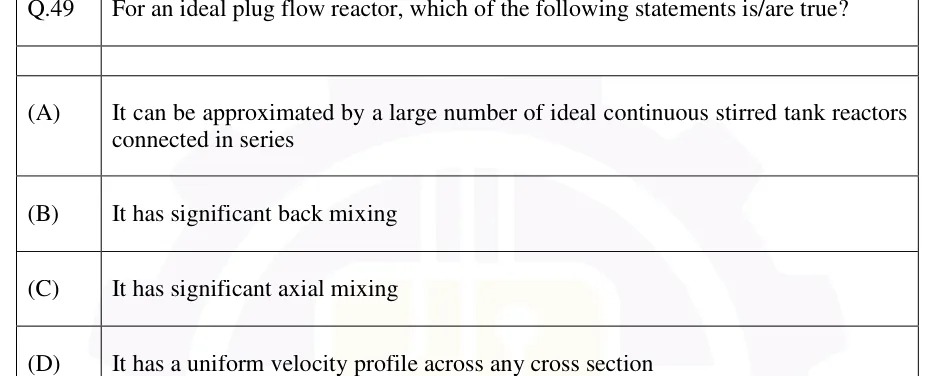
For an ideal plug flow reactor, which of the following statements is/are true?

  1. (A)

    It can be approximated by a large number of ideal continuous stirred tank reactors connected in series

  2. (B)

    It has significant back mixing

  3. (C)

    It has significant axial mixing

  4. (D)

    It has a uniform velocity profile across any cross section
Answer and solution
See the question in the paper
GATE 2026 BT Q.49: answer and solution

GATE 2022 BT Q.59

GATE 2022 · BTQ.59 · 2 marks · NAT

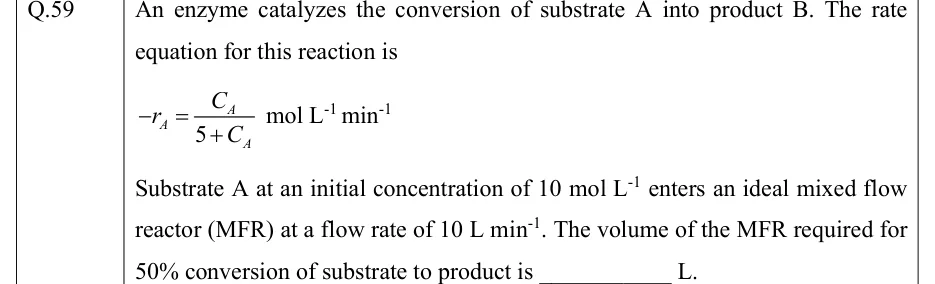
An enzyme catalyzes the conversion of substrate A into product B. The rate equation for this reaction is

Substrate A at an initial concentration of 10 enters an ideal mixed flow reactor (MFR) at a flow rate of 10 . The volume of the MFR required for 50% conversion of substrate to product is ________ L.

Answer and solution
See the question in the paper
GATE 2022 BT Q.59: answer and solution

PRACTICE

6 questions to test yourself

PRACTICE 11 mark · MCQ

An irreversible liquid-phase reaction A → P follows zero-order kinetics, , up to the required exit conversion of 0.8. A CSTR and a PFR receive the same feed (same and the same volumetric flow rate) and each reaches . Which statement about their volumes is correct?

  1. (A)

  2. (B)

  3. (C)

  4. (D)

    The volumes cannot be compared without the value of

Answer and solution

Answer: (B)

  1. For zero order, is constant, so is a horizontal line on the Levenspiel plot.

  2. CSTR: . PFR: .

  3. The space times are equal and so are the feed rates, so the volumes are equal whatever the value of .

PRACTICE 21 mark · MCQ

A liquid-phase irreversible first-order reaction ( h) is carried out in two equal CSTRs in series, each with a space time of 4 h. The density is constant and the feed contains no product. What is the overall conversion of A?

  1. (A)

    0.500

  2. (B)

    0.632

  3. (C)

    0.750

  4. (D)

    0.865

Answer and solution

Answer: (C)

  1. Each tank: .

  2. .

  3. . (0.500 is one 4 h tank, 0.632 is a 4 h PFR and 0.865 is an 8 h PFR.)

PRACTICE 31 mark · NAT

An irreversible liquid-phase reaction A → P has the rate with L mol h. The feed contains 2 mol L of A and enters at 10 L h. The density is constant. The volume (in L) of a steady-state CSTR that converts 80% of A is ______.

Answer and solution

Answer: (accepted range )

  1. Second-order CSTR: .

  2. h.

  3. L.

  4. Check: a PFR needs , so h and L. The ratio , the second-order volume ratio.

PRACTICE 42 marks · MSQ

Which of the following statements about ideal reactors are correct? (Constant density throughout.)

  1. (A)

    For a first-order reaction, N equal CSTRs in series with a fixed total space time approach the conversion of a single PFR of the same total space time as N → ∞.

  2. (B)

    For an autocatalytic reaction (such as microbial growth), a PFR needs a smaller volume than a CSTR at every exit conversion.

  3. (C)

    In a plug flow reactor with recycle, a recycle ratio R = 0 gives plug flow behaviour and R → ∞ gives mixed flow (CSTR) behaviour.

  4. (D)

    For a first-order reaction, the time a batch reactor needs to reach a given conversion equals the space time a CSTR needs to reach the same conversion from the same initial (feed) concentration.

Answer and solution

Answer: (A), (C)

  1. A is correct: as , which is the PFR result.

  2. B is wrong: for an autocatalytic reaction has a minimum. For exit conversions up to the maximum-rate point the CSTR rectangle lies below the PFR area, so the CSTR is smaller there.

  3. C is correct: reduces the recycle equation to the PFR equation, and reduces it to the CSTR equation.

  4. D is wrong: the batch time equals the PFR space time, . The CSTR needs , which is larger for any .

PRACTICE 52 marks · NAT

An irreversible liquid-phase first-order reaction A → P with h is run in a plug flow reactor with recycle. The recycle ratio is R = 1, defined as (volumetric flow returned to the inlet)/(volumetric flow leaving the system). The space time based on the fresh feed is h. The density is constant and the fresh feed contains no P. The exit conversion of A (to three decimal places) is ______.

Answer and solution

Answer: (accepted range )

  1. .

  2. , so .

  3. , so .

  4. . This lies between the CSTR value (0.667) and the PFR value (0.865) at the same , as expected.

PRACTICE 62 marks · NAT

A soluble enzyme obeying Michaelis–Menten kinetics, with g L h and g L, is used in a steady-state CSTR. The enzyme concentration is uniform and constant, and the enzyme does not deactivate. The feed contains 36 g L of substrate and enters at 20 L h. For 80% substrate conversion, the required reactor volume (in L) is ______.

Answer and solution

Answer: (accepted range )

  1. Exit substrate: g L.

  2. Rate at the exit concentration: g L h.

  3. h.

  4. L.

OFFICIAL GATE 2027 SYLLABUS WORDING

Copied from the GATE 2027 syllabus; see all 2027 syllabi.

GATE BT

Ideal reactors - batch, mixed flow and plug flow

Preparing in Kolkata? IAE Academy's course for GATE BT.