
IAE Academy

GATE 2026 BT Q.49: solution and answer

GATE 2026 · BTQ.49 · 2 marks · MSQ

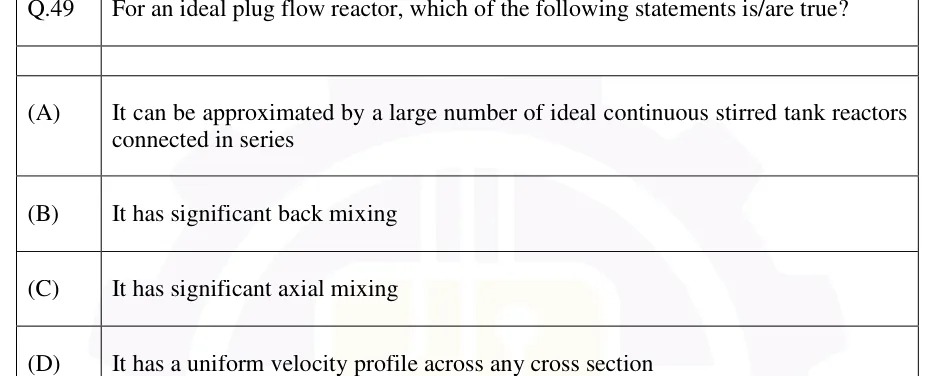
For an ideal plug flow reactor, which of the following statements is/are true?

  1. (A)

    It can be approximated by a large number of ideal continuous stirred tank reactors connected in series

  2. (B)

    It has significant back mixing

  3. (C)

    It has significant axial mixing

  4. (D)

    It has a uniform velocity profile across any cross section
See the question in the paper

Answer and solution

ANSWER

A and D. An ideal PFR is the limit of infinitely many equal CSTRs in series, and it has a flat (uniform) velocity profile across every cross-section. It has no back mixing and no axial mixing.

Official answer: A, DSource: Official answer key, GATE 2026 BT (IIT Guwahati)

  1. What "ideal plug flow" assumes: the fluid moves through the tube as a series of thin slices, or plugs. Every slice moves at the same velocity and does not mix with the slices ahead of it or behind it. So every fluid element spends the same time in the reactor, , where is the reactor volume and is the volumetric flow rate.

  2. (A) True. Tanks-in-series model: let be dimensionless time and the residence-time distribution (RTD). For equal ideal CSTRs in series, where is the dimensionless variance of the RTD. As , and becomes a single spike at . That spike is the RTD of an ideal PFR, so a very large number of CSTRs in series behaves like a PFR.

  3. (B) False. Back mixing: back mixing means material from further downstream mixes with material upstream of it. Ideal plug flow assumes there is none, so each plug keeps its own composition as it moves along the tube.

  4. (C) False. Axial mixing: the axial dispersion model has one parameter, the dispersion number . Here is the axial dispersion coefficient, the mean velocity and the reactor length. Ideal plug flow is the limit , so an ideal PFR has zero axial mixing, not significant axial mixing. Back mixing is axial mixing toward the inlet, so (B) and (C) fail for the same reason.

  5. (D) True. Flat velocity profile: "plug" means the velocity is the same at every radial position, . Compare the parabolic laminar profile , where is the mean velocity and the tube radius. In that profile, fluid near the wall moves more slowly and stays in the tube longer. The ideal PFR also assumes complete mixing across each cross-section, so concentration and temperature change only along the length of the reactor.

  6. Correct options: A and D.

KEY IDEA

In ideal plug flow every fluid element has the same residence time. That means a flat velocity profile, complete mixing across each cross-section and zero mixing along the flow direction (dispersion number ). The tanks-in-series RTD has variance , which goes to zero as and gives the same RTD.

WATCH OUT FOR

Mixing up the two directions of mixing. An ideal PFR is perfectly mixed RADIALLY, across each cross-section, but has NO mixing AXIALLY, along the flow. So 'significant axial mixing' and 'significant back mixing' are false even though mixing across the section is complete. Another mistake is to reject (A) because a single CSTR is the opposite of a PFR. It is the limit of MANY CSTRs in series that approaches plug flow.

From the GATE 2026 BT paper. Every question of this paper · Download the full paper · All 2 Ideal reactors questions, with notes