
IAE Academy

GATE 2025 BT Q.54: solution and answer

GATE 2025 · BTQ.54 · 2 marks · MSQ

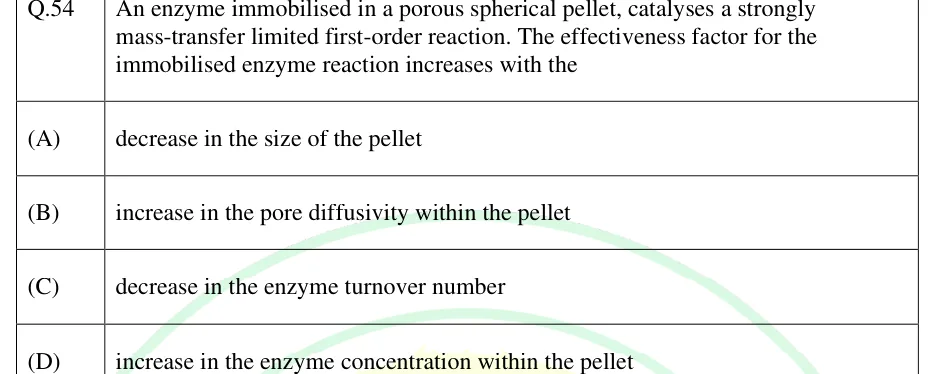
An enzyme immobilised in a porous spherical pellet, catalyses a strongly mass-transfer limited first-order reaction. The effectiveness factor for the immobilised enzyme reaction increases with the

  1. (A)

    decrease in the size of the pellet

  2. (B)

    increase in the pore diffusivity within the pellet

  3. (C)

    decrease in the enzyme turnover number

  4. (D)

    increase in the enzyme concentration within the pellet
See the question in the paper

Answer and solution

ANSWER

The effectiveness factor increases with (A) a smaller pellet, (B) a higher pore diffusivity and (C) a lower enzyme turnover number. Answer: A, B, C.

Official answer: A, B, CSource: Official answer key, GATE 2025 BT (IIT Roorkee)

  1. For a first-order enzyme reaction (substrate concentration well below ), the intrinsic rate per unit pellet volume is , with . Here is the turnover number, the enzyme concentration inside the pellet, the maximum rate and the Michaelis constant.

  2. Thiele modulus for a sphere of radius with effective pore diffusivity :

  3. Effectiveness factor for a first-order reaction in a sphere: . This decreases steadily as increases. In the strongly diffusion-limited regime ( large) it reduces to So rises whenever falls.

  4. (A) Smaller pellet: . A smaller lowers and raises . Correct.

  5. (B) Higher pore diffusivity: . A larger lowers and raises . Correct.

  6. (C) Lower turnover number: . A smaller lowers and raises . The enzyme now reacts more slowly compared with how fast diffusion brings in substrate, so more of the pellet interior is used. The overall rate falls, but is higher. Correct.

  7. (D) More enzyme in the pellet: . A larger raises and lowers , because substrate is used up closer to the surface. Incorrect.

  8. So the effectiveness factor increases for (A), (B) and (C).

KEY IDEA

The effectiveness factor depends only on the Thiele modulus , and it falls as rises (in the strongly diffusion-limited regime, ). Anything that lowers , or , or raises , increases .

WATCH OUT FOR

Treating the effectiveness factor as if it were the reaction rate. More enzyme (D) raises the overall rate, but it lowers because it raises . A lower turnover number (C) lowers the rate but raises , so students often reject C and pick D.

From the GATE 2025 BT paper. Every question of this paper · Download the full paper · All 2 Immobilisation questions, with notes