
IAE Academy

GATE 2024 BT Q.44: solution and answer

GATE 2024 · BTQ.44 · 2 marks · MSQ

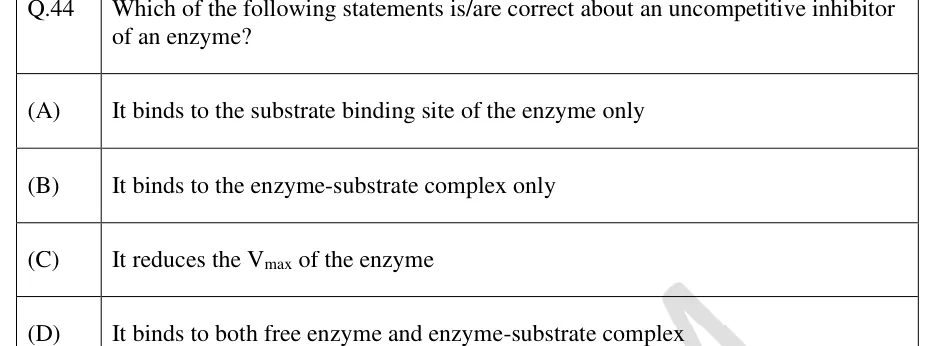
Which of the following statements is/are correct about an uncompetitive inhibitor of an enzyme?

  1. (A)

    It binds to the substrate binding site of the enzyme only

  2. (B)

    It binds to the enzyme-substrate complex only

  3. (C)

    It reduces the V of the enzyme

  4. (D)

    It binds to both free enzyme and enzyme-substrate complex
See the question in the paper

Answer and solution

ANSWER

(B) and (C): an uncompetitive inhibitor binds only to the enzyme-substrate complex, and it lowers the apparent V_max (and K_m) by the factor 1 + [I]/K_I'.

Official answer: B, CSource: Official answer key, GATE 2024 BT (IISc Bengaluru)

  1. Uncompetitive inhibition scheme: the inhibitor has no affinity for the free enzyme . It binds only to the enzyme-substrate complex, , with dissociation constant . The complex does not form product.

  2. Rate law: let be the maximum rate without inhibitor, the Michaelis constant, the substrate concentration, the inhibitor concentration and . Then

  3. Apparent constants: and . Because whenever , both fall by the same factor, so the ratio does not change. On a Lineweaver-Burk plot this shows as parallel lines.

  4. (A) False: an inhibitor that binds only the substrate-binding site of free enzyme is a competitive inhibitor. That raises and leaves unchanged. An uncompetitive inhibitor cannot bind there, because in that site is already filled by the substrate.

  5. (B) True: by definition an uncompetitive inhibitor binds only to the complex, usually at a site that the bound substrate creates or exposes.

  6. (C) True: even at saturating , part of the enzyme is held as inactive , so .

  7. (D) False: binding to both and is noncompetitive (or mixed) inhibition, not uncompetitive inhibition.

  8. Answer: the correct statements are (B) and (C).

KEY IDEA

An uncompetitive inhibitor binds only to the ES complex. Both apparent constants are divided by , so and fall together, their ratio stays the same, and Lineweaver-Burk lines come out parallel.

WATCH OUT FOR

Mixing up uncompetitive and noncompetitive inhibition. Choosing (D) describes noncompetitive or mixed inhibition, where the inhibitor binds both E and ES. Choosing (A) describes competitive inhibition. Another common slip is to think that K_m goes up under uncompetitive inhibition. It actually goes down, by the same factor as V_max.

From the GATE 2024 BT paper. Every question of this paper · Download the full paper · All 9 Enzyme kinetics questions, with notes

More Enzyme kinetics questions