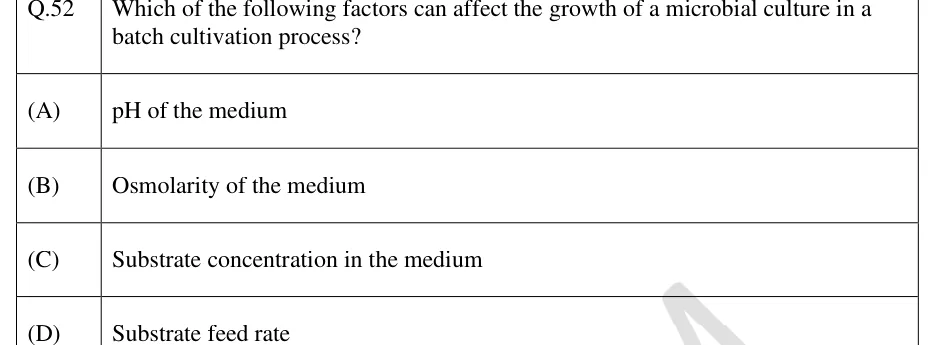
Which of the following factors can affect the growth of a microbial culture in a batch cultivation process?
- (A)
pH of the medium
- (B)
Osmolarity of the medium
- (C)
Substrate concentration in the medium
- (D)
Substrate feed rate

Which of the following factors can affect the growth of a microbial culture in a batch cultivation process?
pH of the medium
Osmolarity of the medium
Substrate concentration in the medium
Substrate feed rate
ANSWER
A, B and C. In a batch culture, growth depends on pH, osmolarity and substrate concentration. Substrate feed rate does not apply because a batch reactor has no feed.
Official answer: A, B, CSource: Official answer key, GATE 2024 BT (IISc Bengaluru)
What a batch process is: all the medium and the inoculum go into a closed vessel at , and nothing is added or removed afterwards except gases (air in, out) and small amounts of acid or base for pH control. So the only things that can affect growth are the conditions inside the vessel.
(A) pH affects growth. Every organism has an optimum pH and a range it can tolerate. pH changes the ionisation of groups in enzyme active sites, the proton-motive force across the membrane and how nutrients are taken up. It also drifts during a batch run as organic acids or ammonia build up, so the specific growth rate (biomass made per unit biomass per unit time, in ) changes with it.
(B) Osmolarity affects growth. A high solute concentration (salt or sugar) draws water out of the cell by osmosis and lowers water activity. The cell then has to spend energy making or taking up compatible solutes, so drops and the lag phase gets longer. A very low osmolarity can make cells without a rigid wall swell and burst. Either way, growth changes.
(C) Substrate concentration affects growth. Monod kinetics gives . Here is the concentration of the limiting substrate (), is the maximum specific growth rate () and is the saturation constant, the value of at which (). As the batch uses up , falls and the culture enters stationary phase. At very high , substrate inhibition can also slow growth.
(D) Substrate feed rate does not apply. A batch reactor has no feed stream, so the feed flow rate is . Feed rate is a variable only in fed-batch and continuous culture. In a chemostat, for example, the dilution rate is and at steady state. A batch culture has no feed rate that could change, so D is not a factor.
Correct options: A, B, C.
KEY IDEA
A batch reactor is closed to liquid flow. Only the conditions inside the vessel (pH, osmolarity, temperature, dissolved oxygen, substrate concentration through Monod kinetics) can change growth. Flow variables such as feed rate or dilution rate belong to fed-batch and continuous operation.
WATCH OUT FOR
Ticking D because substrate supply clearly matters for growth. In a batch, substrate is supplied only once, as the starting concentration, which is option C. A feed rate exists only in fed-batch or continuous culture. The opposite slip is leaving out B because osmolarity seems less important than nutrients, but water activity and osmotic stress directly change the growth rate and the lag time.
From the GATE 2024 BT paper. Every question of this paper · Download the full paper · All 24 Growth kinetics questions, with notes