
IAE Academy

GATE 2025 BT Q.58: solution and answer

GATE 2025 · BTQ.58 · 2 marks · NAT

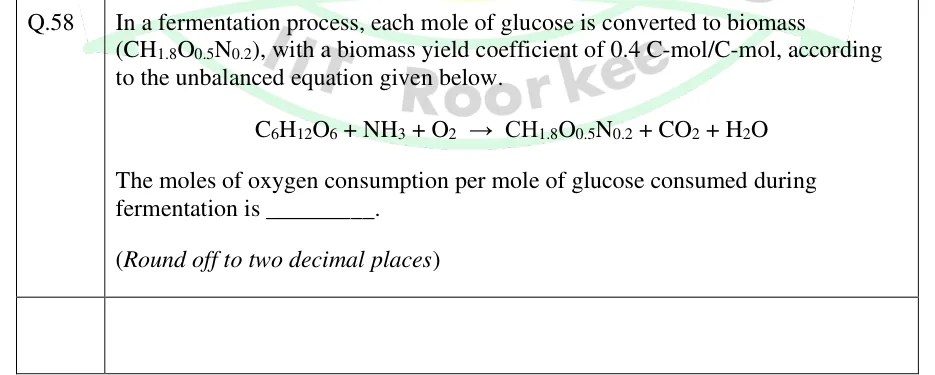
In a fermentation process, each mole of glucose is converted to biomass (), with a biomass yield coefficient of 0.4 C-mol/C-mol, according to the unbalanced equation given below.

The moles of oxygen consumption per mole of glucose consumed during fermentation is ________.

(Round off to two decimal places)
See the question in the paper

Answer and solution

ANSWER

About 3.48 mol of O2 is consumed per mole of glucose.

Official answer: 3.30 to 3.60Source: Official answer key, GATE 2025 BT (IIT Roorkee)

  1. Work on a basis of 1 mol of glucose, which is 6 C-mol (six carbon atoms). The biomass yield coefficient on a carbon basis is , so the biomass formed is . One C-mol of contains exactly one carbon atom.

  2. Carbon balance: , so .

  3. Degree of reduction (available electrons, counting C = 4, H = 1, O = −2, N = −3, with as the nitrogen source). Glucose: per mole (4 per C-mol). Biomass: per C-mol. , and all have , and each mole of accepts 4 electrons.

  4. Available-electron balance: the electrons in the glucose end up either in the biomass or on oxygen, so , i.e. .

  5. Check with a full element balance. Nitrogen: . Hydrogen: , so and . Oxygen: , so . This agrees with the electron balance.

  6. Oxygen consumed mol per mol of glucose.

KEY IDEA

Convert the carbon-basis yield to biomass C-mol (0.4 × 6 = 2.4). Then use the available-electron (degree of reduction) balance: the electrons in the glucose go either into the biomass or to oxygen. With NH3 as the nitrogen source, per mol glucose and per C-mol, so .

WATCH OUT FOR

Treating 0.4 as mol biomass per mol glucose instead of per C-mol, which gives 0.4 C-mol of biomass instead of 2.4. Using 4 as the degree of reduction for a whole mole of glucose (4 is per C-mol; per mole it is 24). Forgetting that N in NH3 counts as −3, which makes the biomass value 5.0 instead of 4.2.

From the GATE 2025 BT paper. Every question of this paper · Download the full paper · All 24 Growth kinetics questions, with notes

More Growth kinetics questions