GATE 2026 DA Q.44
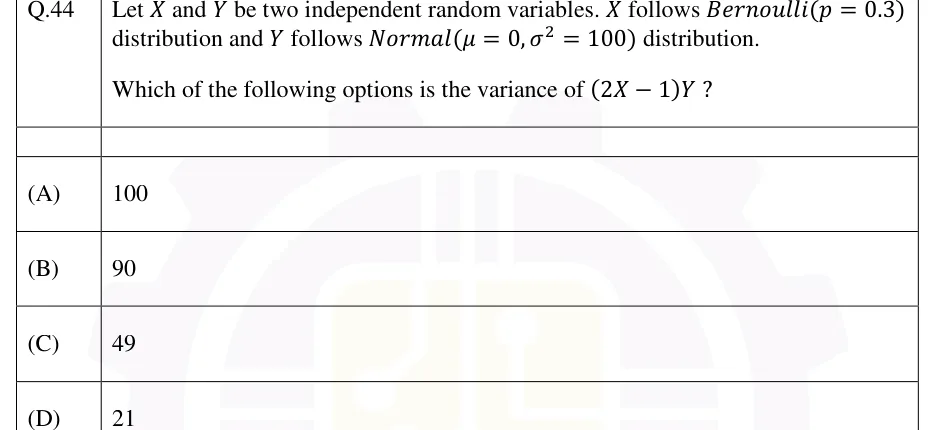
Let and be two independent random variables. follows distribution and follows distribution.
Which of the following options is the variance of ?
- (A)
100
- (B)
90
- (C)
49
- (D)
21

GATE DA
Random variables, expectation and variance, including conditional expectation
A random variable turns the outcome of an experiment into a number, and its distribution (PMF, PDF or CDF) tells you how probability is spread over those numbers. Expectation, variance, covariance and conditional expectation summarise that distribution. Problems on this topic are solved by applying linearity of expectation, the variance rules, and the laws of total expectation and total variance correctly.
8 previous-year questions · 8 solved · 5 practice questions
A random variable assigns a real number to each outcome of an experiment. It is discrete if it takes countably many values and is described by a probability mass function (PMF). It is continuous if it has a probability density function (PDF); then for every single point .
PMF CONDITIONS (DISCRETE)
Use the second condition to find an unknown constant in a given PMF.
PDF CONDITIONS (CONTINUOUS)
A density can exceed 1 at a point; only its integral is a probability.
CDF
The CDF is non-decreasing, right-continuous, with limits 0 at and 1 at . For any random variable, .
RECOVERING PMF AND PDF FROM THE CDF
For a continuous variable differentiate the CDF where it is differentiable; for a discrete variable the PMF is the size of the jump at .
EXAM TIP
For a continuous variable , since single points carry no probability. For a discrete variable the end points matter, so read and carefully.
EXPECTATION
Defined when the sum or integral converges absolutely.
EXPECTATION OF A FUNCTION (LOTUS)
No need to find the distribution of . In general ; they are equal when is linear, .
LINEARITY OF EXPECTATION
True whenever the expectations exist, with or without independence.
VARIANCE
Standard deviation . Since , , and only when is constant with probability 1. Convention: here is the population (distribution) variance. For a list of data values, the population variance divides by and the sample variance divides by .
VARIANCE UNDER A LINEAR CHANGE
A shift does not change the variance; a scale multiplies it by (the sign of is lost).
MOMENTS
The -th raw moment and -th central moment; .
EXPECTATION OF A NON-NEGATIVE INTEGER VARIABLE
Valid for taking values in ; often quicker than summing .
INDICATOR VARIABLES
To find the expected number of events that occur, write the count as ; by linearity its mean is , with no independence needed.
Mean and variance of standard distributions
Distribution | Parameters | Mean | Variance |
|---|---|---|---|
Bernoulli | |||
Binomial | |||
Geometric (trials up to and including the first success, support ) | |||
Geometric (failures before the first success, support ) | |||
Poisson | |||
Discrete uniform on | |||
Continuous uniform on | |||
Exponential (rate ) | |||
Normal |
WORKED EXAMPLE
A continuous random variable has PDF for and elsewhere. Find , and .
Normalise: , so .
.
.
.
Answer: , , .
For two random variables the joint PMF is and the joint PDF satisfies . Both are non-negative and total 1.
MARGINALS
Sum (or integrate) out the other variable over its whole range. Mind the limits when the support is not a rectangle.
INDEPENDENCE
For a PMF the product rule must hold at every pair , so one failing pair shows dependence. For a PDF it must hold everywhere apart from sets of zero probability. If the set where the joint PMF or PDF is positive is not a product set (for example the triangle ), then and are dependent.
EXPECTATION OF A FUNCTION OF TWO VARIABLES
Used for and similar.
COVARIANCE
; .
CORRELATION COEFFICIENT
Defined when both variances are positive. exactly when with probability 1 for some constants and ; then if and if .
VARIANCE OF A SUM
For uncorrelated (in particular independent) variables the covariance term vanishes, so . Note the plus sign, even for the difference.
VARIANCE OF A SUM OF N VARIABLES
For independent identically distributed with variance , the sample mean has .
PRODUCT OF INDEPENDENT VARIABLES
The converse is false: zero covariance (uncorrelated) does not imply independence.
EXAM TIP
Classic trap: take symmetric about 0 (for example uniform on ) and . Then and , so , yet is completely determined by , so they are dependent.
CONDITIONAL PMF AND PDF
Requires (or ). If are independent the conditional equals the marginal.
CONDITIONAL EXPECTATION
For each fixed this is a number; is the random variable obtained by replacing with .
CONDITIONAL VARIANCE
Also a random variable, a function of .
LAW OF TOTAL EXPECTATION
Replace the sum by an integral against when is continuous. For events that partition the sample space, .
LAW OF TOTAL VARIANCE
Average within-group variance plus variance of the group means.
USEFUL PROPERTIES
Once is given, any function of behaves like a constant. The last property does not work in reverse: does not imply independence.
RANDOM SUM
Here are independent and identically distributed with mean and variance , and is a non-negative integer random variable independent of the . It follows from the two total laws with and .
Procedure for a mixture or two-stage problem
Identify the conditioning variable (the first stage, or the group label).
Write down and as functions of .
Find by averaging over the distribution of .
Find as the mean of plus the variance of .
WORKED EXAMPLE
A component is of type A with probability and of type B with probability . A type A lifetime has mean and variance ; a type B lifetime has mean and variance . Find the mean and variance of the lifetime of a randomly chosen component.
Let be the type. .
.
, so .
.
Answer: and .
EXAM TIP
A mixture's variance is at least as large as the average of the component variances, and equal only when every component has the same mean. Forgetting the term is the commonest slip.
MARKOV'S INEQUALITY
For and . Needs only the mean.
CHEBYSHEV'S INEQUALITY
Holds for any distribution with mean and finite variance ; . Complementary form: .
Both give upper bounds that are valid for every distribution of the stated kind, so they can be far from the actual probability. A bound is not the probability itself. A one-sided question such as is also bounded by , since that event lies inside .
EXAM TIP
Markov needs . Chebyshev is Markov applied to with threshold . To bound a probability that a sample mean is far from , use for independent identically distributed samples.
PREVIOUS-YEAR QUESTIONS
Try each question first, then open the answer. We placed each question under a topic ourselves; the exam paper does not label topics.
See these papers in full: GATE DA 2026 · GATE DA 2025 · GATE DA 2024
Let and be two independent random variables. follows distribution and follows distribution.
Which of the following options is the variance of ?
100
90
49
21
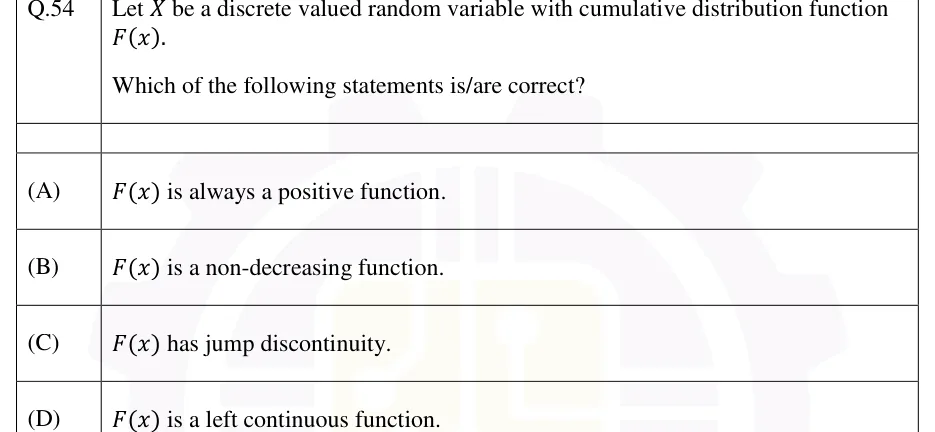
Let be a discrete valued random variable with cumulative distribution function .
Which of the following statements is/are correct?
is always a positive function.
is a non-decreasing function.
has jump discontinuity.
is a left continuous function.
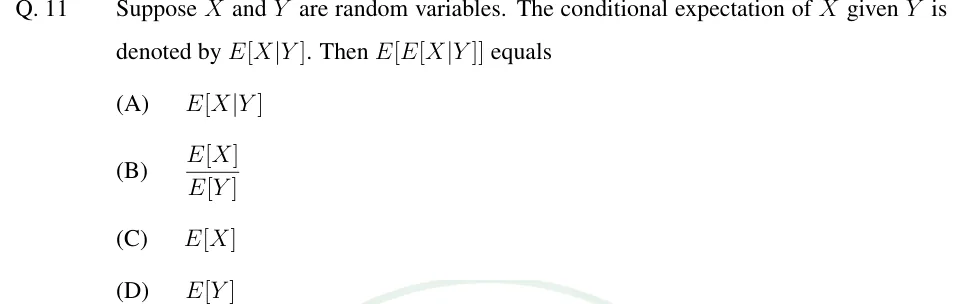
Suppose and are random variables. The conditional expectation of given is denoted by . Then equals
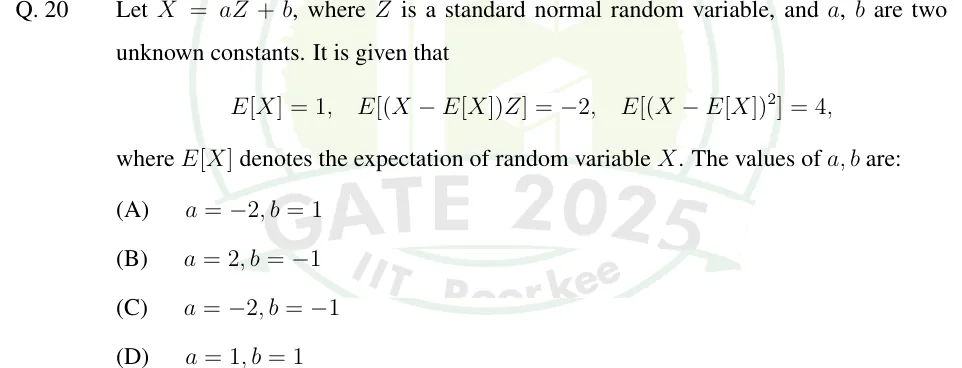
Let , where is a standard normal random variable, and , are two unknown constants. It is given that , , , where denotes the expectation of random variable . The values of are:
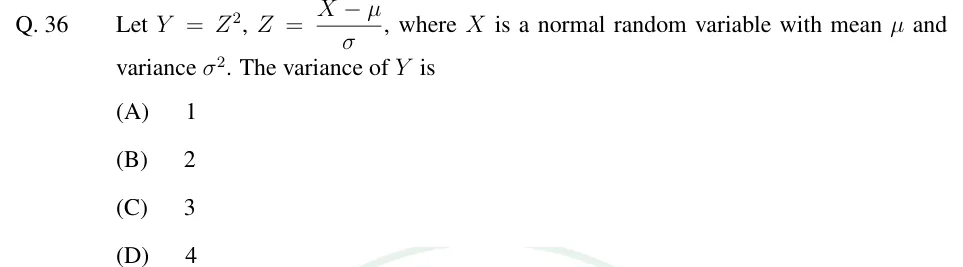
Let , , where is a normal random variable with mean and variance . The variance of is
1
2
3
4
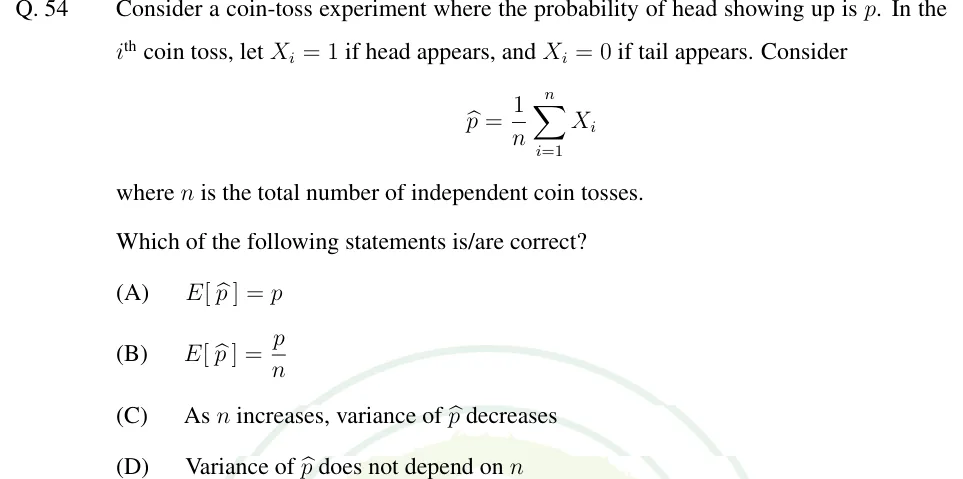
Consider a coin-toss experiment where the probability of head showing up is . In the coin toss, let if head appears, and if tail appears. Consider where is the total number of independent coin tosses. Which of the following statements is/are correct?
As increases, variance of decreases
Variance of does not depend on
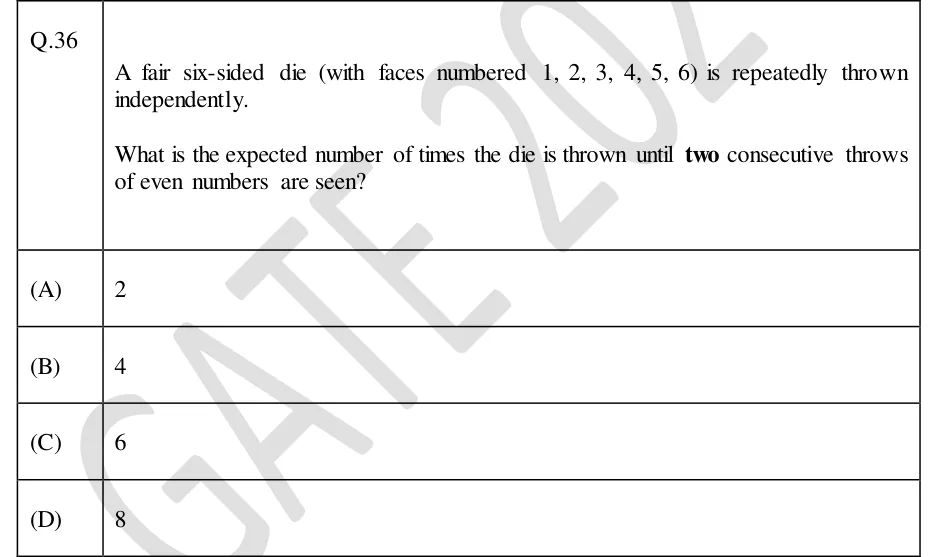
A fair six-sided die (with faces numbered 1, 2, 3, 4, 5, 6) is repeatedly thrown independently.
What is the expected number of times the die is thrown until two consecutive throws of even numbers are seen?
2
4
6
8
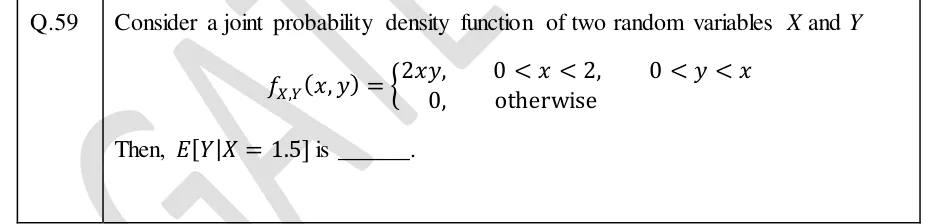
Consider a joint probability density function of two random variables and
Then, is ______.
PRACTICE
A discrete random variable has PMF for and otherwise. The value of is
Answer: (B)
Normalise: , so .
.
Random variables and have , and correlation coefficient . The value of is ______.
Answer: (accepted range )
.
.
.
The joint PMF of is , , , . Which of the following statements is/are TRUE?
and are independent
Answer: (B), (C), (D)
Marginals: and likewise for , so and .
A is false: .
B: , so . True.
C: . True.
D: . True.
A fair six-faced die is rolled once, giving . A fair coin is then tossed times and is the number of heads. The value of , correct to two decimal places, is ______.
Answer: (accepted range )
Given , is Binomial: , .
and for a fair die.
.
.
.
A continuous random variable has PDF for and elsewhere. The value of is
Answer: (A)
.
.
.
OFFICIAL GATE 2027 SYLLABUS WORDING
Copied from the GATE 2027 syllabus; see all 2027 syllabi.
GATE DA
conditional expectation and variance … random variables, discrete random variables and probability mass functions
Preparing in Kolkata? IAE Academy's course for GATE DA.