GATE 2026 DA Q.19
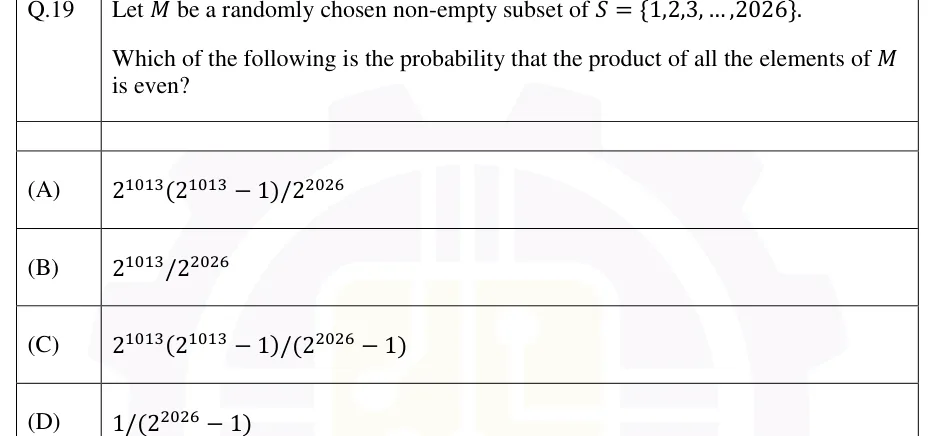
Let be a randomly chosen non-empty subset of . Which of the following is the probability that the product of all the elements of is even?
- (A)
- (B)
- (C)
- (D)

GATE DA
This topic covers how to count outcomes (permutations, combinations, arrangements with repeated objects, stars and bars, onto functions, inclusion-exclusion) and the formal language of probability: sample spaces, events, the three axioms and the rules derived from them. It also separates independent events from mutually exclusive events. Convention used throughout: is the sample space, the complement of , the number of outcomes in , the conditional probability of given , and . Give probabilities as fractions or decimals, as the question asks.
5 previous-year questions · 5 solved · 5 practice questions
Every counting problem starts from two rules. Multiplication rule: if a task is done in stages, with ways for stage 1 and, whatever was chosen, ways for stage 2, and so on, the total is . Addition rule: if a task can be done in one of several mutually disjoint ways, add the counts. If the ways overlap, adding counts the overlap more than once: use inclusion-exclusion (below) instead. Convention: .
PERMUTATIONS OF R FROM N DISTINCT OBJECTS (ORDER MATTERS, NO REPETITION)
Selecting and arranging r of n distinct objects. P(n,n) = n! is the number of orderings of all n, and P(n,0) = 1 because 0! = 1.
COMBINATIONS OF R FROM N DISTINCT OBJECTS (ORDER DOES NOT MATTER)
Selecting r of n distinct objects with no arrangement. Related to permutations by P(n,r) = r! times the binomial coefficient. The binomial coefficient is taken as 0 when r > n.
PASCAL'S IDENTITY AND THE BINOMIAL SUM
The sum counts all subsets of an n-element set, so there are 2^n - 1 non-empty subsets. Useful for 'at least one' style selections.
BINOMIAL THEOREM
Putting x = y = 1 gives the sum 2^n. Putting x = -1, y = 1 shows that the alternating sum of the binomial coefficients is 0 for n >= 1.
INCLUSION-EXCLUSION FOR COUNTING
For finite sets. The count of objects with NONE of the properties is the total minus the union. The same pattern for probabilities is in section 4.
EXAM TIP
Decide first whether the problem asks you to SELECT or to ARRANGE. A committee, a hand of cards or a subset is a selection (combination). A queue, a code or a seating is an arrangement: count it with if no symbol may repeat, or if repetition is allowed. If you are unsure, ask: would swapping two chosen items give a different outcome?
The formulas change when objects may repeat or are not all different. Always ask two questions: may a choice be used more than once, and are some objects identical?
Situation | Count | Condition |
|---|---|---|
Sequences of length r from n symbols, repetition allowed | Order matters | |
Placing r distinct objects into n distinct boxes, no limit per box | Each object independently chooses a box | |
One-to-one functions from an r-element set to an n-element set | ||
Arrangements of n objects with identical of type 1, of type 2, ..., of type k | ||
Selections of r from n types, repetition allowed, order ignored | Stars and bars | |
Non-negative integer solutions of | Each | |
Positive integer solutions of | Each ; the count is 0 if | |
Seating n distinct people around a round table | Rotations count as the same; reflections count as different | |
Necklace or bracelet of n distinct beads that can also be flipped | ; rotations and reflections both count as the same |
MULTINOMIAL COEFFICIENT
The number of ways to split n distinct objects into LABELLED groups of sizes n_1, ..., n_k, and equally the number of arrangements of n objects with repeated types. If the groups are unlabelled, divide by m! for each set of m groups of the same size. For example, 6 distinct people split into three unlabelled pairs: 6!/(2! 2! 2! 3!) = 15.
STARS AND BARS
Distributing n identical objects into k distinct boxes with no limit per box. For a lower bound x_i >= a, substitute y_i = x_i - a and reduce n by a. For an upper bound x_i <= b, count all solutions and subtract those with x_i >= b + 1, using inclusion-exclusion when several variables are bounded.
ONTO FUNCTIONS (NO BOX LEFT EMPTY)
Also the number of ways to place m distinct objects into n distinct boxes with every box non-empty. It comes from inclusion-exclusion over the set of boxes left empty, and is 0 when m < n. Check: m = 4, n = 2 gives 16 - 2 = 14; m = 4, n = 3 gives 81 - 48 + 3 = 36.
Procedure for a counting problem
Identify the objects: are they distinct or identical, and is repetition allowed?
Decide whether order matters.
Handle restrictions in one of three ways: build in stages (multiplication rule); glue items that must be together into one block, then arrange the inside of the block; or count the total and subtract the forbidden arrangements (inclusion-exclusion if there are several conditions).
For 'not adjacent' conditions, first arrange the unrestricted objects, then place the restricted ones in the gaps. Then m objects in a row leave gaps (m gaps around a circle), and k distinct restricted objects go into k different gaps in ways in a row.
Sanity-check with a tiny case (n = 3 or 4) by listing every outcome.
EXAM TIP
For a circular table, fix one person to remove the rotations: n distinct people give seatings. If a pair must sit together (), glue them into a block, seat the units in ways, then multiply by 2 for the order inside the block.
A random experiment has outcomes that cannot be predicted individually. The sample space (also written ) is the set of all possible outcomes. An event is a subset of ; the event happens if the observed outcome lies in it. Events combine as sets: means 'A or B (or both)', means 'both', means 'not A', and means 'A but not B'. Convention in these notes: is the number of outcomes in , and answers are given as fractions or decimals, as the question asks.
Basic vocabulary
Elementary (simple) event: a single outcome.
Sure event: . Impossible event: .
Mutually exclusive (disjoint) events: .
Exhaustive events : .
Partition: events that are both pairwise mutually exclusive and exhaustive.
De Morgan's laws: and .
EQUALLY LIKELY OUTCOMES (CLASSICAL PROBABILITY)
Valid only when the sample space is finite and every outcome is equally likely. State this assumption before using it; the wording of the question (a fair die, chosen at random, uniformly) is what justifies it.
EXAM TIP
Choose the sample space so that the outcomes really are equally likely. For two fair dice, use the 36 ordered pairs, not the 11 possible sums: the sums 2 to 12 are not equally likely. Likewise, for two coins that look identical, treat them as distinguishable and use HH, HT, TH, TT, each with probability 1/4. HT and TH are different outcomes even if you cannot tell the coins apart.
AXIOMS OF PROBABILITY
Every other rule is derived from these three. Axiom 3 applies to any finite or countably infinite sequence of events, but only if they are pairwise mutually exclusive.
COMPLEMENT RULE
Use it for 'at least one' events: compute the probability that none occurs and subtract from 1.
INCLUSION-EXCLUSION FOR TWO EVENTS
Holds for any two events. The subtraction removes the overlap, which was counted twice.
INCLUSION-EXCLUSION FOR THREE EVENTS
Holds for any three events.
INCLUSION-EXCLUSION FOR N EVENTS
Holds for any events. The signs alternate: singles plus, pairs minus, triples plus, and so on. S_k has C(n,k) terms.
DIFFERENCE, MONOTONICITY AND THE UNION BOUND
The first formula holds for any A and B; the simpler form P(B) - P(A) needs A to be a subset of B. The union bound holds with no condition.
FEASIBLE RANGE OF AN INTERSECTION
The lower bound follows from P(A union B) <= 1; the upper bound from monotonicity. It gives the possible values of the intersection when only the two marginal probabilities are known.
PROBABILITY OF EXACTLY ONE OF TWO EVENTS
This is the probability of the symmetric difference of A and B. It holds for any two events.
WORKED EXAMPLE
For events A, B, C let , , , , , and . Find the probability that none of the three events occurs.
Apply three-event inclusion-exclusion: .
The singles sum to and the pairs to , so .
Check that the data are consistent: the Venn regions are A only , B only , C only , only , only , only and all three . All are non-negative and they sum to .
'None occurs' is the complement of the union: .
Answer: 0.17
INDEPENDENCE OF TWO EVENTS
With the conditional probability P(A | B) = P(A and B)/P(B), defined for P(B) > 0, independence is equivalent to P(A | B) = P(A). If A and B are independent, so are A and B^c, A^c and B, and A^c and B^c.
MUTUAL INDEPENDENCE OF THREE EVENTS
All four equations are required; pairwise independence is only the first three. For n events, the product rule must hold for every sub-collection of two or more events, which is 2^n - n - 1 equations.
AT LEAST ONE OF N INDEPENDENT EVENTS
Valid when A_1, ..., A_n are mutually independent: their complements are then mutually independent too, and the probability that none occurs is the product.
Property | Mutually exclusive | Independent |
|---|---|---|
Defining condition | (the events cannot occur together), which implies | |
Union | ||
Learning that B occurred | Tells you A did not occur: when | Does not change the probability of A: when |
Describes | The events as sets (a statement about outcomes) | The probability measure (a statement about numbers) |
Why two events of non-zero probability cannot be both. If and are mutually exclusive then . If they were also independent, then when both probabilities are positive, a contradiction. So mutually exclusive events with positive probabilities are always dependent, and independent events with positive probabilities always overlap. The only way to be both is for at least one of the events to have probability .
Pairwise versus mutual independence. Toss two fair coins. Let = the first toss is heads, = the second toss is heads, and = the two tosses agree. Each event has probability , and each pair has intersection probability , so the events are pairwise independent. But is just HH, with probability , not . So pairwise independence does not imply mutual independence.
EXAM TIP
To test independence, compute , and , and compare with the product. Do not decide from a picture or because the events 'seem unrelated'. Also remember that 'mutually exclusive' is not 'independent': a question that offers both words as options is testing exactly this.
DRAWING WITHOUT REPLACEMENT (HYPERGEOMETRIC COUNTING)
An urn has R red and B blue balls, and n <= R + B balls are drawn at random without replacement. Order is ignored in both the numerator and the denominator.
BIRTHDAY PROBLEM
Assumes N equally likely days and independent birthdays (N = 365, ignoring 29 February). For k > N the probability is 0. The probability that at least two people share a birthday is 1 minus this.
DERANGEMENTS AND THE MATCHING PROBLEM
n letters are placed at random in n addressed envelopes, one per envelope. D_n counts the permutations with no fixed point: D_1 = 0, D_2 = 1, D_3 = 2, D_4 = 9, D_5 = 44. Recurrence: D_n = (n-1)(D_{n-1} + D_{n-2}) for n >= 3. As n grows, P(no match) tends to 1/e, about 0.3679.
The matching probability comes from inclusion-exclusion. Let be the event that letter lands in its own envelope. For any given letters, the probability that all of them match is ; for example, and . There are choices of the letters, so , and .
WORKED EXAMPLE
The letters of the word BANANAS are arranged in a row at random, all distinct arrangements being equally likely. Find the probability that the three A's are together.
The word has 7 letters: A three times, N twice, and B and S once each. The number of distinct arrangements is .
Glue the three A's into one block. The objects are now the block AAA, B, S and two N's: 5 objects with N repeated twice, giving arrangements.
Because the A's are identical, the order inside the block gives nothing new.
Probability .
Answer: 1/7
EXAM TIP
When a question says 'distinct arrangements are equally likely' for a word with repeated letters, count both the numerator and the denominator as distinct arrangements, as above. Using distinct arrangements in one count and letter-labelled arrangements in the other gives a wrong ratio.
PREVIOUS-YEAR QUESTIONS
Try each question first, then open the answer. We placed each question under a topic ourselves; the exam paper does not label topics.
See these papers in full: GATE DA 2026 · GATE DA 2025 · GATE DA 2024
Let be a randomly chosen non-empty subset of . Which of the following is the probability that the product of all the elements of is even?
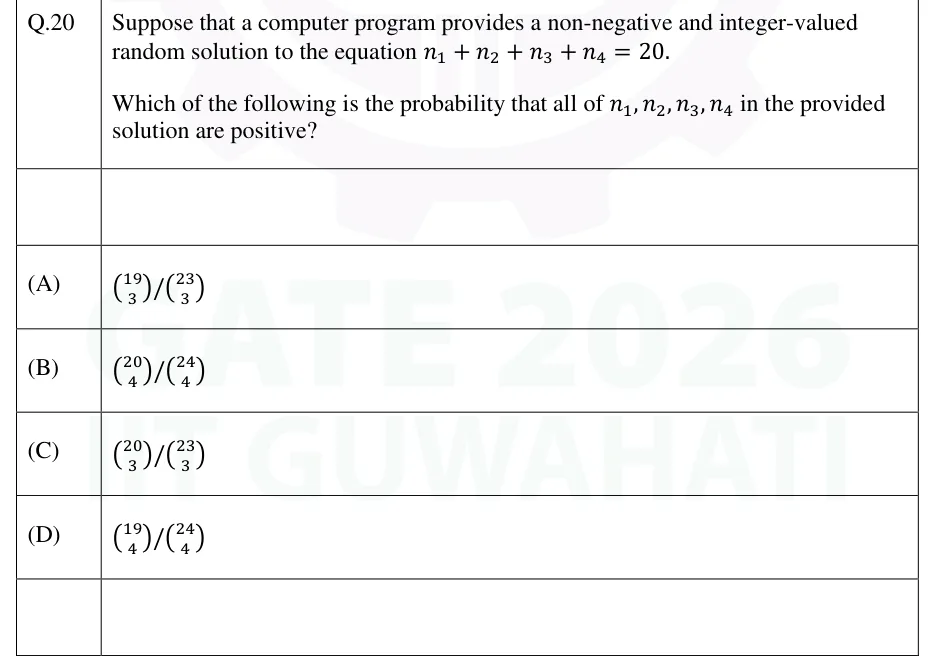
Suppose that a computer program provides a non-negative and integer-valued random solution to the equation . Which of the following is the probability that all of in the provided solution are positive?
The number of bijections from the set to itself such that , for all , is ______. (Answer in integer)
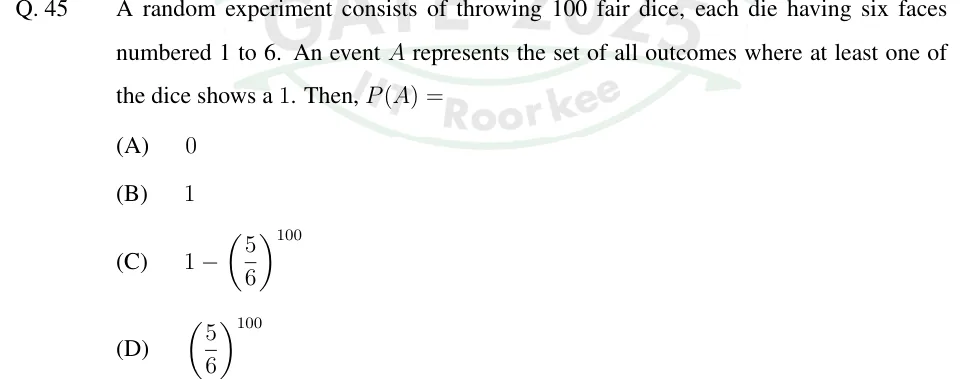
A random experiment consists of throwing 100 fair dice, each die having six faces numbered 1 to 6. An event represents the set of all outcomes where at least one of the dice shows a 1. Then,
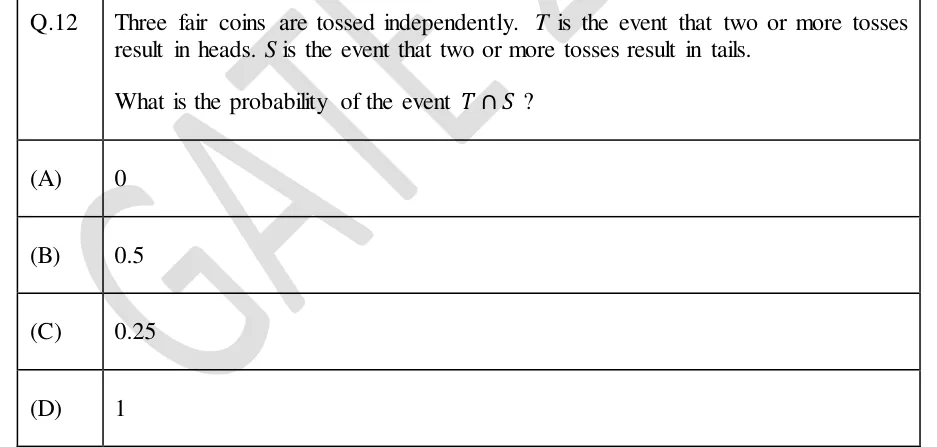
Three fair coins are tossed independently. is the event that two or more tosses result in heads. is the event that two or more tosses result in tails.
What is the probability of the event ?
0
0.5
0.25
1
PRACTICE
Six distinct people are to be seated around a circular table. Two particular people, P and Q, must sit next to each other. Two seatings are the same if one is a rotation of the other. How many different seatings are possible?
Answer:
Glue P and Q into one block. There are then 5 units (the block and the four other people) to seat around a circle.
Circular arrangements of 5 distinct units: .
P and Q can be ordered inside the block in 2 ways.
Total .
A fair six-sided die is rolled twice. Let E be the event that the sum of the two numbers is 8 or the first roll shows a 6. What is ?
5/18
11/36
1/3
1/4
Answer: (A)
Use the 36 equally likely ordered pairs.
Sum equal to 8: (2,6), (3,5), (4,4), (5,3), (6,2), so 5 outcomes.
First roll equal to 6: 6 outcomes. Both conditions: only (6,2), so 1 outcome.
Inclusion-exclusion: outcomes, so .
For two events A and B, , and . Which of the following statements are TRUE?
A and B are independent
A and B are mutually exclusive
Answer: (A), (C)
From inclusion-exclusion: .
Independence check: , so A is true.
The intersection has probability , so the events overlap and B is false.
By De Morgan, , so C is true.
, so D is false.
Find the number of non-negative integer solutions of the equation in which .
Answer:
Put , so the equation becomes with all four variables non-negative.
Stars and bars with and : .
.
Four letters, each addressed to a different person, are placed at random one in each of four addressed envelopes (every assignment of letters to envelopes is equally likely). What is the probability that at least one letter is placed in its correct envelope?
5/8
3/8
2/3
7/12
Answer: (A)
Count the assignments with no letter in its own envelope: .
Total assignments: , so .
Complement rule: .
Check by inclusion-exclusion: .
OFFICIAL GATE 2027 SYLLABUS WORDING
Copied from the GATE 2027 syllabus; see all 2027 syllabi.
GATE DA
Counting (permutation and combinations), probability axioms, Sample space, events, independent events, mutually exclusive events
Preparing in Kolkata? IAE Academy's course for GATE DA.