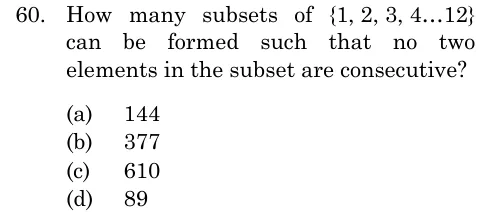
How many subsets of {1, 2, 3, 4…12} can be formed such that no two elements in the subset are consecutive?
- (A)
144
- (B)
377
- (C)
610
- (D)
89

How many subsets of {1, 2, 3, 4…12} can be formed such that no two elements in the subset are consecutive?
144
377
610
89
ANSWER
The number of such subsets is , option (B).
Official answer: BSource: ISRO's final answer key of 15 May 2026
Let be the number of subsets of with no two consecutive elements. The empty set counts as a valid subset.
Split on the element . If is not chosen, the subset is any valid subset of , giving ways.
If is chosen, then must be left out. The rest is any valid subset of , giving ways.
Every valid subset falls in exactly one of these two cases, so for . This is the Fibonacci recurrence.
Base cases: (only the empty set) and (the empty set and ).
Compute: .
Hence with , and . The other options are Fibonacci numbers at the wrong index: , and .
KEY IDEA
Condition on whether the largest element is chosen. This gives , so the count of subsets of with no two consecutive elements is the Fibonacci number .
WATCH OUT FOR
Starting the recurrence from the wrong base case, or leaving out the empty set. That shifts the answer to a neighbouring Fibonacci number such as , , or .
From the ISRO CS 2025 paper. Every question of this paper · The full paper (PDF, ISRO) · All 5 ISRO Counting & axioms questions, with notes