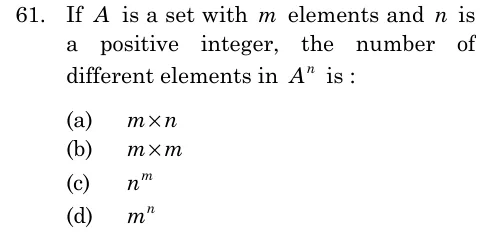
If is a set with elements and is a positive integer, the number of different elements in is :
- (A)
- (B)
- (C)
- (D)

If is a set with elements and is a positive integer, the number of different elements in is :
ANSWER
The number of elements in is , option (D).
Official answer: DSource: ISRO's final answer key of 15 May 2026
is the -fold Cartesian product , so each element is an ordered -tuple with every .
By the multiplication rule of counting, each of the positions can be filled independently in ways.
Hence .
Check with : , which agrees with and not with (the two are equal only when ).
Option (a) adds the sizes instead of multiplying per position. Option (b) is only the case . Option (c) swaps the base and the exponent: it counts functions from an -set to an -set.
KEY IDEA
is the set of ordered -tuples over . Each of the positions has independent choices, so the count is .
WATCH OUT FOR
Swapping base and exponent to get , or treating as (adding sizes instead of multiplying choices per position).
From the ISRO CS 2025 paper. Every question of this paper · The full paper (PDF, ISRO) · All 5 ISRO Counting & axioms questions, with notes