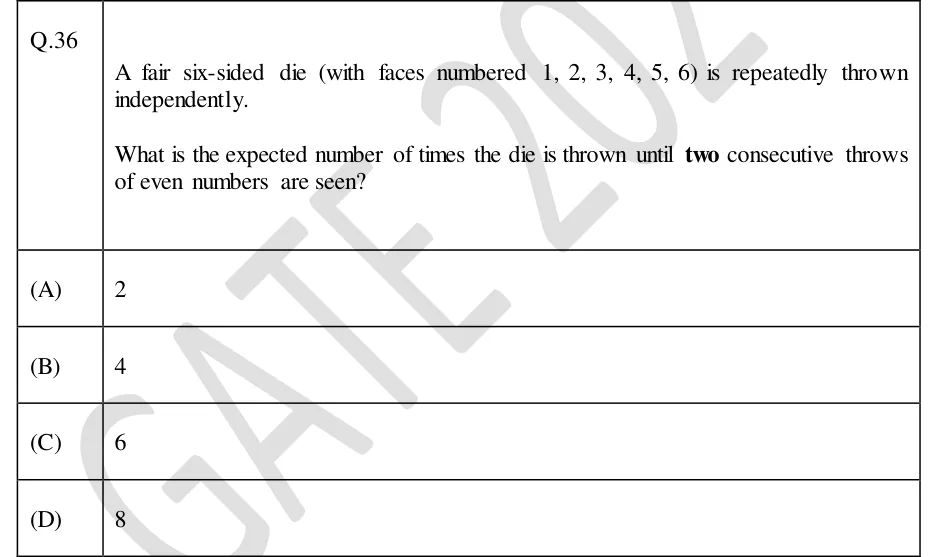
A fair six-sided die (with faces numbered 1, 2, 3, 4, 5, 6) is repeatedly thrown independently.
What is the expected number of times the die is thrown until two consecutive throws of even numbers are seen?
- (A)
2
- (B)
4
- (C)
6
- (D)
8

A fair six-sided die (with faces numbered 1, 2, 3, 4, 5, 6) is repeatedly thrown independently.
What is the expected number of times the die is thrown until two consecutive throws of even numbers are seen?
2
4
6
8
ANSWER
The expected number of throws until two consecutive even numbers appear is 6, option (C).
Official answer: CSource: Official answer key, GATE 2024 DA (IISc Bengaluru)
Each throw is even (2, 4 or 6) with probability and odd with probability , independently of the other throws. We wait for two even throws in a row.
Define two states. is the expected number of further throws when the last throw was not even (or at the start). is the expected number of further throws when the last throw was even.
From state 0 one throw is made. With probability it is even and we move to state 1. With probability it is odd and we stay in state 0:
From state 1 one throw is made. With probability it is even and we stop. With probability it is odd and we fall back to state 0:
Substitute into the first equation:
So , which gives (and ). The die starts in state 0, so the expected number of throws is .
Check with the standard result for consecutive successes with success probability : This agrees, so the answer is option (C).
KEY IDEA
Model the wait as a two-state Markov chain (last throw even or not) and solve the two first-step equations for the expected remaining throws.
WATCH OUT FOR
Answering by treating pairs of throws as independent trials. An odd throw after one even throw wipes out the progress, and overlapping runs are allowed, so the true expectation is larger, at 6.
From the GATE 2024 DA paper. Every question of this paper · Download the full paper · All 8 Random variables questions, with notes