IAE Academy

GATE BT

Microbial products

Microbial products, recombinant protein production and screening

This topic covers how microbes are grown at scale to make biomass, primary and secondary metabolites, biofuels, bioplastics, industrial enzymes and recombinant proteins, how these products are recovered and purified, the basics of clinical, food and industrial microbiology, and how new products are found by screening. It includes growth kinetics and yield arithmetic, the trophophase and idiophase distinction, host choice for recombinant proteins, purification order and the standard organism-product pairs.

4 previous-year questions · 4 solved · 6 practice questions

1. Growth, metabolites and the kinetics you need

Industrial microbiology grows a chosen strain in a controlled bioreactor so that it makes a useful product. The product may be the cells themselves (biomass), a primary metabolite made during active growth, or a secondary metabolite made when growth slows.

Feature

Primary metabolite

Secondary metabolite

Growth phase of formation

Trophophase (growth phase)

Idiophase (production phase, usually late exponential or stationary)

Role for the cell

Essential for growth

Not essential for growth; often a survival or defence function

Pattern vs biomass

Mostly growth-associated

Mostly non-growth-associated

Trigger

Formed whenever the cell grows

Often switched on by limitation of a nutrient (carbon, nitrogen or phosphate) and repressed by readily used carbon sources such as glucose

Examples

Ethanol, lactic acid, citric acid, glutamic acid, lysine

Penicillin, streptomycin, cephalosporin, erythromycin

Structure and distribution

Common to many species

Often complex and specific to a few species or strains

SPECIFIC GROWTH RATE

X is biomass concentration (g/L). In exponential growth with constant , .

DOUBLING TIME

Valid only in the exponential phase, where is constant. is in h, so is in hours.

MONOD EQUATION

S is the concentration of the growth-limiting substrate (g/L). , the saturation constant, is the value of S at which . When , ; when , . Linearised (Lineweaver-Burk form): . Applies when one substrate limits growth.

BIOMASS YIELD COEFFICIENT

Grams of biomass formed per gram of substrate consumed, taken as constant over the culture. Similarly for product and .

LUEDEKING-PIRET MODEL

(g product per g biomass) is the growth-associated coefficient and (g product per g biomass per h) the non-growth-associated coefficient. A purely growth-associated product has ; a purely non-growth-associated product, such as a typical secondary metabolite, has . Mixed products such as lactic acid need both terms.

VOLUMETRIC PRODUCTIVITY

Product formed per litre per hour of batch time (g L h). If the turnaround time (emptying, cleaning, sterilising, filling) is included in t, the productivity is lower.

CHEMOSTAT AT STEADY STATE

F is the feed flow rate (L/h), V the culture volume (L), D the dilution rate (h) and the limiting-substrate concentration in the feed. Assumes a sterile feed, Monod kinetics, constant yield, and no death or maintenance. Washout occurs when D reaches , the highest growth rate the feed can support.

WORKED EXAMPLE

A batch culture grows exponentially with . Biomass is 0.2 g/L at the start of the exponential phase. How long does it take to reach 3.2 g/L, and what is the doubling time?

Solution
  1. , so .

  2. , and .

  3. h.

  4. h (16 is , and h, which agrees).

Answer: About 7.9 h to reach 3.2 g/L; doubling time about 2.0 h.

2. Biomass, primary and secondary metabolites

Single-cell protein (SCP) is microbial biomass used as food or feed. It is rich in protein, grows fast and can use cheap substrates, but its nucleic acid content is high and must be reduced before human use. Baker's yeast (Saccharomyces cerevisiae) is made by aerobic fed-batch culture on molasses. Sugar is fed slowly so that it never accumulates; excess sugar makes yeast ferment to ethanol even under aerobic conditions (the Crabtree effect), which lowers the biomass yield.

Product

Typical organism

Class and use

Single-cell protein

Methylophilus methylotrophus (methanol), Fusarium venenatum (mycoprotein), Spirulina, Candida yeasts

Biomass; food and feed

Baker's yeast

Saccharomyces cerevisiae

Biomass; baking

Ethanol

S. cerevisiae, Zymomonas mobilis

Primary metabolite; fuel and solvent

Citric acid

Aspergillus niger

Primary; aerobic, high sugar, low pH and trace-metal (Mn, Fe) limitation; food and drinks

Lactic acid

Lactobacillus species

Primary; fermentation by aerotolerant anaerobes; food and PLA

Glutamic acid, lysine

Corynebacterium glutamicum

Primary; glutamate excretion is induced by biotin limitation; flavour and feed

Acetone and butanol

Clostridium acetobutylicum

Primary; anaerobic solvent fermentation

Vitamin B12

Propionibacterium freudenreichii subsp. shermanii, Pseudomonas denitrificans

Vitamin; feed and pharmaceutical

Riboflavin

Ashbya gossypii

Vitamin; feed and food

Xanthan gum

Xanthomonas campestris

Extracellular polysaccharide; thickener

Penicillin

Penicillium chrysogenum

Secondary; antibiotic

Cephalosporin

Acremonium chrysogenum (formerly Cephalosporium)

Secondary; antibiotic

Streptomycin

Streptomyces griseus

Secondary; antibiotic

Tetracycline

Streptomyces aureofaciens

Secondary; antibiotic

Erythromycin

Saccharopolyspora erythraea (formerly Streptomyces erythreus)

Secondary; antibiotic

Cyclosporin A

Tolypocladium inflatum

Secondary; immunosuppressant

Lovastatin

Aspergillus terreus

Secondary; cholesterol-lowering drug

Penicillin is made by fed-batch culture. Growth (trophophase) comes first; penicillin accumulates in the idiophase, once growth slows. Glucose is fed slowly because a high glucose level represses penicillin synthesis (catabolite repression). Lactose, which the fungus uses slowly, is also a common carbon source. A side-chain precursor is added to direct synthesis: phenylacetic acid gives penicillin G and phenoxyacetic acid gives penicillin V. Penicillin G acylase removes the side chain from penicillin G to give 6-aminopenicillanic acid (6-APA), the starting material for semisynthetic penicillins such as ampicillin.

EXAM TIP

Trophophase gives primary metabolites; idiophase gives secondary metabolites. A product whose formation stops when growth stops is growth-associated. Penicillin keeps accumulating after growth has slowed, so it is non-growth-associated.

ALCOHOLIC FERMENTATION OF GLUCOSE

Theoretical ethanol yield is g ethanol per g glucose, and CO is g per g glucose. Real yields are lower because some sugar goes to cells and by-products.

WORKED EXAMPLE

A fermenter holds 1000 L of medium with 120 g/L glucose. Yeast consumes 95% of the glucose and the ethanol yield is 0.46 g per g glucose consumed. Find the ethanol concentration and the yield as a percentage of theoretical (0.511 g/g).

Solution
  1. Glucose consumed g/L.

  2. Ethanol g/L (52.4 kg in 1000 L).

  3. Percentage of theoretical .

Answer: About 52.4 g/L ethanol, which is about 90% of the theoretical yield.

3. Biofuels and bioplastics

Biofuel

Raw material

Process

Key point

Bioethanol (first generation)

Sugarcane juice, molasses, starch crops (maize)

Starch is first hydrolysed to glucose by -amylase (liquefaction) and glucoamylase (saccharification); yeast ferments the sugar to ethanol; distillation

Sucrose in cane juice and molasses is split by the yeast's own invertase, so no separate hydrolysis step is needed

Bioethanol (second generation)

Lignocellulose (straw, bagasse)

Pretreatment, then cellulase saccharification, then fermentation

Lignin hinders enzyme access; pentoses such as xylose are also released, and wild-type S. cerevisiae does not ferment xylose

Biodiesel

Vegetable oils, animal fats

Transesterification of triglyceride with methanol (base catalyst such as NaOH or KOH) giving fatty acid methyl esters (FAME)

Glycerol is the by-product; feedstocks high in free fatty acids form soap with alkali, so they are first esterified with an acid catalyst

Biogas

Dung, sludge, crop waste

Anaerobic digestion: hydrolysis, acidogenesis, acetogenesis, methanogenesis

Mostly methane (about 50 to 70%) and CO; the first three stages are carried out by bacteria, and methanogenesis by archaea

BIODIESEL TRANSESTERIFICATION

Three moles of methanol per mole of triglyceride, usually with excess methanol to push the equilibrium forward and an alkali catalyst; lipases can also catalyse it.

Bioplastics. Polyhydroxyalkanoates (PHA), of which polyhydroxybutyrate (PHB) is the commonest, are intracellular carbon and energy storage granules made by bacteria such as Cupriavidus necator (formerly Ralstonia eutropha) and some Bacillus and Pseudomonas species. They accumulate when carbon is in excess and another nutrient (nitrogen, phosphorus or oxygen) is limiting. PHA is biodegradable. The polymer is recovered by breaking the cells or extracting them with solvents. Polylactic acid (PLA) is made chemically, by ring-opening polymerisation of lactide made from fermentation lactic acid; the microbe makes only the monomer.

EXAM TIP

Starch needs amylases to release glucose before yeast can ferment it. Lignocellulose needs pretreatment and cellulases. In biogas, bacteria carry out hydrolysis, acidogenesis and acetogenesis; only the methane-forming step is done by methanogenic archaea, never by yeast or fungi.

4. Industrial enzymes

Enzyme

Common source

Typical use

-Amylase

Bacillus licheniformis, B. amyloliquefaciens, Aspergillus oryzae

Starch liquefaction, desizing of textiles, baking

Glucoamylase

Aspergillus niger

Saccharification of liquefied starch to glucose

Glucose isomerase (a xylose isomerase)

Streptomyces species, Bacillus coagulans (often immobilised)

Glucose to fructose for high-fructose syrup

Protease (subtilisin)

Bacillus licheniformis, B. amyloliquefaciens

Detergents, leather processing, protein hydrolysates

Lipase

Candida rugosa, Rhizopus, Pseudomonas

Detergents, dairy flavour, biodiesel, resolution of chiral compounds

Pectinase

Aspergillus niger

Clarifying fruit juice

Chymosin (rennet)

Recombinant, in E. coli, Aspergillus or Kluyveromyces

Cheese making

Microbial rennet (aspartic protease)

Rhizomucor miehei

Cheese making

Cellulase

Trichoderma reesei

Biomass saccharification, textile finishing

Penicillin G acylase

E. coli

Penicillin G to 6-APA for semisynthetic penicillins

Lactase (-galactosidase)

Kluyveromyces lactis, Aspergillus species

Lactose-reduced milk

Invertase

Saccharomyces cerevisiae

Sucrose to invert sugar for confectionery

Most bulk industrial enzymes, such as amylases, proteases and cellulases, are extracellular, so they are recovered from the broth after the cells are removed. Some, such as glucose isomerase and penicillin acylase, are intracellular and are used as immobilised cells or as enzyme released from the cells. Microbial sources are preferred because they grow fast, give high yield, can be improved by mutation or genetic engineering, and tolerate heat or alkali (needed for detergent and starch processing). Enzymes used repeatedly are often immobilised so that they can be reused and kept out of the product.

5. Recombinant proteins and metabolites: host, expression and purification

Host

Advantages

Limitations

E. coli

Fast growth, cheap medium, well-known genetics, high yield

No glycosylation; reducing cytoplasm, so disulfide bonds form poorly unless the protein is sent to the periplasm or a special strain is used; proteins may form inclusion bodies; cells carry endotoxin (lipopolysaccharide)

Yeast (Saccharomyces cerevisiae, Pichia pastoris, now classified as Komagataella phaffii)

Eukaryotic folding and secretion; simple medium; Pichia has a methanol-inducible AOX1 promoter and reaches high cell density

Glycosylation differs from human (high mannose)

Insect cells with baculovirus

High expression; many eukaryotic modifications

Slower and costlier than microbes; glycosylation is not human-like

Mammalian cells (CHO)

Human-like folding and glycosylation

Slow growth, costly medium, risk of viral contamination

A small, non-glycosylated protein such as human insulin or growth hormone can be made in E. coli. Human insulin was first made there by expressing the A and B chains separately and joining them through disulfide bonds; later processes make proinsulin, in E. coli or S. cerevisiae, and cut it to insulin. A glycoprotein whose activity depends on its sugars, such as erythropoietin or many antibodies, is normally made in mammalian cells. Expression in E. coli usually uses an inducible promoter (for example lac-type promoters induced by IPTG, or the T7 promoter in strains such as BL21(DE3)), so that cells grow to high density before the protein is switched on.

Inclusion bodies are dense aggregates of misfolded protein formed when expression is high. They are easy to collect (low-speed centrifugation after cell lysis, then washing), and they protect a toxic or protease-sensitive protein, but the protein must be solubilised with a denaturant (8 M urea or 6 M guanidine hydrochloride) and then refolded by dilution or dialysis. A lower induction temperature, a lower inducer concentration or a solubility tag can reduce their formation.

Typical downstream sequence for an intracellular recombinant protein

  1. Harvest cells by centrifugation or filtration.

  2. Disrupt cells (high-pressure homogeniser, bead mill or sonication).

  3. Clarify to remove debris (centrifugation or microfiltration); handle inclusion bodies by washing, solubilising and refolding.

  4. Capture and concentrate, for example by affinity chromatography (His-tagged protein on Ni-NTA, eluted with imidazole).

  5. Intermediate purification by ion-exchange chromatography.

  6. Polishing by size-exclusion (gel filtration) chromatography; remove endotoxin and nucleic acids.

  7. Formulate, sterile filter and dry or freeze-dry.

EXAM TIP

Purification order runs from high capacity and low resolution to low capacity and high resolution: capture, then intermediate purification, then polishing. Gel filtration usually comes last because a column takes only a small sample volume. Secreted products skip the cell disruption step.

Product

Standard recovery route

Penicillin

Remove mycelium by filtration; acidify broth to pH 2 to 2.5 and extract quickly into butyl or amyl acetate in the cold (penicillin is unstable at low pH); back-extract into aqueous buffer at about pH 7.5; crystallise as the sodium or potassium salt

Citric acid

Remove mycelium; precipitate calcium citrate with lime (Ca(OH)); treat with sulfuric acid to free citric acid, leaving calcium sulfate; purify and crystallise

Ethanol

Distillation to the azeotrope (about 95.6% ethanol by mass), then molecular sieves to dry it for fuel use

Lactic acid

Precipitation as calcium lactate followed by acidification, or membrane and ion-exchange methods

PHA

Cell disruption or solvent extraction of the intracellular granules

For large-scale production of recombinant proteins, fed-batch culture with a controlled feed gives high cell density, keeps acetate formation in E. coli low and extends the productive phase. Continuous culture is rarely used for recombinant products because plasmid-bearing cells are lost over time and the risk of contamination grows with run length.

6. Clinical, food and industrial microbiology

Area

Standard facts

Clinical

Culture and Gram stain identify pathogens. Selective and differential media are used, for example MacConkey agar: bile salts and crystal violet suppress Gram-positive bacteria, and lactose fermenters among the Gram-negative enterics appear pink. Antibiotic susceptibility is measured by Kirby-Bauer disc diffusion on Mueller-Hinton agar (zone of inhibition), by MIC (the lowest concentration that prevents visible growth) and by MBC (the lowest concentration that kills the inoculum).

Fermented foods

Yoghurt: Lactobacillus delbrueckii subsp. bulgaricus and Streptococcus thermophilus convert lactose to lactic acid; curd: mixed lactic acid bacteria. Vinegar: yeast makes ethanol, then Acetobacter oxidises it to acetic acid. Bread and beer: S. cerevisiae. Cheese: lactic acid bacteria plus rennet; Propionibacterium freudenreichii makes the holes in Swiss cheese; Penicillium roqueforti and P. camemberti ripen blue and soft cheeses. Idli and dosa batter: Leuconostoc mesenteroides, Enterococcus and yeasts.

Spoilage

Microbial growth is controlled by water activity, pH, temperature and nutrients. Moulds and yeasts tolerate low water activity and low pH better than most bacteria.

Preservation

Heat: pasteurisation at C for 30 min (batch) or C for 15 s (HTST); UHT at about 135 to C for a few seconds. Other methods: cold storage, drying, salting, sugar, acid, irradiation, vacuum or modified atmosphere, and nisin (a bacteriocin from Lactococcus lactis).

Industrial

Strain improvement by mutation and selection or genetic engineering; sterilised medium; control of pH, temperature, aeration and foam; product recovery; contamination control.

THERMAL DEATH KINETICS AND D VALUE

Assumes first-order death at a constant temperature. N is the number of viable cells or spores, the specific death rate (min), and D the time at that temperature that cuts the viable count tenfold (one log). The z value is the temperature rise that cuts D tenfold.

EXAM TIP

Pasteurisation reduces pathogens and spoilage organisms but does not sterilise. Sterilisation removes or kills all life, including spores. It is normally done by autoclave at C and 15 psi above atmospheric pressure (about 103 kPa gauge) for 15 to 20 min.

7. Screening strategies for new products

Screening is the search for microbes that make a wanted product. The usual source is soil or other natural material. Enrichment culture applies selective conditions (a particular carbon source, temperature or pH) so that organisms with the wanted ability outgrow the rest.

Typical screening scheme

  1. Isolate many strains from a natural sample, often after enrichment.

  2. Primary screening: a simple, cheap, high-throughput test that detects any activity. Examples: a clear halo around a colony on starch agar flooded with iodine (amylase), casein or skim-milk agar (protease) or tributyrin agar (lipase); inhibition of an indicator organism (antibiotic); the crowded plate technique (antibiotic producers); auxanography (producers of growth factors such as vitamins and amino acids); a pH indicator dye or a cleared zone in CaCO agar (organic acid producers).

  3. Secondary screening: test positive isolates in shake flasks or small fermenters and measure yield with quantitative assays.

  4. Check novelty and usefulness (dereplication removes known compounds), toxicity and stability.

  5. Improve the strain, optimise the medium and scale up.

Modern screening also uses robotic microplate assays, reporter strains that signal a wanted activity, and functional metagenomic libraries, which express DNA taken directly from an environmental sample, including DNA from organisms that cannot be cultured.

EXAM TIP

Primary screening asks whether a strain makes something; secondary screening asks how much it makes and whether the product is new and useful. Agar plate halo tests, the crowded plate technique and auxanography are primary screens.

PREVIOUS-YEAR QUESTIONS

4 questions from the BT papers

Try each question first, then open the answer. We placed each question under a topic ourselves; the exam paper does not label topics.

See these papers in full: GATE BT 2026 · GATE BT 2025 · GATE BT 2024 · GATE BT 2022

GATE 2026 BT Q.24

GATE 2026 · BTQ.24 · 1 mark · MCQ

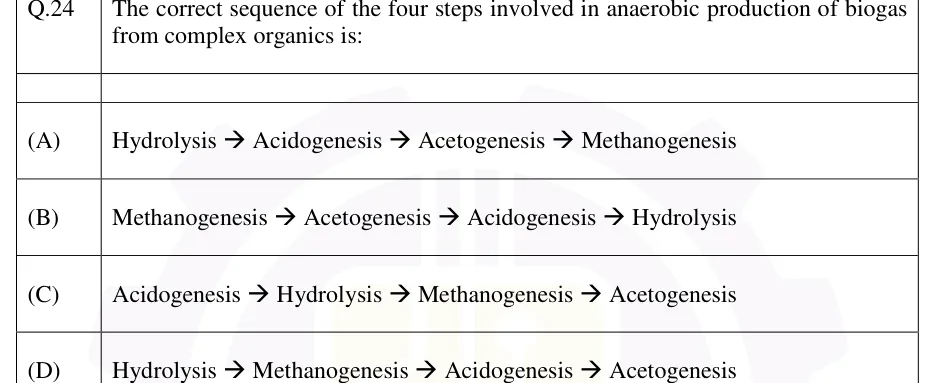
The correct sequence of the four steps involved in anaerobic production of biogas from complex organics is:

  1. (A)

    Hydrolysis → Acidogenesis → Acetogenesis → Methanogenesis

  2. (B)

    Methanogenesis → Acetogenesis → Acidogenesis → Hydrolysis

  3. (C)

    Acidogenesis → Hydrolysis → Methanogenesis → Acetogenesis

  4. (D)

    Hydrolysis → Methanogenesis → Acidogenesis → Acetogenesis
Answer and solution
See the question in the paper
GATE 2026 BT Q.24: answer and solution

GATE 2025 BT Q.19

GATE 2025 · BTQ.19 · 1 mark · MCQ

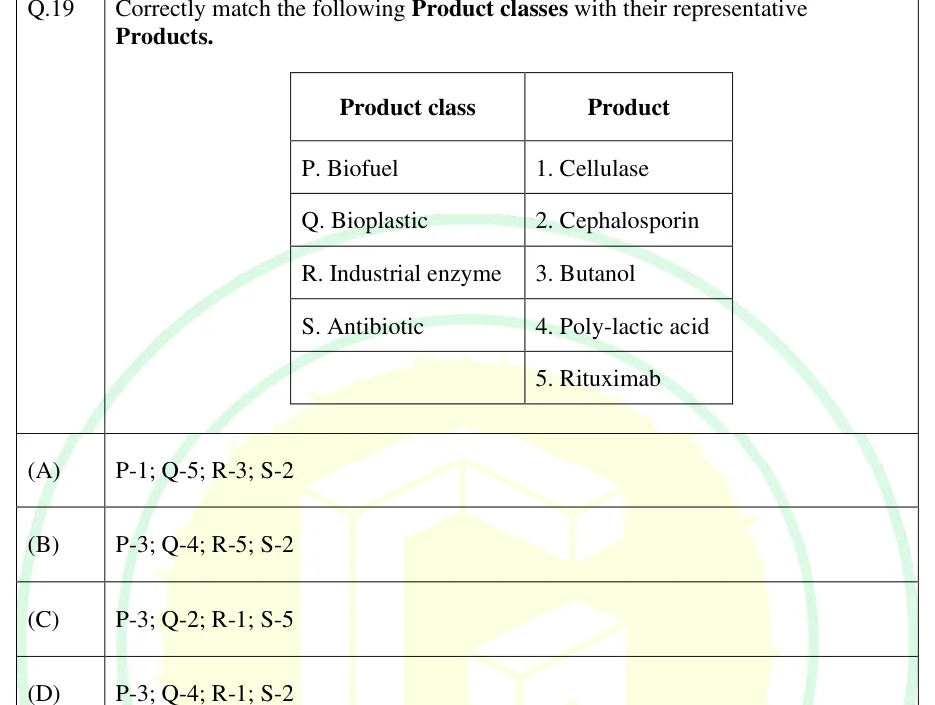
Correctly match the following Product classes with their representative Products.

Product class: P. Biofuel; Q. Bioplastic; R. Industrial enzyme; S. Antibiotic.
Product: 1. Cellulase; 2. Cephalosporin; 3. Butanol; 4. Poly-lactic acid; 5. Rituximab.

GATE 2025 BT question 19: A two-column table with header row 'Product class' and 'Product'.Tap to open full size
Figure from the GATE 2025 BT paper. It is part of the question.
Figure description

A two-column table with header row 'Product class' and 'Product'. Rows: P. Biofuel | 1. Cellulase; Q. Bioplastic | 2. Cephalosporin; R. Industrial enzyme | 3. Butanol; S. Antibiotic | 4. Poly-lactic acid; (blank) | 5. Rituximab.

  1. (A)

    P-1; Q-5; R-3; S-2

  2. (B)

    P-3; Q-4; R-5; S-2

  3. (C)

    P-3; Q-2; R-1; S-5

  4. (D)

    P-3; Q-4; R-1; S-2

Answer and solution
GATE 2025 BT Q.19: answer and solution

GATE 2024 BT Q.37

GATE 2024 · BTQ.37 · 2 marks · MCQ

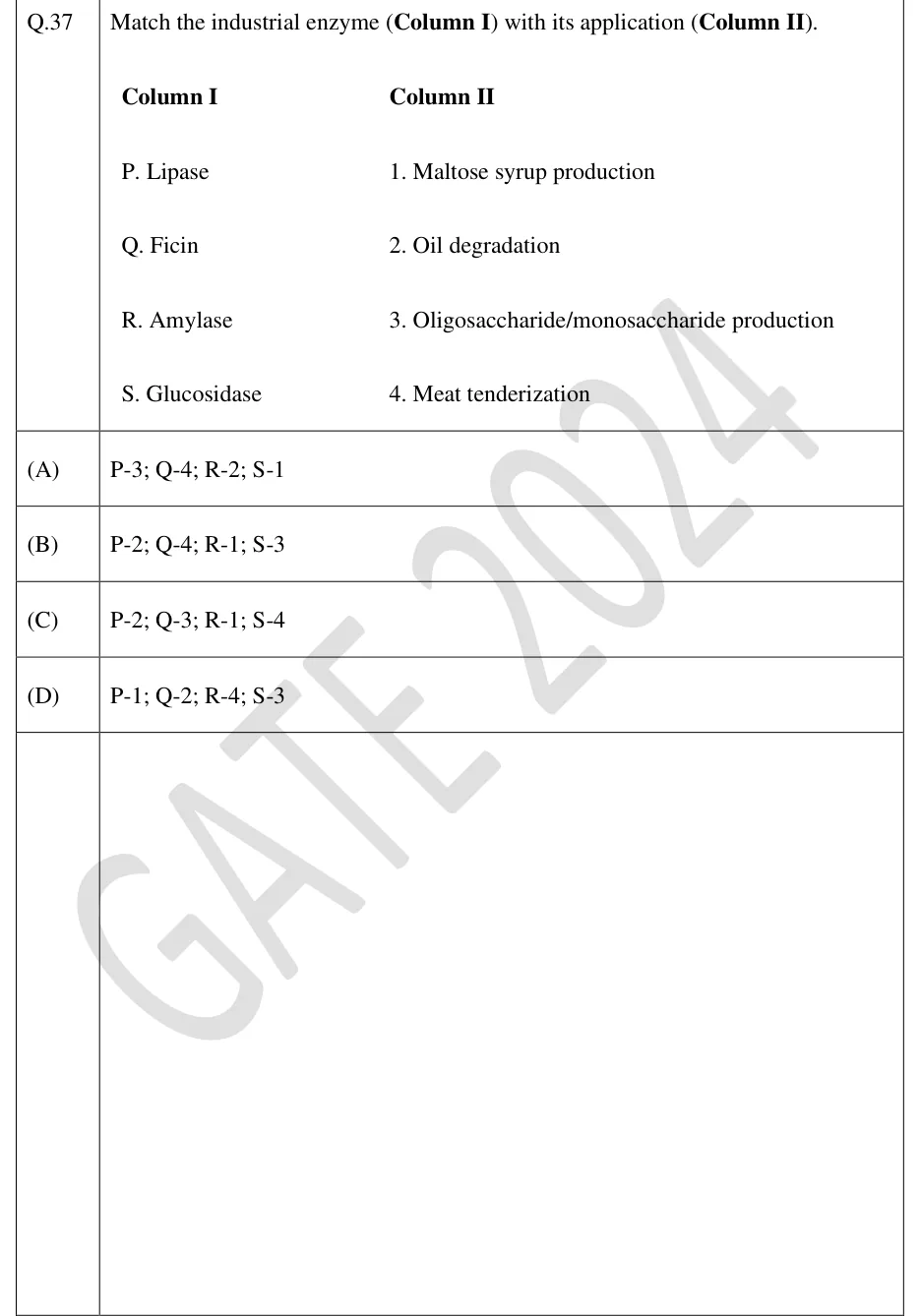
Match the industrial enzyme (Column I) with its application (Column II).

Column I: P. Lipase; Q. Ficin; R. Amylase; S. Glucosidase
Column II: 1. Maltose syrup production; 2. Oil degradation; 3. Oligosaccharide/monosaccharide production; 4. Meat tenderization

  1. (A)

    P-3; Q-4; R-2; S-1

  2. (B)

    P-2; Q-4; R-1; S-3

  3. (C)

    P-2; Q-3; R-1; S-4

  4. (D)

    P-1; Q-2; R-4; S-3

Answer and solution
See the question in the paper
GATE 2024 BT Q.37: answer and solution

PRACTICE

6 questions to test yourself

PRACTICE 11 mark · NAT

A yeast fermentation converts 200 g of glucose to ethanol at 90% of the theoretical yield. Take the theoretical yield as 0.511 g ethanol per g glucose. How many grams of ethanol are formed? Give the answer to one decimal place.

Answer and solution

Answer: (accepted range )

  1. Theoretical ethanol g.

  2. Actual ethanol g.

  3. Rounded to one decimal place, 92.0 g.

PRACTICE 21 mark · MCQ

Which statement about industrial penicillin production is correct?

  1. (A)

    Penicillin is a primary metabolite formed mainly during rapid growth.

  2. (B)

    Penicillin is a secondary metabolite formed mainly in the idiophase, and slow glucose feeding avoids repression of its synthesis.

  3. (C)

    High constant glucose concentration gives the highest penicillin yield.

  4. (D)

    Penicillin is made by continuous culture of Streptomyces griseus.

Answer and solution

Answer: (B)

  1. Penicillin is a secondary metabolite of Penicillium chrysogenum, formed after rapid growth slows (idiophase).

  2. Excess glucose causes catabolite repression, so glucose is fed slowly in fed-batch mode.

  3. A is wrong (it is secondary), C is wrong (glucose represses it) and D is wrong (S. griseus makes streptomycin, and production is fed-batch).

PRACTICE 32 marks · MSQ

Which of the following statements about inclusion bodies in recombinant E. coli are correct?

  1. (A)

    They are aggregates of misfolded recombinant protein.

  2. (B)

    They can be recovered by low-speed centrifugation after cell lysis.

  3. (C)

    The protein in them is usually obtained in active form without any refolding step.

  4. (D)

    Solubilisation with 8 M urea or 6 M guanidine hydrochloride is commonly used before refolding.

Answer and solution

Answer: (A), (B), (D)

  1. Inclusion bodies are dense aggregates of misfolded protein, so A is correct.

  2. Being dense, they sediment at low speed after lysis, so B is correct.

  3. The protein is misfolded and inactive, so refolding is needed; C is wrong.

  4. A strong denaturant dissolves them before the protein is refolded, so D is correct.

PRACTICE 42 marks · NAT

In a batch culture 30 g/L of glucose is the only limiting substrate and is completely consumed. The initial biomass is 1.0 g/L and the biomass yield coefficient is 0.45 g biomass per g glucose. What is the final biomass concentration in g/L?

Answer and solution

Answer: (accepted range )

  1. Biomass formed g/L.

  2. Final biomass g/L.

PRACTICE 51 mark · MCQ

A soil isolate is spread on an agar plate seeded with a test bacterium, and a clear zone with no growth appears around some colonies. This step in a screening programme for new antibiotics is best described as

  1. (A)

    secondary screening, because it quantifies antibiotic yield in a fermenter

  2. (B)

    primary screening, because it is a simple plate test that detects activity

  3. (C)

    strain improvement by mutation

  4. (D)

    downstream purification

Answer and solution

Answer: (B)

  1. The test is a simple, cheap plate assay that only shows whether a colony produces an inhibitory substance.

  2. That is primary screening; secondary screening would measure yield in flasks or small fermenters, so B is correct.

PRACTICE 62 marks · NAT

A chemostat is fed with sterile medium containing 20 g/L of the growth-limiting substrate at a dilution rate of 0.4 h. The organism follows Monod kinetics with h and g/L, and the biomass yield is 0.5 g biomass per g substrate. Ignoring death and maintenance, what is the steady-state biomass concentration in g/L?

Answer and solution

Answer: (accepted range )

  1. Check for washout: the largest dilution rate the feed can support is h, which is above 0.4 h, so a steady state exists.

  2. At steady state h, so g/L.

  3. g/L.

OFFICIAL GATE 2027 SYLLABUS WORDING

Copied from the GATE 2027 syllabus; see all 2027 syllabi.

GATE BT

Microbes: Production of biomass and primary/secondary metabolites - Biofuels, bioplastics, industrial enzymes, antibiotics; Large scale production and purification of recombinant proteins and metabolites; Clinical-, food- and industrial- microbiology; Screening strategies for new products

Preparing in Kolkata? IAE Academy's course for GATE BT.