IAE Academy

GATE BT

Animal cell culture

Media, preservation and growth

Animal cell culture grows cells taken from animal tissue outside the body, in nutrient media under controlled temperature, pH, osmolality and gas conditions. This topic covers what the media contain, how cultures are classified (primary or continuous; anchorage-dependent or suspension), how cells are frozen and revived, how growth is described by the specific growth rate and doubling time, how cells are counted, and how microcarriers and macroporous carriers scale up adherent cells.

5 previous-year questions · 5 solved · 5 practice questions

Culture media and their components

Animal cells need a medium that supplies salts, an energy source, amino acids, vitamins and growth-promoting factors, and that holds the pH and osmolality steady. Three levels of media are used: balanced salt solutions, basal media and complete media (basal medium plus serum or defined supplements).

Type

Examples

What it contains

Typical use

Balanced salt solution (BSS)

Earle's BSS, Hanks' BSS, phosphate-buffered saline (PBS)

Isotonic inorganic salts and a buffer, often glucose; no amino acids or vitamins

Washing and rinsing cells, short-term holding, tissue dissection, diluting cells and reagents

Basal medium

Eagle's minimum essential medium (MEM), Dulbecco's modified Eagle's medium (DMEM), RPMI-1640, Ham's F-12

Salts, glucose, amino acids (all have the essential ones; some, such as DMEM and RPMI-1640, also have some non-essential ones), vitamins, a bicarbonate buffer, usually glutamine (often added just before use) and often phenol red as a pH indicator

On its own usually does not support sustained growth of most cells; needs serum or defined supplements

Complete medium

Basal medium plus serum, usually fetal bovine serum (FBS) at 5-20% (v/v), commonly 10%; antibiotics are often added

Serum adds growth factors, hormones, attachment factors and transport proteins

Routine culture of most cell lines

Serum-free medium

Basal medium with defined supplements (insulin, transferrin, selenium, defined lipids and proteins)

No serum; when every component is known and no protein of animal origin is used, the medium is called chemically defined

Reproducible and regulated production, easier purification of secreted products

DMEM is a modification of Eagle's medium with higher concentrations of amino acids and vitamins (about four times those of Eagle's original basal medium), and is made in a low-glucose (1 g/L) and a high-glucose (4.5 g/L) form. RPMI-1640 was developed for leukocytes and is widely used for lymphocytes, hybridomas and other suspension cells. Ham's F-12 is a rich medium designed for growth at low cell density; mixed 1:1 with DMEM (DMEM/F-12) it is a common base for serum-free media. Phenol red is red near pH 7.4, turns yellow as the medium becomes acidic and purple-pink as it becomes alkaline.

L-glutamine is a major energy and nitrogen source for cultured cells. It breaks down slowly in solution to ammonia, so it is added fresh or replaced by a stable dipeptide (alanyl-glutamine).

Serum component

Role

Growth factors and hormones

Stimulate cell division and survival

Attachment factors (fibronectin and others)

Help adherent cells attach and spread on the surface

Transport proteins (albumin, transferrin)

Carry lipids, hormones, iron and trace elements

Protease inhibitors (for example alpha-1-antitrypsin, alpha-2-macroglobulin)

Protect cells and proteins, and neutralise residual trypsin after subculture

Lipids, minerals and trace elements

Supply nutrients the basal medium may lack

Buffering and detoxifying proteins

Bind toxic substances and help stabilise pH

EXAM TIP

Serum varies from batch to batch and can carry viruses, mycoplasma or prions, which is why serum-free media are preferred when the product is a therapeutic protein. A BSS is not a growth medium: it has no amino acids or vitamins.

Growth conditions and buffering

Mammalian cells are usually grown at 37 °C in a humidified incubator with 5% CO2 (10% for some high-bicarbonate media), at pH 7.2-7.4 and an osmolality of about 260-320 mOsm/kg. Humidity prevents evaporation, which would raise the osmolality of the medium. Insect cells are grown at about 25-28 °C (commonly 27 °C) in media that are usually phosphate-buffered, so they need no CO2 incubator.

BICARBONATE-CO2 BUFFER

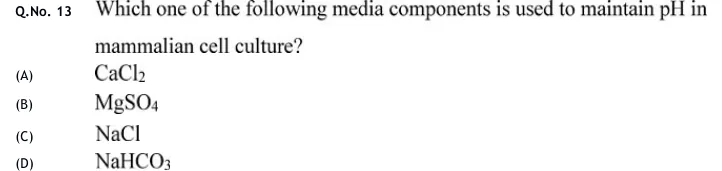
NaHCO3 in the medium is balanced against CO2 in the gas phase: at a fixed bicarbonate concentration, more CO2 lowers the pH and less CO2 raises it.

  1. Media with high bicarbonate (Earle's-based media, about 2.2 g/L NaHCO3; DMEM, 3.7 g/L) are used under 5-10% CO2 to hold pH near 7.4.

  2. Media with low bicarbonate (Hanks'-based media, about 0.35 g/L NaHCO3) are used in air, in sealed vessels.

  3. HEPES, an organic buffer (commonly about 10-25 mM), can be added to stabilise pH when cells are handled outside the incubator.

  4. Lactic acid made by the cells lowers the pH; ammonia, formed from glutamine metabolism and from glutamine breaking down in the medium, is toxic. Both slow growth, so the medium is replaced regularly.

  5. Penicillin and streptomycin are often added against bacteria, and amphotericin B against fungi. Mycoplasma has no cell wall, so penicillin does not act on it, and routine antibiotic use can hide low-level contamination.

EXAM TIP

In a CO2 incubator a flask needs a loosened cap or a vented (filter) cap so its gas phase equilibrates with the incubator. A tightly sealed flask suits media buffered for air (low bicarbonate, or HEPES). A medium that turns yellow has become acidic, usually from dense growth or bacterial contamination.

Primary cultures, cell lines and anchorage dependence

A primary culture is started directly from tissue, either by letting cells grow out of small tissue fragments (primary explant culture) or by disaggregating the tissue mechanically or with enzymes such as trypsin, collagenase or dispase. When a primary culture is subcultured (passaged) for the first time it becomes a cell line. A cell line that has been purified by selection or cloning and then characterised is called a cell strain.

Property

Finite cell line

Continuous cell line

Origin

Normal tissue

Tumour tissue, or cells that became immortal spontaneously, after transformation by a virus or chemical, or after introduction of genes such as telomerase

Life span

Limited: a set number of population doublings (roughly 40-60 for human diploid fibroblasts), then senescence

Unlimited (immortal)

Contact inhibition

Present

Often lost

Anchorage dependence

Present for most

Often lost, but some continuous lines (Vero, NIH-3T3) remain anchorage-dependent

Karyotype

Diploid (normal)

Often aneuploid

Saturation density

Lower

Often higher

Serum requirement

Higher

Often lower

Examples

Human diploid fibroblasts (for example WI-38, MRC-5)

HeLa, CHO, Vero, BHK-21, NIH-3T3

Property

Anchorage-dependent cells

Anchorage-independent (suspension) cells

Need for a surface

Must attach and spread on a solid surface to divide

Grow freely suspended in the medium

Growth form

Monolayer; normal cells stop dividing at confluence (contact inhibition, density limitation)

Cell density limited by nutrients and wastes, not by surface area

Subculture

Detached with trypsin-EDTA or a scraper, then reseeded

Simply diluted into fresh medium

Scale-up

Needs added surface (roller bottles, microcarriers, packed beds)

Stirred tanks and bioreactors directly

Examples

Fibroblasts, epithelial cells, Vero

Hybridomas, lymphocytes, CHO adapted to suspension, many transformed lines

EXAM TIP

Loss of anchorage dependence is a common marker of transformation: transformed cells often form colonies in soft agar, which normal anchorage-dependent cells do not. To detach adherent cells, trypsin cleaves cell-surface and attachment proteins and EDTA chelates the Ca2+ and Mg2+ that cell adhesion needs; serum (which contains trypsin inhibitors) or a trypsin inhibitor is then added to stop the trypsin.

Preservation of animal cells

Cells are stored for long periods in liquid nitrogen: -196 °C in the liquid phase, or about -150 °C or colder in the vapour phase above it. Below about -130 °C there is effectively no biochemical activity, so cells keep for many years; storage at -80 °C is suitable only for short periods. The dangers during freezing are ice crystals forming inside the cell, which damage membranes and organelles, and the rise in solute concentration as water freezes outside the cell (solution effects).

  1. Harvest cells in the log phase of growth, with viability above about 90%, and count them.

  2. Resuspend in freezing medium: complete medium (often with extra serum) containing a cryoprotectant, commonly 5-10% (v/v) DMSO or about 10% glycerol.

  3. Dispense into cryovials, usually about to cells per mL.

  4. Cool slowly and under control, at about 1 °C per minute, to about -80 °C (in a controlled-rate freezer or an insulated container).

  5. Transfer to liquid nitrogen storage.

  6. To revive, thaw rapidly in a 37 °C water bath, then dilute the cryoprotectant promptly into fresh medium or remove it by centrifugation, because DMSO is toxic to cells on prolonged exposure at room temperature or 37 °C.

DMSO and glycerol are permeating cryoprotectants: they enter the cell, lower the freezing point and reduce intracellular ice formation and the build-up of salts. Non-permeating agents (sucrose, trehalose, polyvinylpyrrolidone, hydroxyethyl starch) act outside the cell and draw water out osmotically. During slow cooling, water leaves the cell gradually instead of freezing inside it.

Vitrification is the alternative used for embryos, oocytes and some tissues: a high concentration of cryoprotectant and very rapid cooling turn the sample into a glass-like solid with no ice crystals. Cell lines are kept as a frozen master cell bank, from which working cell banks are made, so that cultures always restart at a low passage number.

EXAM TIP

For conventional freezing the rule is slow freezing and rapid thawing. With the usual low cryoprotectant concentrations, fast cooling traps water inside the cell as ice; slow thawing lets small ice crystals grow (recrystallisation) and damage the cells.

Kinetics of cell growth, counting and viability

A batch culture passes through four phases: lag (adaptation, little or no increase), log or exponential (constant doubling time, highest viability; the best time for experiments, freezing or infection), stationary or plateau (growth slows and stops because of nutrient depletion, waste build-up or, for adherent normal cells, density limitation; the viable count stays roughly constant), and decline (death exceeds division). Animal cells divide much more slowly than bacteria; doubling times of cultured mammalian cells are commonly about 12-48 hours.

EXPONENTIAL GROWTH

X is the viable cell concentration (cells/mL), X_0 its value at the start of the exponential phase, and μ the specific growth rate (per hour); valid only in the exponential phase.

SPECIFIC GROWTH RATE IN LOG PHASE

X in cells/mL and t in hours, so μ is in per hour; both points must lie in the exponential phase.

DOUBLING TIME

Convention used here: t_d = ln 2/μ, in the same time unit as μ; exponential phase only.

NUMBER OF DOUBLINGS

For exponential growth from X_0 with no lag, n doublings take n × t_d. For a cell line, the population doubling level adds n at each subculture (cells harvested over cells seeded); the passage number counts subcultures only.

MONOD MODEL (SUBSTRATE-LIMITED GROWTH)

S is the limiting substrate concentration (for animal cells often glucose or glutamine), μ_max the maximum specific growth rate and K_s the substrate concentration at which μ = μ_max/2. When S is much larger than K_s, μ ≈ μ_max.

HAEMOCYTOMETER COUNT

In the standard chamber one large square is 1 mm × 1 mm with depth 0.1 mm, so its volume is 0.1 mm³ = 10^-4 mL. Cells on two agreed sides of a square are counted, those on the other two are not. The dilution factor includes the stain: a 1:1 mix with trypan blue gives 2.

VIABILITY BY TRYPAN BLUE EXCLUSION

Live cells with intact membranes exclude the dye; dead cells with damaged membranes take it up and look blue.

WORKED EXAMPLE

A cell suspension is mixed 1:1 with trypan blue. Four large squares of a haemocytometer show 200 unstained and 20 blue cells in total. Find the live cell concentration and the viability.

Solution
  1. Mean live count per large square = .

  2. Dilution factor = 2 (equal volumes of suspension and stain).

  3. Live cells/mL = .

  4. Viability = .

Answer: live cells/mL; viability about 90.9%.

WORKED EXAMPLE

In log phase a culture rises from to cells/mL in 72 h. Find the number of doublings, the doubling time and the specific growth rate.

Solution
  1. Ratio .

  2. doublings.

  3. h.

  4. per hour (check: ).

Answer: 3 doublings; = 24 h; per hour.

Microcarrier and macrocarrier culture

Anchorage-dependent cells need surface, and flasks give little surface per volume. Microcarriers are small beads, typically about 100-300 micrometres in diameter, kept in suspension by gentle stirring in a stirred-tank bioreactor. Cells attach and grow as a monolayer on the bead surface. This gives a very large surface area per unit volume, so large cell numbers can be grown in one vessel, with pH, oxygen and nutrients monitored and controlled as in suspension culture. Other ways to give adherent cells more surface are roller bottles, multilayer flasks, hollow-fibre reactors and packed beds.

Feature

Microcarriers

Macrocarriers (macroporous carriers)

Structure

Small beads, solid or with pores too small for cells to enter; dextran, polystyrene, glass or cellulose, often charged or coated with collagen or gelatin

Carriers with pores large enough for cells to enter: macroporous beads (for example gelatin or cellulose) or larger porous glass beads, sponges and fibre disks

Where cells grow

On the outer surface of the bead

Inside the pores as well as on the surface

Shear protection

Cells on the surface are exposed to stirring shear and bead collisions

Cells inside the pores are shielded from shear

Cell density per carrier volume

Limited by the outer surface

Higher, since the internal volume is used

Typical culture

Stirred tank

Stirred tank, packed bed or fluidised bed

Harvest

Cells detached with trypsin, then separated from the beads by settling or sieving

Cells are hard to recover from the pores (gelatin carriers can be digested); well suited when the product is secreted into the medium and the cells stay on the carrier

  1. Seed cells at adequate density, often with intermittent stirring at first so that cells attach to the beads.

  2. Increase stirring gradually once cells are attached.

  3. Cells attach and spread well only if the bead's surface charge and coating suit the cell type.

  4. Beads are slightly denser than the medium, so they stay suspended with gentle stirring and settle when stirring stops, which makes medium exchange easy.

  5. Excessive stirring causes shear damage and bead-to-bead collisions that harm cells; beads should not clump.

EXAM TIP

Microcarriers and macrocarriers are for anchorage-dependent cells (for example Vero cells for viral vaccines). A suspension line such as a hybridoma does not need them.

PREVIOUS-YEAR QUESTIONS

5 questions from the BT papers

Try each question first, then open the answer. We placed each question under a topic ourselves; the exam paper does not label topics.

See these papers in full: GATE BT 2024 · GATE BT 2022 · GATE BT 2020 · GATE BT 2019

GATE 2024 BT Q.39

GATE 2024 · BTQ.39 · 2 marks · MCQ

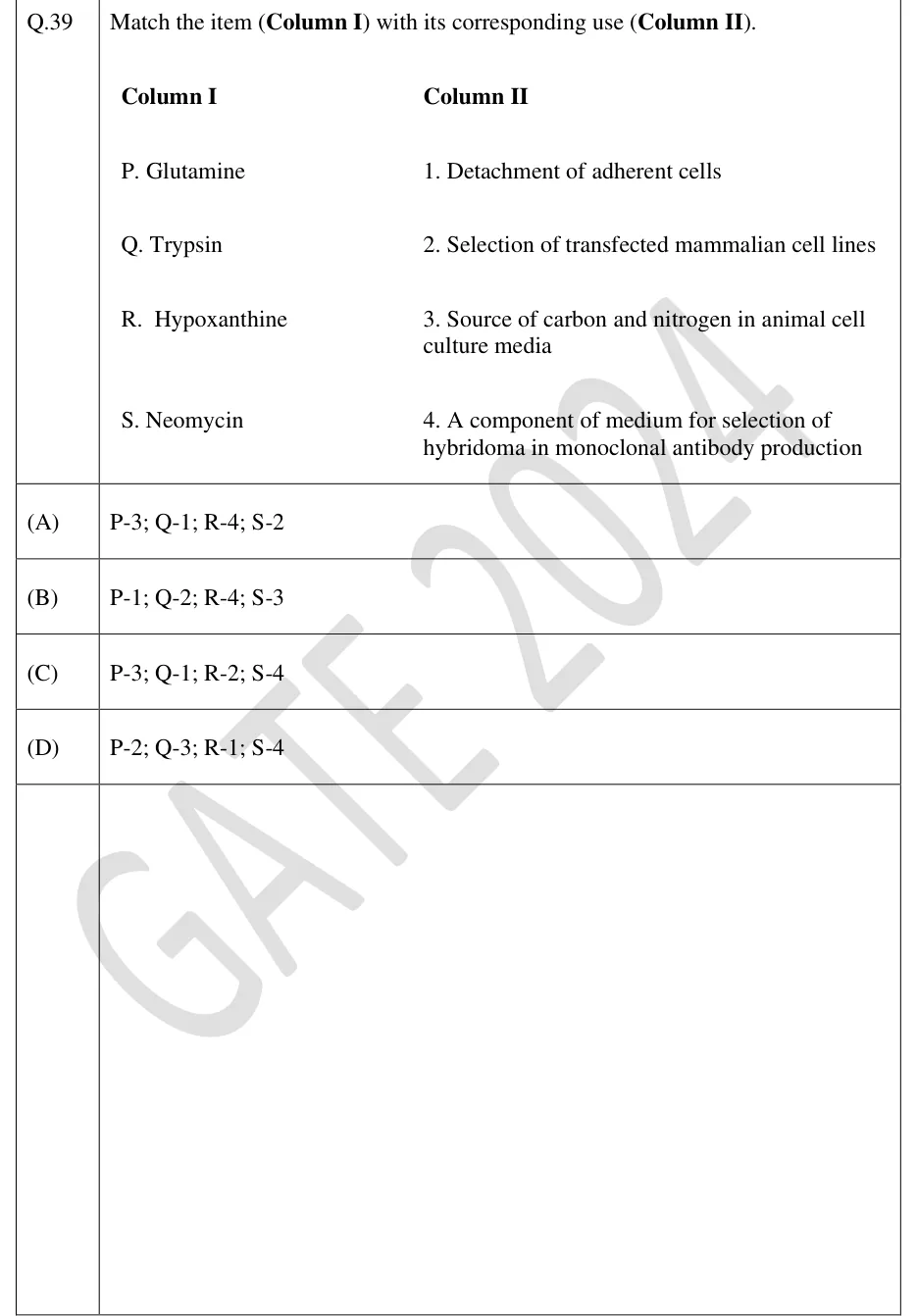
Match the item (Column I) with its corresponding use (Column II).

Column I: P. Glutamine; Q. Trypsin; R. Hypoxanthine; S. Neomycin.
Column II: 1. Detachment of adherent cells; 2. Selection of transfected mammalian cell lines; 3. Source of carbon and nitrogen in animal cell culture media; 4. A component of medium for selection of hybridoma in monoclonal antibody production.

  1. (A)

    P-3; Q-1; R-4; S-2

  2. (B)

    P-1; Q-2; R-4; S-3

  3. (C)

    P-3; Q-1; R-2; S-4

  4. (D)

    P-2; Q-3; R-1; S-4

Answer and solution
See the question in the paper
GATE 2024 BT Q.39: answer and solution

GATE 2022 BT Q.37

GATE 2022 · BTQ.37 · 2 marks · MCQ

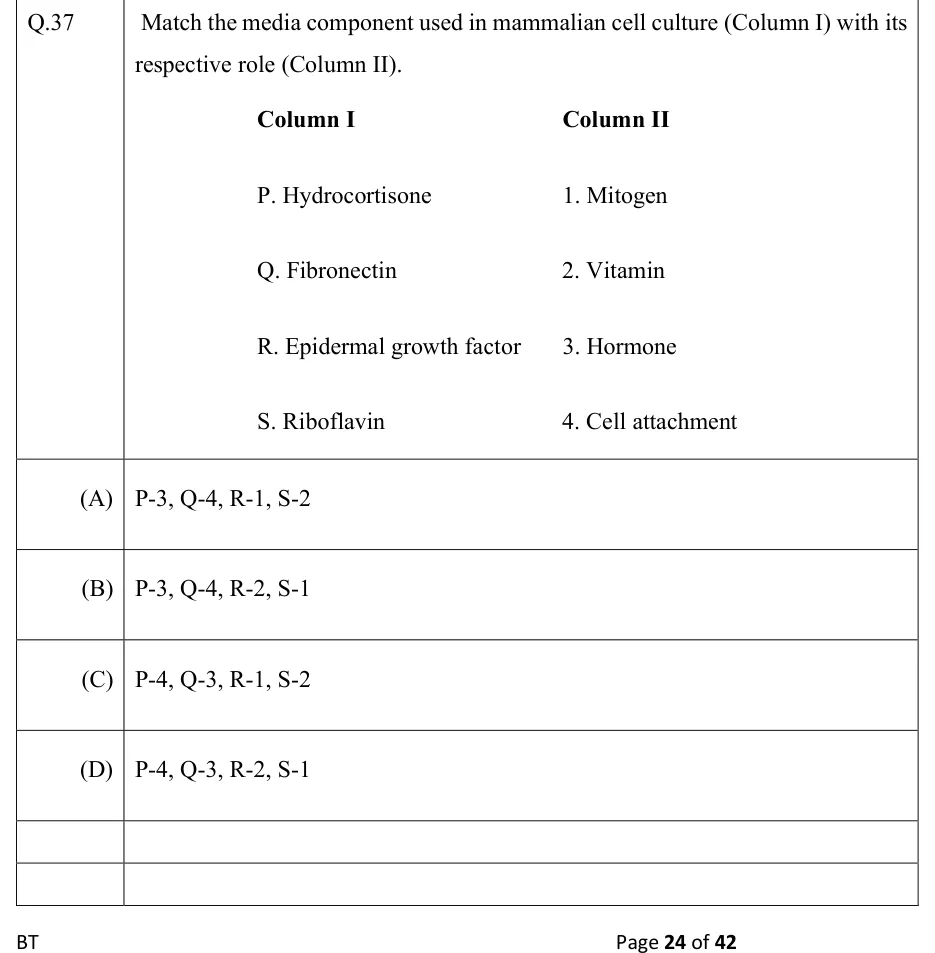
Match the media component used in mammalian cell culture (Column I) with its respective role (Column II).

Column I: P. Hydrocortisone; Q. Fibronectin; R. Epidermal growth factor; S. Riboflavin
Column II: 1. Mitogen; 2. Vitamin; 3. Hormone; 4. Cell attachment

  1. (A)

    P-3, Q-4, R-1, S-2

  2. (B)

    P-3, Q-4, R-2, S-1

  3. (C)

    P-4, Q-3, R-1, S-2

  4. (D)

    P-4, Q-3, R-2, S-1

Answer and solution
See the question in the paper
GATE 2022 BT Q.37: answer and solution

GATE 2019 BT Q.35

GATE 2019 · BTQ.35 · 2 marks · MCQ

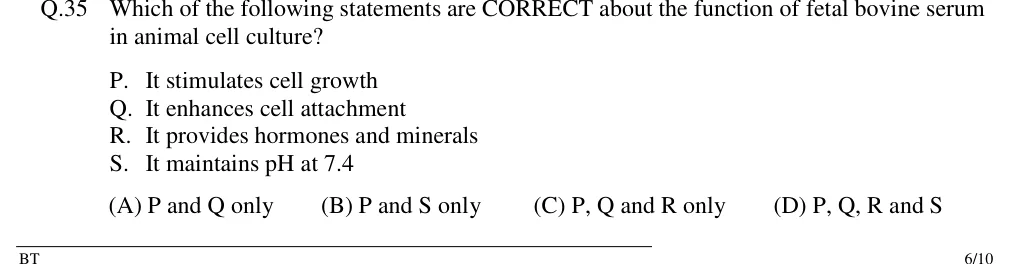
Which of the following statements are CORRECT about the function of fetal bovine serum in animal cell culture?
P. It stimulates cell growth
Q. It enhances cell attachment
R. It provides hormones and minerals
S. It maintains pH at 7.4

  1. (A)

    P and Q only

  2. (B)

    P and S only

  3. (C)

    P, Q and R only

  4. (D)

    P, Q, R and S

Answer and solution
See the question in the paper
GATE 2019 BT Q.35: answer and solution

PRACTICE

5 questions to test yourself

PRACTICE 11 mark · MCQ

A culture medium containing phenol red turns yellow after several days in a dense culture. The most likely explanation is:

  1. (A)

    The medium has become acidic, for example from lactic acid accumulation and dissolved CO2

  2. (B)

    The medium has become strongly alkaline

  3. (C)

    The osmolality has risen above 400 mOsm/kg

  4. (D)

    The pH is unchanged at 7.4

Answer and solution

Answer: (A)

  1. Phenol red is red near pH 7.4, yellow when acidic and purple-pink when alkaline.

  2. Dense cells produce lactic acid, which lowers the pH.

  3. So yellow indicates acidification (option A).

PRACTICE 22 marks · MSQ

Which of the following statements about conventional cryopreservation of animal cells are correct?

  1. (A)

    Cells in the log phase with high viability are preferred

  2. (B)

    Cooling is slow and controlled, at about 1 °C per minute

  3. (C)

    Thawing is done slowly at 4 °C to avoid damage

  4. (D)

    DMSO is commonly used at about 5-10% (v/v) as a cryoprotectant

Answer and solution

Answer: (A), (B), (D)

  1. Healthy log-phase cells with high viability freeze and recover best (A true).

  2. Slow controlled cooling lets water leave the cell and avoids intracellular ice (B true).

  3. Thawing should be rapid in a 37 °C bath; slow thawing allows ice recrystallisation (C false).

  4. DMSO at about 5-10% (v/v) is standard (D true).

PRACTICE 31 mark · NAT

A cell suspension is diluted 10-fold with medium (dilution factor 10) and counted, without stain, in a haemocytometer. The mean count per large square (1 mm × 1 mm, depth 0.1 mm) is 36. Calculate the concentration of the original suspension in units of cells/mL.

Answer and solution

Answer: (accepted range )

  1. Volume of one large square = 1 mm × 1 mm × 0.1 mm = 0.1 mm³ = mL, so cells/mL = mean count × dilution factor × .

  2. cells/mL.

  3. In units of cells/mL the answer is 3.6.

PRACTICE 42 marks · NAT

A cell line grows exponentially with a doubling time of 20 h and no lag phase. How many hours are needed for the concentration to rise from to cells/mL?

Answer and solution

Answer: (accepted range )

  1. Ratio .

  2. Number of doublings .

  3. Time h.

PRACTICE 51 mark · MCQ

Which of the following cell types would need microcarriers to be grown in a stirred-tank bioreactor?

  1. (A)

    A hybridoma line growing in suspension

  2. (B)

    Vero cells, which are anchorage-dependent

  3. (C)

    CHO cells already adapted to suspension

  4. (D)

    Lymphocytes grown in suspension

Answer and solution

Answer: (B)

  1. Microcarriers supply surface for anchorage-dependent cells.

  2. Hybridomas, suspension-adapted CHO cells and lymphocytes grow freely in suspension.

  3. Vero cells are anchorage-dependent, so option B.

OFFICIAL GATE 2027 SYLLABUS WORDING

Copied from the GATE 2027 syllabus; see all 2027 syllabi.

GATE BT

Animals: Culture media composition and growth conditions; Animal cell and tissue preservation; Anchorage and non-anchorage dependent cell culture; Kinetics of cell growth; Micro & macro- carrier culture

Preparing in Kolkata? IAE Academy's course for GATE BT.