IAE Academy

GATE BT

Hybridomas, stem cells, cloning and transgenic animals

This topic covers how animal cells are made immortal, pluripotent, cloned or genetically edited: hybridoma technology for monoclonal antibodies, stem cells and their potency, somatic cell nuclear transfer, and transgenic, knock-out and knock-in animals. The key ideas are the selection logic (HAT medium; neo and HSV-tk markers), the order of steps in each method, the differences between potency levels, and Mendelian ratios in breeding schemes.

3 previous-year questions · 3 solved · 7 practice questions

Hybridoma technology and monoclonal antibodies

A monoclonal antibody (mAb) is made by the descendants of a single B cell (one clone), so every molecule has the same sequence and recognises the same epitope. A polyclonal antiserum comes from many B-cell clones and recognises many epitopes. A normal B cell makes one antibody but stops dividing and dies after a short time in culture. A myeloma cell (a cancerous plasma cell) divides indefinitely; the lines used for fusion are chosen to secrete no antibody of their own. A hybridoma is a fusion of the two: it secretes the B cell's antibody and grows indefinitely.

Steps in making a hybridoma line

  1. Immunise a mouse (or rat) with the antigen, usually with an adjuvant and booster doses, so that antigen-specific B cells expand.

  2. Remove the spleen and prepare a single-cell suspension of splenocytes, which include the antibody-producing B cells.

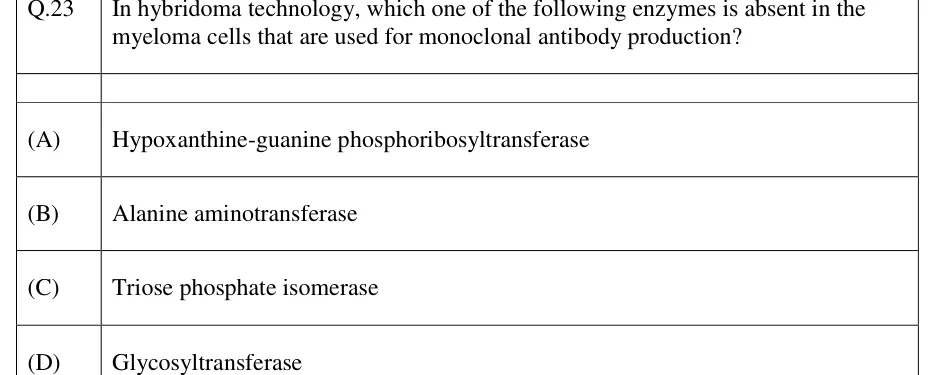
  3. Fuse the splenocytes with myeloma cells using polyethylene glycol (PEG), inactivated Sendai virus or electrofusion. The myeloma line is HGPRT-deficient and secretes no antibody of its own.

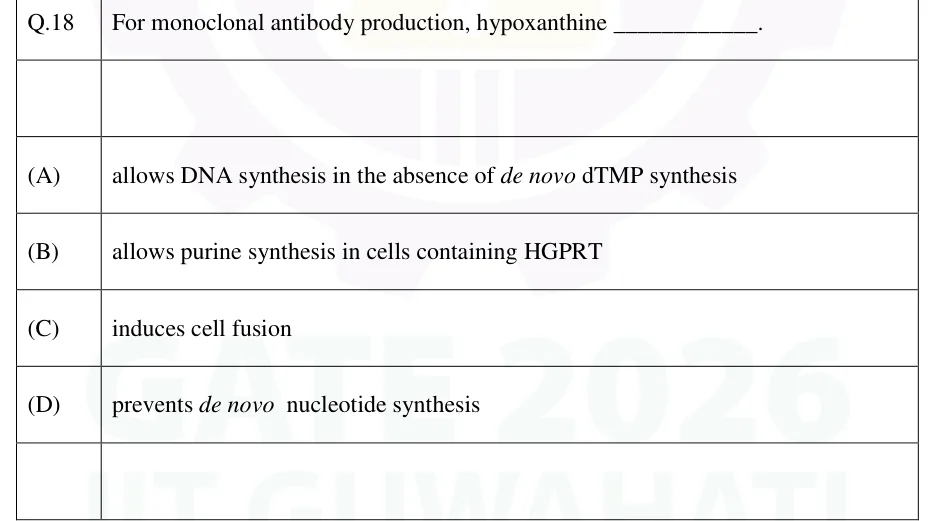
  4. Culture the fusion mixture in HAT medium. Unfused myeloma cells die because they lack HGPRT; unfused B cells die off on their own within days because they cannot keep dividing in culture. Only hybrids grow.

  5. Screen the culture supernatant of each well for the wanted antibody, usually by ELISA.

  6. Subclone positive wells by limiting dilution, seeding an average of one cell or fewer per well (often repeated), so that each line comes from a single cell.

  7. Expand the chosen clone in culture (flasks or bioreactors) or, traditionally, in the peritoneal cavity of a mouse to collect antibody-rich ascites fluid. Freeze stocks in liquid nitrogen.

HAT medium contains Hypoxanthine, Aminopterin and Thymidine (a common 1x working concentration is 100 µM hypoxanthine, 0.4 µM aminopterin and 16 µM thymidine). Aminopterin, a folate analogue, inhibits dihydrofolate reductase (DHFR). Without regenerated tetrahydrofolate, the de novo synthesis of purine nucleotides and of thymidylate (dTMP) stops. A cell can then make DNA only through the salvage pathways: hypoxanthine is converted to IMP by HGPRT (hypoxanthine-guanine phosphoribosyltransferase), and thymidine is phosphorylated to dTMP by thymidine kinase (TK). A cell needs both enzymes to survive in HAT medium.

Cell type in HAT medium

De novo pathway

Salvage pathway (HGPRT and TK)

Immortal?

Outcome

Unfused myeloma (HGPRT-deficient)

Blocked by aminopterin

HGPRT absent

Yes

Dies

Unfused B cell

Blocked by aminopterin

HGPRT and TK present

No (short life span in culture)

Dies after a few days

Hybridoma

Blocked by aminopterin

HGPRT from the B-cell genome; TK from both parents

Yes (myeloma parent)

Survives and grows

EXAM TIP

The myeloma parent must lack a salvage enzyme. HGPRT-deficient lines are selected by growing myeloma cells in 8-azaguanine (or 6-thioguanine): HGPRT converts these purine analogues into toxic nucleotides, so only HGPRT-negative cells survive. TK-deficient lines are selected in the same way with 5-bromodeoxyuridine. A myeloma line that still had both enzymes would grow in HAT medium and overgrow the hybrids.

Mouse mAbs given to patients provoke a human anti-mouse antibody (HAMA) response, which clears them and can cause reactions. They are therefore engineered into chimeric antibodies (mouse variable regions joined to human constant regions) or humanised antibodies (only the complementarity-determining regions, the antigen-binding loops, come from the mouse). Fully human mAbs are obtained from mice whose immunoglobulin genes have been replaced by human ones, or by phage display. Uses of mAbs include diagnostics (pregnancy test strips that detect hCG, ELISA, blood typing), affinity purification, flow cytometry, imaging and therapy.

Stem cells and potency

A stem cell can divide to renew itself and can also give rise to specialised cells. It may divide asymmetrically (one daughter stays a stem cell, the other differentiates) or symmetrically (two stem cells, or two differentiating cells). Potency describes how many cell types it can produce.

Potency

Can form

Example

Totipotent

All embryonic cell types and the extra-embryonic tissues (including the trophoblast-derived placenta), so a complete organism

Zygote and the blastomeres of the first cleavage divisions

Pluripotent

All three germ layers (ectoderm, mesoderm, endoderm) and germ cells, but not the trophoblast (placenta)

Embryonic stem (ES) cells, induced pluripotent stem cells (iPSCs), embryonic germ cells

Multipotent

Several cell types of one tissue or lineage

Haematopoietic stem cell (all blood cells), mesenchymal stem cell

Oligopotent

A few closely related cell types

Common myeloid progenitor, common lymphoid progenitor

Unipotent

Only one cell type, though it can self-renew

Spermatogonial stem cell (sperm only), epidermal basal stem cell (keratinocytes)

Property

Embryonic stem cells

Adult (tissue) stem cells

Induced pluripotent stem cells

Source

Inner cell mass of the blastocyst

Bone marrow, gut crypt, skin, brain and other tissues

Reprogrammed somatic cells such as fibroblasts

Potency

Pluripotent

Multipotent or unipotent

Pluripotent

Self-renewal in culture

Very high

Limited

High

Main concerns

Ethical objection (an embryo is destroyed); teratoma risk; immune rejection of donor-derived cells

Hard to isolate and expand

Tumour risk (c-Myc is an oncogene; integrating viral vectors); teratoma risk from residual undifferentiated cells; low reprogramming efficiency

Immune match to patient

Not matched, unless derived from an SCNT embryo made with the patient's own nucleus

Matched if taken from the patient

Matched if made from the patient's own cells

Reprogramming to iPSCs: introducing four transcription factors, Oct4, Sox2, Klf4 and c-Myc, into a differentiated cell resets it to a pluripotent state. This shows that differentiation is reversible and removes the need for an embryo. c-Myc can be left out at lower efficiency, and non-integrating delivery (episomal plasmids, Sendai virus, mRNA) reduces the tumour risk.

Mouse ES cells are kept undifferentiated on a feeder layer of mitotically inactivated mouse embryonic fibroblasts, or in medium containing LIF (leukaemia inhibitory factor), which signals through STAT3. Withdrawing LIF and feeders lets them differentiate, for example into embryoid bodies. Human ES cells do not depend on LIF; they are maintained with basic fibroblast growth factor (FGF2).

Injected into an immunodeficient mouse, undifferentiated pluripotent cells form a teratoma, a benign tumour containing tissues of all three germ layers. This is a standard test of pluripotency. For mouse cells the stricter test is contribution to every tissue of a chimera, including the germ line, after injection into a blastocyst.

Applications: cell replacement therapy (haematopoietic stem cell, or bone marrow, transplantation is in established clinical use; skin grafts are another example), disease modelling with patient-derived iPSCs, drug and toxicity screening, and the study of development.

Animal cloning by nuclear transfer

Cloning here means producing an animal whose nuclear genome is a copy of that of a donor. The method is somatic cell nuclear transfer (SCNT). The first mammal cloned from an adult somatic cell was the sheep Dolly, born in 1996.

Steps of SCNT

  1. Collect unfertilised eggs (oocytes arrested at metaphase II) from a donor female and remove their chromosomes (enucleation), usually by micropipette suction.

  2. Take a somatic cell from the animal to be cloned (in Dolly's case a mammary gland cell) and make it quiescent by serum starvation, so that it is in G0.

  3. Fuse the donor cell with the enucleated egg by a short electric pulse, or inject the donor nucleus into the egg.

  4. Activate the reconstructed egg (electric or chemical stimulus; the fusion pulse can contribute) so that it starts to divide, and culture it to an early embryo or blastocyst.

  5. Transfer the embryo into the uterus of a surrogate mother, which carries it to term.

The clone has the nuclear DNA of the nucleus donor. Its mitochondrial DNA comes almost entirely from the egg donor (a little donor-cell mitochondrial DNA can persist when the whole donor cell is fused), so the clone is not completely identical to the nucleus donor. The surrogate mother contributes no DNA, only the uterine environment. Cloning efficiency is low (Dolly was the only lamb obtained from 277 fused eggs), and many clones show abnormalities, partly because the donor nucleus must be epigenetically reprogrammed.

Type

Purpose of the embryo

Outcome

Reproductive cloning

Embryo is transferred to a surrogate

A live animal that is a nuclear copy of the donor

Therapeutic cloning

Embryo is grown only to the blastocyst

ES cells genetically matched to the donor, for therapy or research

EXAM TIP

Do not confuse SCNT with embryo splitting. Splitting an early embryo gives identical twins from one fertilisation, whose genome is a new combination from both parents. SCNT copies an existing individual's nuclear genome into a new egg.

Transgenic animals

A transgenic animal carries a foreign gene (transgene) stably integrated in its genome and passed to its offspring through the germ line. A transgene construct usually has a promoter chosen to control where and when the gene is expressed, the coding sequence (cDNA or genomic gene, often with an intron to improve expression) and a polyadenylation signal.

Method

How the gene is delivered

Key features and limitations

Pronuclear microinjection

DNA is injected into the male pronucleus (the larger one) of a fertilised egg; injected eggs are transferred to a foster mother

Widely used for mice. Integration is usually at a single random site, often as several tandem copies. Expression varies with the site (position effect). Founders are mosaic if integration happens after the first DNA replication. Low efficiency.

Retroviral vector

Early embryos are infected with a recombinant retrovirus

Efficient single-copy integration, but the insert size is limited and the animal is mosaic (not all cells carry the gene), so the germ line may not be transgenic.

ES-cell method

DNA is introduced into cultured ES cells, cells with the transgene are selected, then injected into a blastocyst

Allows selection and screening before an animal is made. Gives chimeras that must be bred for germline transmission. Allows targeted insertion.

SCNT with modified cells

Donor somatic cells are genetically modified and selected in culture, then used for nuclear transfer

Used in livestock, where germline-competent ES cells have not been available. Every cell of the clone carries the change, so the founder is not mosaic.

Animals of the first generation (founders) are often mosaic or hemizygous (one copy of the insertion). Breeding founders and testing the offspring identifies lines with germline transmission, and crossing hemizygous parents can produce homozygous lines (1/4 of the offspring). A homozygous line can show an unexpected phenotype if the insertion has disrupted an endogenous gene (insertional mutagenesis).

Uses: studying gene function and disease models (for example the oncomouse, carrying an activated oncogene); production of human proteins in milk, where the promoter of a milk protein gene such as beta-lactoglobulin, casein or whey acidic protein directs expression in the mammary gland (a recombinant human antithrombin made in goat milk has been approved as a drug); improved livestock traits; testing vaccines and drugs; and xenotransplantation research.

Knock-out and knock-in animals

A knock-out animal has a chosen gene inactivated, so its function can be learned from the phenotype. A knock-in animal has a sequence inserted or replaced at a defined locus, for example a mutant version of a gene or a reporter gene, so that it is expressed under the gene's own regulation. Both rely on homologous recombination or on genome editing.

Gene targeting by homologous recombination in mouse ES cells (positive-negative selection)

  1. Build a replacement targeting vector: a selectable marker, usually neo (encoding aminoglycoside phosphotransferase), sits inside an exon of the gene to be disrupted, flanked on both sides by long stretches of DNA homologous to the target gene (the homology arms). A second marker, HSV-tk (herpes simplex virus thymidine kinase), is placed outside the homology arms.

  2. Linearise the vector and introduce it into ES cells by electroporation.

  3. Select with G418, an aminoglycoside antibiotic that the neo product inactivates: only cells that integrated the vector survive.

  4. Select with ganciclovir: HSV-tk phosphorylates it to a toxic nucleotide analogue, so cells expressing HSV-tk die. After correct homologous recombination only the DNA between the homology arms is exchanged, tk is lost, and the cell survives. After random integration the whole vector usually enters, tk is kept, and the cell is killed.

  5. Confirm correct targeting in surviving colonies by PCR or Southern blot.

  6. Inject targeted ES cells into a blastocyst and transfer it to a foster mother to get chimeric offspring.

  7. Mate chimeras and screen the offspring for germline transmission, giving heterozygous (+/-) animals; intercross these to get homozygous knock-outs (-/-).

ES cells and host blastocysts are taken from strains with different coat colours (for example agouti ES cells in a black host blastocyst). A chimera shows patches of both colours. When a chimera is mated to a black mouse, agouti pups show that ES-derived cells entered the germ line. Because the targeted ES cells are heterozygous, only about half of these agouti pups carry the targeted allele, so they are genotyped.

OFFSPRING OF A HETEROZYGOUS INTERCROSS (A = NULL ALLELE)

For one autosomal locus with Mendelian segregation and equal viability of all genotypes. The fraction of homozygous null (knock-out) pups is 1/4. To be homozygous null at two unlinked loci the chance is 1/4 x 1/4 = 1/16. If the null homozygote dies as an embryo, live pups are +/+ : +/- = 1 : 2, so 2/3 of them are heterozygous.

Conditional knock-outs use the Cre-loxP system. Cre is a site-specific recombinase from bacteriophage P1, and loxP is its 34 bp recognition site. Cre deletes the DNA between two loxP sites in the same orientation (sites in opposite orientations give an inversion instead). A mouse homozygous for a floxed allele (an essential exon flanked by loxP sites) is crossed with one expressing Cre from a tissue-specific promoter, so the gene is deleted only in that tissue. Cre fused to a modified oestrogen receptor ligand-binding domain is activated by tamoxifen, which also controls the timing. This is used when a complete knock-out is lethal to the embryo. The yeast FLP-FRT system works in the same way.

CRISPR-Cas9 speeds this up. A guide RNA directs Cas9 to a matching 20-nucleotide DNA sequence that lies immediately 5' of a PAM (5'-NGG-3' for the commonly used Streptococcus pyogenes Cas9), and Cas9 makes a blunt double-strand break about 3 bp upstream of the PAM. Repair by non-homologous end joining (NHEJ) often leaves small insertions or deletions that shift the reading frame, giving a knock-out. If a repair template with homology arms is supplied, homology-directed repair (HDR) copies the new sequence in, giving a knock-in; HDR is less efficient than NHEJ and works mainly in the S and G2 phases. CRISPR components can be injected directly into zygotes, bypassing ES cells and chimeras, though founders are often mosaic and must be bred.

Feature

Transgenic

Knock-out

Knock-in

Integration site

Random

Targeted

Targeted

Effect on the host gene

Usually none (an extra gene), unless the insertion disrupts one

Gene is disrupted or deleted

Gene is replaced or modified, or a tag or reporter is added

Main tool

Pronuclear injection

Homologous recombination in ES cells, or CRISPR with NHEJ

Homologous recombination, or CRISPR with HDR

EXAM TIP

Positive selection (G418) keeps cells that carry the vector anywhere. Negative selection (ganciclovir) removes cells where the vector inserted randomly, which works only because HSV-tk lies outside the homology arms. Both are needed to enrich correctly targeted ES cell colonies. Ganciclovir kills only cells expressing HSV-tk, not normal mouse cells.

EXAM TIP

A knock-down (for example by RNA interference) lowers the amount of a gene's mRNA without changing the gene. A knock-out changes the gene itself, so the change is inherited.

Worked examples

WORKED EXAMPLE

A myeloma line lacking HGPRT is fused with splenocytes from an immunised mouse. The mixture is grown in HAT medium. Explain which of the following cell types survives: (i) unfused myeloma, (ii) unfused spleen cell, (iii) myeloma-spleen hybrid.

Solution
  1. Aminopterin blocks the de novo synthesis of purines and thymidylate, so cells must use the salvage pathways, which need HGPRT and TK.

  2. (i) The myeloma line lacks HGPRT, so it cannot use hypoxanthine. It dies.

  3. (ii) The spleen cell has HGPRT and TK, so it can use the salvage pathways, but a normal B cell does not divide indefinitely in culture and soon dies.

  4. (iii) The hybrid receives HGPRT from the spleen cell and the capacity for unlimited growth from the myeloma cell, so it survives.

Answer: Only the hybridoma survives in HAT medium.

WORKED EXAMPLE

Two heterozygous knock-out mice (+/-) for gene X are mated, and 80 pups are born. Assuming Mendelian ratios and no loss of embryos, how many pups are expected to be homozygous null, and how many heterozygous?

Solution
  1. The cross is +/- x +/-, which gives 1/4 +/+ : 1/2 +/- : 1/4 -/-.

  2. Homozygous null: (1/4) x 80 = 20.

  3. Heterozygous: (1/2) x 80 = 40.

Answer: 20 homozygous null pups and 40 heterozygous pups.

PREVIOUS-YEAR QUESTIONS

3 questions from the BT papers

Try each question first, then open the answer. We placed each question under a topic ourselves; the exam paper does not label topics.

See these papers in full: GATE BT 2026 · GATE BT 2023 · GATE BT 2019

PRACTICE

7 questions to test yourself

PRACTICE 12 marks · MSQ

Which of the following statements about stem cells are correct?

  1. (A)

    Induced pluripotent stem cells can be made from differentiated cells by introducing Oct4, Sox2, Klf4 and c-Myc

  2. (B)

    Embryonic stem cells are derived from the inner cell mass of the blastocyst

  3. (C)

    Embryonic stem cells can form the placenta

  4. (D)

    A haematopoietic stem cell is multipotent

Answer and solution

Answer: (A), (B), (D)

  1. A is true: the four factors reprogram somatic cells to pluripotency.

  2. B is true: ES cells come from the inner cell mass.

  3. C is false: ES cells are pluripotent, not totipotent, so they do not form the trophoblast-derived placenta.

  4. D is true: haematopoietic stem cells give all blood cell types, so they are multipotent.

PRACTICE 21 mark · MCQ

A sheep is cloned by transferring the nucleus of a mammary gland cell of ewe X into an enucleated egg of ewe Y, and the embryo is carried to term by ewe Z. The lamb's nuclear DNA and (essentially all of) its mitochondrial DNA come, respectively, from:

  1. (A)

    X and X

  2. (B)

    X and Y

  3. (C)

    Y and Z

  4. (D)

    Z and Y

Answer and solution

Answer: (B)

  1. The nuclear genome comes from the donor nucleus, ewe X.

  2. The mitochondria come from the egg's cytoplasm, ewe Y.

  3. The surrogate Z gives no DNA. Answer B.

PRACTICE 32 marks · MCQ

A targeting vector carries neo inside the gene to be knocked out, with homology arms on both sides of neo and an HSV-tk gene outside one homology arm. ES cells transfected with it are grown in G418 plus ganciclovir. Which cells give colonies?

  1. (A)

    Cells with no vector integration

  2. (B)

    Cells in which the whole vector integrated at a random site

  3. (C)

    Cells in which the gene was replaced by homologous recombination

  4. (D)

    No cells survive both drugs

Answer and solution

Answer: (C)

  1. G418 kills cells lacking neo, so untransfected cells (A) die.

  2. Random integration brings in the whole vector, including HSV-tk, so these cells are killed by ganciclovir (B dies).

  3. Homologous recombination exchanges only the region between the arms: neo is inserted, tk is lost. These cells survive both drugs. Answer C.

PRACTICE 42 marks · NAT

Mice heterozygous at two unlinked loci, each carrying one knock-out allele (genotype Aa Bb, with a and b the null alleles), are intercrossed. Out of 320 pups, how many are expected to be homozygous null at both loci (aa bb)? Assume Mendelian segregation and no embryonic loss.

Answer and solution

Answer:

  1. Each locus gives 1/4 homozygous null offspring.

  2. The loci are unlinked, so the probabilities multiply: 1/4 x 1/4 = 1/16.

  3. Expected number = 320 / 16 = 20.

PRACTICE 52 marks · NAT

Mice heterozygous (+/-) for a knock-out of gene Y are intercrossed. All -/- embryos die before birth, while +/+ and +/- embryos survive equally well. What fraction of the live-born pups is expected to be heterozygous? Give the answer to two decimal places.

Answer and solution

Answer: (accepted range )

  1. At conception the genotypes are 1/4 +/+ : 1/2 +/- : 1/4 -/-.

  2. The -/- quarter dies, leaving 3/4 of the embryos alive.

  3. Fraction heterozygous among live pups = (1/2) / (3/4) = 2/3 = 0.67.

PRACTICE 61 mark · MCQ

A mouse is homozygous for an allele of gene Z in which exon 3 is flanked by two loxP sites in the same orientation. It also carries a transgene expressing Cre recombinase from a liver-specific promoter. What is expected?

  1. (A)

    Exon 3 is deleted in liver cells only

  2. (B)

    Exon 3 is deleted in every cell of the mouse

  3. (C)

    Exon 3 is inverted in liver cells only

  4. (D)

    Exon 3 is duplicated in liver cells only

Answer and solution

Answer: (A)

  1. Cre is made only where the liver-specific promoter is active, so recombination happens only in liver cells.

  2. Cre acting on two loxP sites in the same orientation excises the DNA between them (opposite orientations would invert it).

  3. So exon 3 is deleted only in the liver. Answer A.

PRACTICE 71 mark · MCQ

A hybridoma line is made by fusing HGPRT-deficient myeloma cells with spleen cells and selecting in HAT medium. Which statement correctly explains why the hybrid cells grow but the unfused myeloma cells do not?

  1. (A)

    Hybrid cells receive a functional HGPRT gene from the spleen cell, so they can use the salvage pathway when aminopterin blocks de novo synthesis

  2. (B)

    Aminopterin is toxic only to cells that carry antibody genes

  3. (C)

    Hybrid cells make their own hypoxanthine by de novo synthesis

  4. (D)

    Unfused myeloma cells cannot take up thymidine

Answer and solution

Answer: (A)

  1. Aminopterin blocks de novo nucleotide synthesis, so survival needs the salvage pathway.

  2. The salvage pathway needs HGPRT, which the myeloma line lacks and the spleen cell supplies.

  3. So only hybrids (with HGPRT and immortality) grow. Option A is correct.

OFFICIAL GATE 2027 SYLLABUS WORDING

Copied from the GATE 2027 syllabus; see all 2027 syllabi.

GATE BT

Hybridoma technology; Stem cell technology; Animal cloning; Transgenic animals; Knock-out and knock-in animals

Preparing in Kolkata? IAE Academy's course for GATE BT.