GATE 2024 BT Q.45
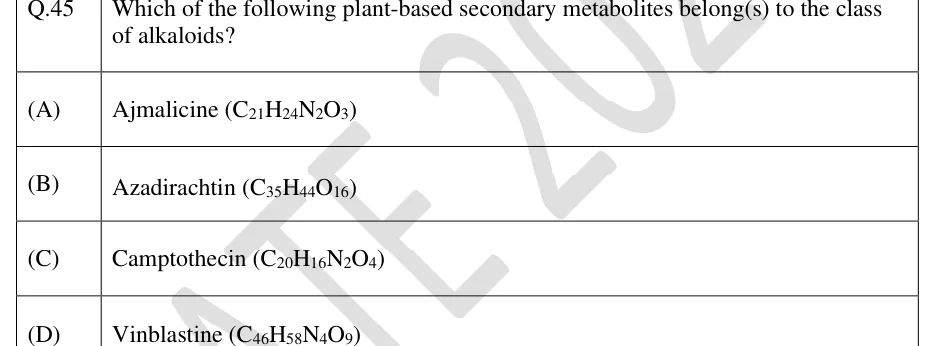
Which of the following plant-based secondary metabolites belong(s) to the class of alkaloids?
- (A)
Ajmalicine (C21H24N2O3)
- (B)
Azadirachtin (C35H44O16)
- (C)
Camptothecin (C20H16N2O4)
- (D)
Vinblastine (C46H58N4O9)

GATE BT
Plant cells can regain the ability to form any tissue (totipotency), and tissue culture exploits this by steering cell fate with plant growth regulators on defined media. The same cultures give regenerated, virus-free and haploid plants, callus and suspension cells that make secondary metabolites, hairy roots and artificial seeds. These notes cover hormone ratios, culture types, growth-kinetics arithmetic, elicitors, industrial products and the causes and uses of somaclonal variation.
8 previous-year questions · 7 solved · 6 practice questions
Totipotency is the ability of a single living plant cell to give rise to a whole fertile plant, because it carries the complete genome and can reprogram which genes it expresses. Most living, nucleated plant cells keep this ability after differentiation, unlike most differentiated animal cells. Cells that lose their nucleus or die at maturity (sieve tube elements, xylem vessels) cannot regenerate a plant.
Regeneration in culture is a series of cell fate transitions. A differentiated cell of the explant first dedifferentiates, losing its specialised identity and resuming division. It then becomes competent (able to respond to a signal). Under a suitable hormone signal it becomes determined to a new fate, and it finally redifferentiates into a shoot, a root, or an embryo. Wounding of the explant and auxin are the usual triggers for the first step.
Term | Meaning |
|---|---|
Dedifferentiation | Mature, non-dividing cell returns to a dividing, less specialised state (callus formation) |
Competence | Ability of a cell to respond to a morphogenic signal |
Determination | Cell is committed to a particular developmental path even if the signal is removed |
Redifferentiation | Dedifferentiated cells re-specialise into organs or embryos |
EXAM TIP
Callus is an unorganised, largely undifferentiated mass of dividing cells. Its formation is dedifferentiation, and regeneration of an organ or embryo from it is redifferentiation. Do not call callus formation "differentiation".
An explant is the piece of plant (leaf disc, node, shoot tip, anther, cotyledon) placed in culture. Young, actively growing tissue and meristems respond best. Explants are surface sterilised (for example 70% ethanol for 30 to 60 s, then sodium hypochlorite or mercuric chloride, then several rinses in sterile water). Media, vessels and tools are autoclaved at 121 °C and 15 psi for 15 to 20 min, and work is done in a laminar air-flow cabinet. Heat-labile components (gibberellic acid, some vitamins, antibiotics) are filter sterilised through 0.22 µm filters and added after autoclaving.
MS medium contains macronutrients (nitrate and ammonium nitrogen, potassium, calcium, magnesium, phosphate, sulfate), micronutrients, Fe-EDTA, vitamins (myo-inositol, thiamine and others), a carbon source (sucrose, usually 20 to 30 g/L) and plant growth regulators. It is solidified with agar (about 0.6 to 0.8% w/v) or used liquid for suspensions. The pH is adjusted to about 5.6 to 5.8 before autoclaving. Browning from phenolic oxidation is reduced with activated charcoal, polyvinylpyrrolidone (PVP) or ascorbic acid.
Plant growth regulator | Examples | Main role in culture |
|---|---|---|
Auxins | IAA (indole-3-acetic acid), NAA (naphthaleneacetic acid), IBA (indole-3-butyric acid), 2,4-D (2,4-dichlorophenoxyacetic acid) | Callus induction, cell division, root formation; 2,4-D is strong for callus and for induction of somatic embryogenesis |
Cytokinins | Kinetin, BAP (6-benzylaminopurine), zeatin; thidiazuron (TDZ), a phenylurea with cytokinin-like activity | Cell division, shoot bud formation and shoot multiplication, delay of senescence |
Gibberellins | GA3 (gibberellic acid) | Stem and internode elongation, embryo germination, breaking of dormancy |
Abscisic acid (ABA) | ABA | Maturation of somatic embryos, desiccation tolerance, suppresses precocious germination |
Ethylene | Gas (ethephon releases it) | Accumulates in closed vessels; often inhibits shoot growth and can cause leaf drop |
The auxin-to-cytokinin ratio steers organogenesis. A high auxin to cytokinin ratio favours root formation, a high cytokinin to auxin ratio favours shoot formation, and a roughly balanced ratio favours undifferentiated callus growth. This is a general rule, and the absolute concentrations and the species matter.
Auxin : cytokinin | Typical outcome |
|---|---|
High auxin, low cytokinin | Roots |
Roughly equal | Callus proliferation |
Low auxin, high cytokinin | Shoots |
STOCK DILUTION
is the volume of stock at concentration needed to make volume of medium at concentration . Put both concentrations in one unit and both volumes in one unit before substituting (1 mg/mL = 1000 mg/L).
WORKED EXAMPLE
A medium of 500 mL must contain 1.0 mg/L BAP and 2.0 mg/L NAA. Separate stock solutions of each are 1 mg/mL. What volume of each stock is added?
Mass of BAP needed = 1.0 mg/L × 0.5 L = 0.5 mg.
Volume of BAP stock = 0.5 mg ÷ (1 mg/mL) = 0.5 mL.
Mass of NAA needed = 2.0 mg/L × 0.5 L = 1.0 mg.
Volume of NAA stock = 1.0 mg ÷ (1 mg/mL) = 1.0 mL.
Check with in matching units: for BAP, , so mL.
Answer: 0.5 mL of BAP stock and 1.0 mL of NAA stock.
Organogenesis forms shoots or roots (unipolar structures that stay connected to the vascular tissue of the explant). It is direct when organs arise straight from the explant with no intervening callus, and indirect when the explant first forms callus and organs arise from the callus. Indirect routes are more likely to give genetic variation. Regeneration through callus usually runs in stages on different media: a callus induction medium (relatively high auxin), then a shoot induction medium (higher cytokinin), then a rooting medium (an auxin such as IBA or NAA).
Somatic embryogenesis forms bipolar embryos (shoot and root poles together) from somatic cells, with no vascular connection to the parent tissue. This is the key difference from organogenesis. It is direct when embryos form from explant cells that are already embryogenically determined, and indirect when a callus phase is needed to induce cells to become embryogenic. In dicots the stages are globular, heart, torpedo and cotyledonary. In monocots they are globular, scutellar and coleoptilar. Induction often uses 2,4-D, and embryo development usually needs the auxin removed or reduced. ABA helps maturation.
Feature | Organogenesis | Somatic embryogenesis |
|---|---|---|
Structure formed | Shoot or root (unipolar) | Embryo (bipolar) |
Vascular link to explant | Present | Absent, embryo is separate |
Typical regulator | Cytokinin-rich medium for shoots; auxin for roots | Auxin (2,4-D) for induction, removed for development |
Product | Plantlet after rooting | Plantlet by embryo germination |
Stages of micropropagation
Stage 0: selection and preparation of the stock plant.
Stage I: establishment of an aseptic culture from the explant.
Stage II: multiplication of shoots (cytokinin-rich medium).
Stage III: rooting of shoots (auxin).
Stage IV: acclimatisation (hardening) of plantlets to greenhouse humidity and soil.
Meristem (shoot-tip) culture for virus-free plants. The apical dome with one or two leaf primordia (about 0.1 to 0.5 mm) often carries little or no virus, because it has no differentiated vascular tissue and its cells divide rapidly. Culturing this tip gives virus-free plants, often after heat treatment of the stock plant (thermotherapy) or with antiviral chemicals. The plants are then tested for virus (for example by ELISA or PCR). The method is used for potato, banana, sugarcane and many ornamentals.
Haploid plants are obtained by culturing anthers or isolated microspores (androgenesis), which regenerate from the haploid microspore cells either through embryos or callus. Culture of unfertilised ovaries or ovules (gynogenesis) is another route. Anther culture can also regenerate diploid plants from the anther wall, so the ploidy of regenerated plants is checked. Treating haploids with colchicine doubles the chromosome number to give doubled haploids, which are completely homozygous in one generation. This shortens the time to get pure lines.
Artificial (synthetic) seeds are somatic embryos, shoot tips or axillary buds encapsulated in a protective, nutrient-containing gel. The usual matrix is sodium alginate (about 2 to 3%), which is dropped into a calcium chloride solution (about 50 to 100 mM). Calcium ions replace sodium and form calcium alginate beads. The bead may hold nutrients, growth regulators and antimicrobial agents. Synthetic seeds are hydrated (encapsulated in a hydrogel such as calcium alginate) or desiccated (hardened somatic embryos, dried, with or without a coating). The advantages are easy handling and storage, clonal uniformity, and large-scale propagation. The limits are poor conversion to plants, lack of natural dormancy, and sensitivity to desiccation.
A callus culture is maintained on solid medium and subcultured every few weeks. A cell suspension is started by transferring a friable callus into liquid medium and shaking it (about 100 to 150 rpm), which breaks the callus into single cells and small aggregates. Suspensions are subcultured by diluting into fresh medium, and are easier to scale up in bioreactors, to sample, and to treat uniformly with nutrients or elicitors. Plant cells divide slowly: their doubling times are usually measured in days, not the minutes to hours typical of bacteria.
Phase of batch growth | What happens |
|---|---|
Lag | Cells adapt to fresh medium; little division |
Exponential | Maximum constant specific growth rate; nutrients are in excess |
Linear / deceleration | Growth slows as a nutrient or space becomes limiting |
Stationary | Biomass is constant; many secondary metabolites accumulate here |
Decline | Cells lose viability and lyse |
Measuring growth. Common measures are fresh weight, dry weight, cell number (haemocytometer), packed cell volume (PCV) after centrifugation or settling, culture viability (fluorescein diacetate stains live cells, Evans blue stains dead cells), and the electrical conductivity of the medium, which falls as ions are taken up.
EXPONENTIAL GROWTH
Biomass concentration at time during the exponential phase; is the biomass at the start of that phase and the specific growth rate.
SPECIFIC GROWTH RATE
Calculated from two points within the exponential phase; the unit is per time (for example per day).
DOUBLING TIME
Time for biomass to double in the exponential phase; is in the same time unit as .
NUMBER OF DOUBLINGS
Number of doublings needed to grow from to in the exponential phase; they take time .
GROWTH INDEX
is the initial and the final fresh weight, dry weight or cell concentration of a culture cycle; it is a ratio with no unit. Some define growth index as the fold increase instead, so check which definition a question uses.
BIOMASS YIELD ON SUBSTRATE
Biomass formed per unit of substrate (for example sucrose) consumed over the same interval; in g biomass per g substrate when and are both in g/L.
PACKED CELL VOLUME
Volume of the settled or centrifuged cell pellet as a percentage of the total culture volume sampled.
WORKED EXAMPLE
A suspension culture grows exponentially from 2.0 g/L to 16.0 g/L dry weight in 12 days. Find the specific growth rate and the doubling time.
Fold increase = 16.0 ÷ 2.0 = 8, so .
.
d. Check: , so 3 doublings take 12 d, which is 4 d each.
Answer: ; d.
Nutrient optimisation. Sucrose is mostly hydrolysed by cell-wall invertase into glucose and fructose, which the cells take up. Ammonium is usually taken up before nitrate. Ammonium uptake acidifies the medium and nitrate uptake makes it more alkaline, so the pH often first falls and then rises. Phosphate is often depleted early, and a low phosphate level can raise secondary metabolite output while limiting growth. Conditions are optimised by changing one factor at a time or, more efficiently, by statistical designs and response surface methods that test several factors together (sucrose, nitrogen source and ratio, phosphate, growth regulators, inoculum size, agitation, aeration, temperature, light).
Secondary metabolites are compounds not needed for basic growth but important for defence, signalling and attraction. The main classes are alkaloids (nitrogen-containing), terpenoids (built from isoprene units) and phenolics (phenylpropanoids, flavonoids). They are often made at low levels, only in specific tissues or developmental stages, and frequently in the non-growth (stationary) phase, so growth and production may be run in two stages: a growth medium, then a production medium.
Class | Biosynthetic origin | Examples |
|---|---|---|
Alkaloids | Amino acids (for example tryptophan, tyrosine, ornithine) | Vinblastine, ajmalicine (indole), berberine (isoquinoline), hyoscyamine and scopolamine (tropane) |
Terpenoids | Five-carbon isoprene units (isopentenyl pyrophosphate) from the mevalonate pathway (cytosol) and the MEP pathway (plastids) | Paclitaxel (diterpenoid), artemisinin (sesquiterpene lactone), ginsenosides (triterpenoid saponins) |
Phenolics | Shikimate pathway to phenylalanine, then phenylalanine ammonia-lyase (PAL) into the phenylpropanoid pathway | Rosmarinic acid, anthocyanins and other flavonoids |
Strategies to raise the yield in culture
Select and maintain high-yielding cell lines.
Optimise medium (sucrose, phosphate, nitrogen source) and growth regulators; high 2,4-D often suppresses product formation, so it may be lowered or replaced in the production stage.
Add elicitors to switch on defence-related pathways.
Feed precursors of the pathway.
Remove product during culture (adsorbent resin or a two-phase system) to avoid feedback inhibition, or permeabilise cells to release product.
Immobilise cells, use differentiated cultures (shoots, roots), or use metabolic engineering.
Elicitors are molecules or treatments that trigger a defence response and so increase secondary metabolite synthesis. Biotic elicitors come from living sources (yeast extract, chitosan, fungal cell-wall fragments, pectin fragments called oligogalacturonides). Abiotic elicitors are chemical or physical (heavy metal salts, UV light, osmotic stress). The plant signal molecules methyl jasmonate and salicylic acid are classed differently in different sources; here they are grouped with the chemical (abiotic) elicitors. The response involves receptor perception, calcium influx, reactive oxygen species and signalling that up-regulates the biosynthetic genes. Concentration and exposure time must be optimised, because too strong an elicitor kills the cells.
Hairy root culture uses Agrobacterium rhizogenes (now also classified as Rhizobium rhizogenes), which carries a Ri (root-inducing) plasmid. Wound phenolics such as acetosyringone induce the vir genes of the plasmid, and the bacterium transfers T-DNA into the genome of the wounded plant cells. The T-DNA carries the rol genes (mainly rolA, rolB, rolC), which make the transformed cells form abundant roots, largely by raising their sensitivity to auxin. The T-DNA also directs the synthesis of opines. After co-cultivation the bacteria are killed with an antibiotic (for example cefotaxime) and roots are grown on hormone-free medium.
Property | Hairy roots | Crown gall (Agrobacterium tumefaciens, Ti plasmid) |
|---|---|---|
Tissue formed | Highly branched roots | Undifferentiated tumour (gall) |
Plasmid | Ri plasmid | Ti plasmid |
Growth regulators needed in culture | None, grows in hormone-free medium | None either, because Ti T-DNA carries genes for auxin and cytokinin synthesis |
Growth | Fast, genetically and biochemically stable | Disorganised |
Use | Secondary metabolites typical of roots, in bioreactors | Gene transfer vector (disarmed Ti plasmid), tumour model |
Hairy roots grow quickly in hormone-free medium and are stable, so they make root-type metabolites (for example tropane alkaloids) at levels often similar to or higher than the intact root. Their limits are shear damage, uneven oxygen and nutrient supply in dense root mats, and the need for special bioreactors (airlift, bubble column, mist or trickle-bed types).
Product | Source plant (culture) | Class / use |
|---|---|---|
Shikonin | Lithospermum erythrorhizon (cell suspension) | Naphthoquinone dye and medicine; the first commercial product of plant cell culture |
Paclitaxel | Taxus species (cell suspension) | Diterpenoid anticancer drug |
Vinblastine and vincristine | Catharanthus roseus (extracted from leaves of the plant) | Dimeric indole alkaloids, anticancer drugs |
Ajmalicine and serpentine | Catharanthus roseus (cell suspension) | Indole alkaloids; ajmalicine is an antihypertensive |
Berberine | Coptis japonica (cell suspension) | Isoquinoline alkaloid, antimicrobial |
Artemisinin | Artemisia annua (field-grown plants; studied in shoot and hairy root cultures) | Sesquiterpene lactone, antimalarial |
Hyoscyamine and scopolamine | Atropa, Hyoscyamus (hairy roots) | Tropane alkaloids |
Ginsenosides | Panax ginseng (adventitious roots, cells) | Triterpenoid saponins |
Rosmarinic acid | Coleus blumei (cell suspension) | Phenolic ester, antioxidant |
Anthocyanins | Daucus carota, Vitis vinifera (cell cultures) | Flavonoid pigments, food colours |
Diosgenin | Dioscorea species | Steroidal sapogenin, precursor for steroid drugs |
Pyrethrins | Chrysanthemum (Tanacetum) cinerariifolium | Natural insecticides |
Somaclonal variation is the genetic or epigenetic variation seen among plants regenerated from cells or tissues grown in culture, especially through a callus or suspension phase. Plants regenerated from gametic cells show the same effect, called gametoclonal variation.
Aspect | Detail |
|---|---|
Causes | Pre-existing variation in the explant; chromosomal rearrangements, polyploidy and aneuploidy; point mutations; activation of transposable elements; changes in DNA methylation (epigenetic) |
Increased by | Long periods in culture, repeated subculture, the callus or suspension phase, high levels of growth regulators (such as 2,4-D), old cultures |
Lowest risk | Culture of existing meristems (shoot tip, axillary bud), which keeps true-to-type clones |
Detection | Morphology, chromosome counts, protein or isozyme patterns, DNA markers (RAPD, AFLP, SSR) |
Uses | Selecting useful variants for disease resistance, stress tolerance and quality traits, mainly in vegetatively propagated crops |
Drawbacks | Loss of uniformity in commercial micropropagation; some changes are epigenetic and not stable |
EXAM TIP
For clonal (true-to-type) propagation use axillary or shoot-tip multiplication and avoid callus. For variation, use callus or suspension culture. Variation can be heritable or non-heritable, because epigenetic changes may be lost.
PREVIOUS-YEAR QUESTIONS
Try each question first, then open the answer. We placed each question under a topic ourselves; the exam paper does not label topics.
See these papers in full: GATE BT 2024 · GATE BT 2023 · GATE BT 2022 · GATE BT 2020 · GATE BT 2019
Which of the following plant-based secondary metabolites belong(s) to the class of alkaloids?
Ajmalicine (C21H24N2O3)
Azadirachtin (C35H44O16)
Camptothecin (C20H16N2O4)
Vinblastine (C46H58N4O9)
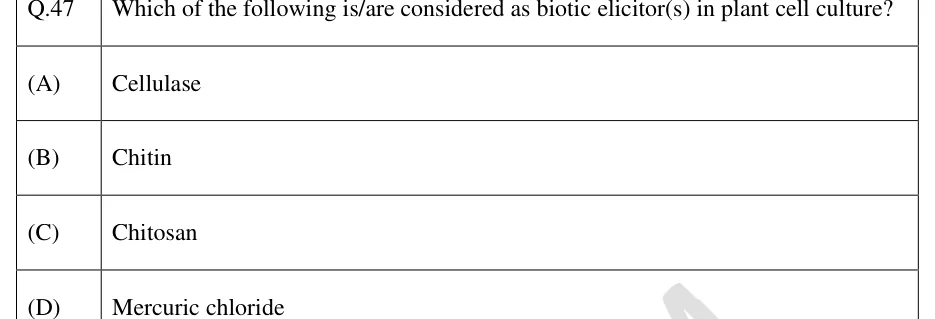
Which of the following is/are considered as biotic elicitor(s) in plant cell culture?
Cellulase
Chitin
Chitosan
Mercuric chloride
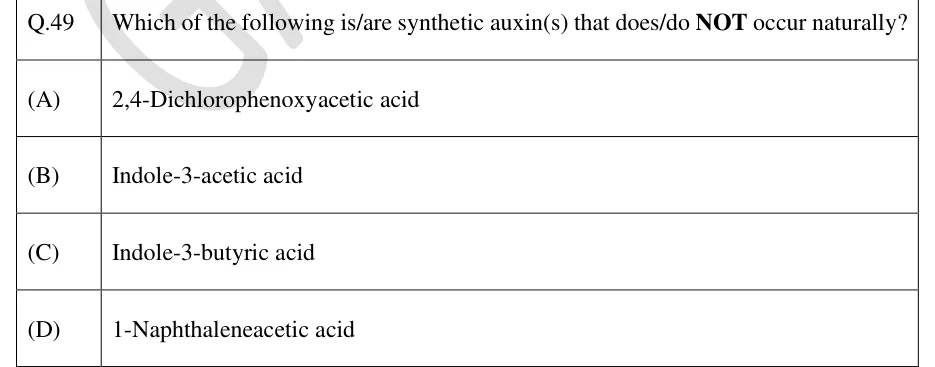
Which of the following is/are synthetic auxin(s) that does/do NOT occur naturally?
2,4-Dichlorophenoxyacetic acid
Indole-3-acetic acid
Indole-3-butyric acid
1-Naphthaleneacetic acid
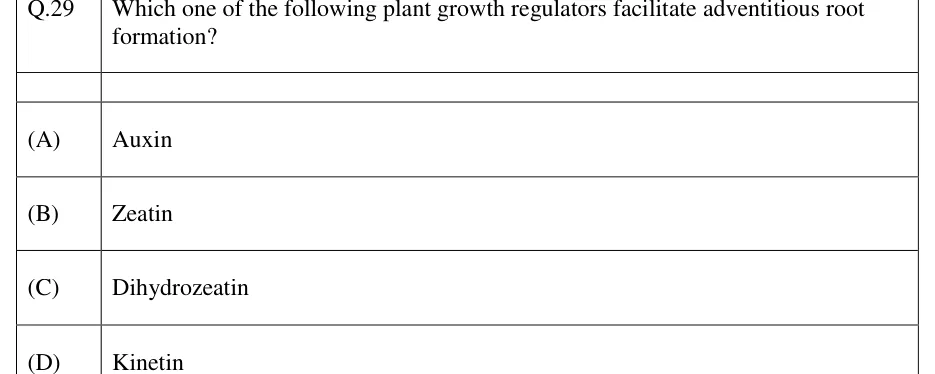
Which one of the following plant growth regulators facilitate adventitious root formation?
Auxin
Zeatin
Dihydrozeatin
Kinetin
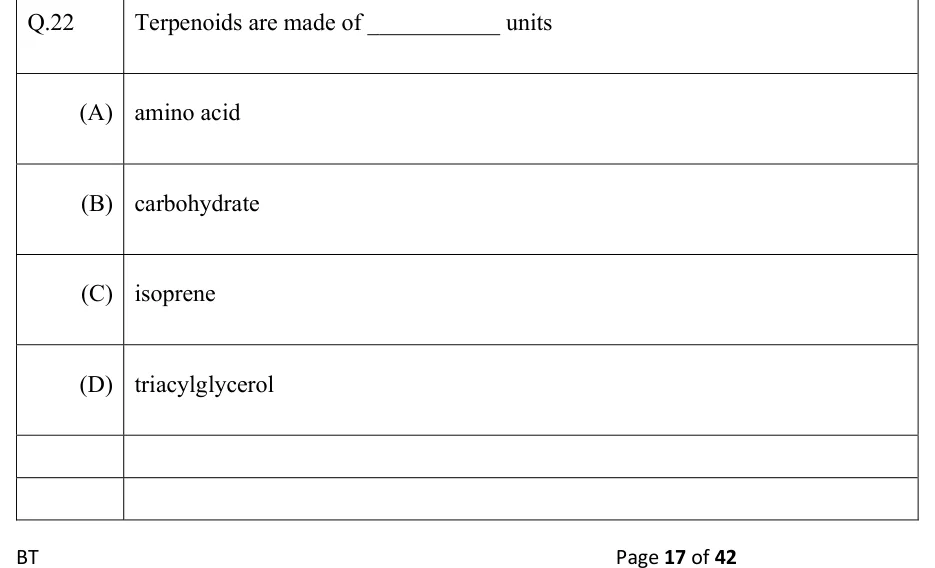
Terpenoids are made of ___________ units
amino acid
carbohydrate
isoprene
triacylglycerol
Official answer: CSource: Official answer key, GATE 2022 BT (IIT Kharagpur)
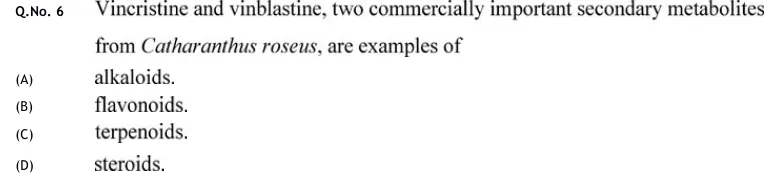
Vincristine and vinblastine, two commercially important secondary metabolites from Catharanthus roseus, are examples of
alkaloids.
flavonoids.
terpenoids.
steroids.
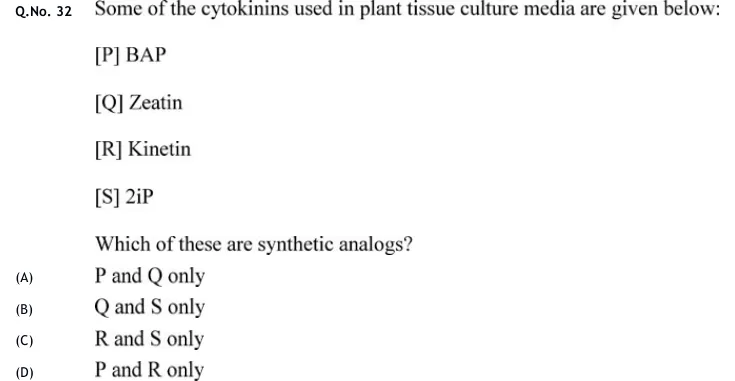
Some of the cytokinins used in plant tissue culture media are given below: [P] BAP, [Q] Zeatin, [R] Kinetin, [S] 2iP. Which of these are synthetic analogs?
P and Q only
Q and S only
R and S only
P and R only
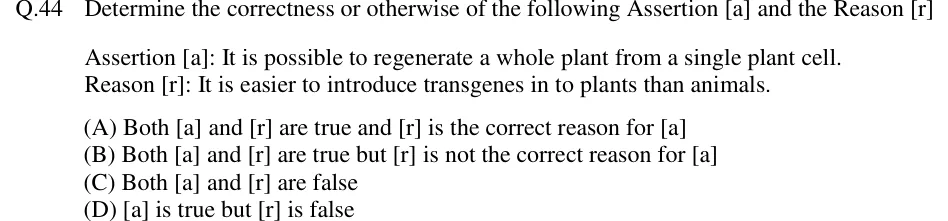
Determine the correctness or otherwise of the following Assertion [a] and the Reason [r].
Assertion [a]: It is possible to regenerate a whole plant from a single plant cell.
Reason [r]: It is easier to introduce transgenes in to plants than animals.
Both [a] and [r] are true and [r] is the correct reason for [a]
Both [a] and [r] are true but [r] is not the correct reason for [a]
Both [a] and [r] are false
[a] is true but [r] is false
PRACTICE
In a tobacco explant culture, a medium with a high auxin to cytokinin ratio will most likely promote:
Shoot bud formation
Root formation
Embryo germination
Stem elongation only
Answer: (B)
A high auxin to cytokinin ratio favours root formation.
A high cytokinin to auxin ratio would favour shoots, and a balanced ratio gives callus.
So option B is correct.
A cell suspension culture grows exponentially from 1.5 g/L to 12.0 g/L dry weight over 9 days. Calculate the doubling time in days (round to one decimal place).
Answer: (accepted range )
Fold increase = 12.0 ÷ 1.5 = 8, so ln 8 = 2.079.
μ = 2.079 ÷ 9 = 0.231 per day.
t_d = 0.693 ÷ 0.231 = 3.0 days (check: 8 = 2^3, so 3 doublings in 9 days).
Which of the following statements about hairy root cultures are correct?
They are induced by Agrobacterium rhizogenes through transfer of T-DNA from the Ri plasmid.
They require exogenous auxin in the medium for continued growth.
They typically grow fast and are genetically stable.
They are produced by the Ti plasmid of Agrobacterium tumefaciens.
Answer: (A), (C)
A is correct: hairy roots are induced by the Ri plasmid T-DNA of Agrobacterium rhizogenes.
B is wrong: the transformed roots grow in hormone-free medium.
C is correct: fast and stable growth is the main advantage.
D is wrong: the Ti plasmid of Agrobacterium tumefaciens causes crown gall.
Which statement about somaclonal variation is correct?
It arises only through sexual recombination during seed formation.
It can arise during culture, and is greater in plants regenerated from long-term callus than from shoot-tip multiplication.
It cannot be caused by epigenetic changes.
It is never useful for crop improvement.
Answer: (B)
Somaclonal variation arises in culture, not through sexual recombination, so A is wrong.
Variation increases with a callus phase and long culture time, and meristem culture keeps clones true to type, so B is correct.
DNA methylation changes (epigenetic) are one cause, so C is wrong.
Selected variants have been used for disease resistance and stress tolerance, so D is wrong.
A 10.0 mL sample of a cell suspension is centrifuged and the cell pellet occupies 1.8 mL. What is the packed cell volume, in per cent?
Answer: (accepted range )
PCV (%) = (volume of cells ÷ volume of culture) × 100.
= (1.8 ÷ 10.0) × 100 = 18%.
Virus-free plants are to be raised from a potato clone infected with a virus. Which explant is the standard choice?
Callus from a leaf disc
The apical meristem (shoot tip) with one or two leaf primordia
Segments of mature root
Anthers at the uninucleate microspore stage
Answer: (B)
The apical meristem tip has no differentiated vascular tissue and divides rapidly, so it often carries little or no virus.
Callus and mature root tissue come from infected, vascularised tissue and also raise the risk of somaclonal variation, so A and C are wrong.
Anther culture gives haploid plants, not a virus-free clone of the same genotype, so D is wrong.
So option B is correct.
OFFICIAL GATE 2027 SYLLABUS WORDING
Copied from the GATE 2027 syllabus; see all 2027 syllabi.
GATE BT
Plants: Totipotency; Cell fate transition, direct and indirect organogenesis, regeneration of plants; Plant growth regulators and elicitors; Tissue culture and cell suspension culture system - methodology, kinetics of growth and nutrient optimization; Production of secondary metabolites; Hairy root culture; Plant products of industrial importance; Artificial seeds; Somaclonal variation
Preparing in Kolkata? IAE Academy's course for GATE BT.