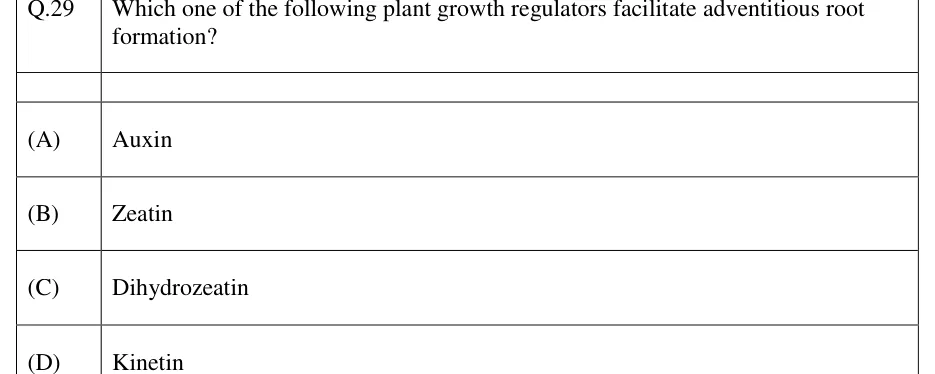
Which one of the following plant growth regulators facilitate adventitious root formation?
- (A)
Auxin
- (B)
Zeatin
- (C)
Dihydrozeatin
- (D)
Kinetin

Which one of the following plant growth regulators facilitate adventitious root formation?
Auxin
Zeatin
Dihydrozeatin
Kinetin
ANSWER
The answer is (A) Auxin.
Official answer: ASource: Official answer key, GATE 2023 BT (IIT Kanpur)
Adventitious roots (roots arising from stems, leaves or callus rather than from the primary root) are induced by the auxin to cytokinin balance: a high auxin to cytokinin ratio favours root formation, and a high cytokinin to auxin ratio favours shoot formation.
(A) Auxin (for example IAA, IBA, NAA) stimulates cells near the vascular tissue to divide and form root primordia, so it promotes adventitious root formation. Correct.
(B) Zeatin is a naturally occurring cytokinin. Cytokinins promote shoot bud formation and tend to inhibit root initiation. Wrong.
(C) Dihydrozeatin is a reduced derivative of zeatin and is also a cytokinin, so it does not promote rooting. Wrong.
(D) Kinetin is a synthetic cytokinin (a furfuryl adenine derivative) that promotes cell division and shoot formation, not rooting. Wrong.
Options B, C and D are all cytokinins and only option A is an auxin, so the answer is (A).
KEY IDEA
Rooting versus shooting in plant tissue culture is set by the auxin to cytokinin ratio. High auxin gives roots, and high cytokinin gives shoots. Zeatin, dihydrozeatin and kinetin are all cytokinins.
WATCH OUT FOR
Picking a cytokinin because it sounds like a general growth promoter. Cytokinins drive cell division and shoot buds, and they tend to suppress root initiation.
From the GATE 2023 BT paper. Every question of this paper · Download the full paper · All 8 Plant tissue culture questions, with notes