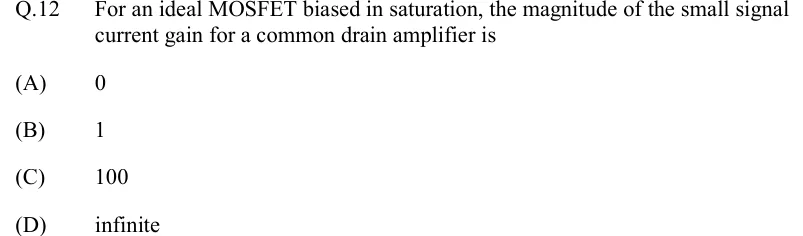
For an ideal MOSFET biased in saturation, the magnitude of the small signal current gain for a common drain amplifier is
- (A)
0
- (B)
1
- (C)
100
- (D)
infinite

For an ideal MOSFET biased in saturation, the magnitude of the small signal current gain for a common drain amplifier is
0
1
100
infinite
ANSWER
(D) infinite. The ideal MOSFET's gate draws zero current, while the source delivers a finite current to the load. The current gain is therefore unbounded.
Official answer: DSource: Official answer key, GATE 2022 EE (IIT Kharagpur)
Small-signal model (ideal MOSFET in saturation): the gate is insulated from the channel by the oxide, so it draws no current. The model therefore has an open circuit between gate and source, and its only active element is the controlled source from drain to source. Assumptions: , body effect neglected, capacitances neglected (low-frequency analysis).
Common drain (source follower): the input goes to the gate and the output is taken at the source, across the load . The drain is at small-signal ground.
Input current: because the gate is an open circuit, for any input voltage, so .
Output current: the source current is finite and non-zero, . Substituting and gives , so
Current gain: A finite, non-zero output current is produced by zero input current, so the ratio grows without bound: .
The voltage gain is , which is option (B)'s value. The question asks for the current gain, and that is infinite. Answer: (D).
KEY IDEA
In an ideal MOSFET the insulated gate draws no current, so every configuration that takes its input at the gate (common source and common drain) has zero input current and infinite current gain. The common drain stage has a voltage gain close to 1, not a current gain of 1.
WATCH OUT FOR
Choosing (B) 1 because the source follower is remembered as a unity-gain stage. That value is its voltage gain. Its current gain is infinite because the gate current is zero. For the common gate stage, where input current enters at the source, the current gain is 1.
From the GATE 2022 EE paper. Every question of this paper · Download the full paper · All 20 Amplifiers questions, with notes