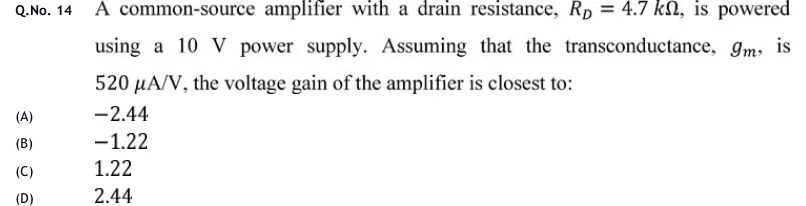
A common-source amplifier with a drain resistance, , is powered using a 10 V power supply. Assuming that the transconductance, , is , the voltage gain of the amplifier is closest to:
- (A)
- (B)
- (C)
- (D)

A common-source amplifier with a drain resistance, , is powered using a 10 V power supply. Assuming that the transconductance, , is , the voltage gain of the amplifier is closest to:
ANSWER
The voltage gain is , which is option (A).
Official answer: ASource: Official answer key, GATE 2020 EE (IIT Delhi)
Assumptions: the MOSFET is biased in saturation, the output resistance is neglected (), there is no load other than , and the source is at AC ground (no unbypassed source resistance). The question gives no , load or source resistor, so this is the intended model.
Small-signal model: replace the MOSFET with a voltage-controlled current source flowing from drain to source. The source is grounded, so .
The 10 V supply is a DC source, so it is AC ground and the top of sits at in the small-signal circuit. The current drawn into the drain has to come from that node through . KCL at the drain gives , so .
Voltage gain: The minus sign is the phase inversion of a common-source stage.
Substitute the values:
The supply voltage (10 V) only sets the DC operating point, and its effect is already inside the given . It does not appear in the small-signal gain. , which is option (A).
KEY IDEA
With neglected and the source at AC ground, a common-source stage has small-signal gain . The DC supply is AC ground, so it sets the bias but never appears in the gain.
WATCH OUT FOR
Dropping the minus sign and choosing +2.44 (D). A common-source amplifier inverts the signal. Another mistake is trying to use the 10 V supply in the gain, or halving the result to about 1.22 (options B and C). The supply only fixes the DC bias, and nothing in the circuit halves .
From the GATE 2020 EE paper. Every question of this paper · Download the full paper · All 20 Amplifiers questions, with notes