
IAE Academy

GATE 2025 EC Q.30: solution and answer

GATE 2025 · ECQ.30 · 1 mark · MSQ

Which of the following statements is/are TRUE with respect to ideal MOSFET-based DC-coupled single-stage amplifiers having finite load resistors?

  1. (A)

    The common-gate amplifier has an infinite input resistance

  2. (B)

    The common-source amplifier has an infinite input resistance

  3. (C)

    The input and output voltages of the common-source amplifier are in phase

  4. (D)

    The input and output voltages of the common-drain amplifier are in phase
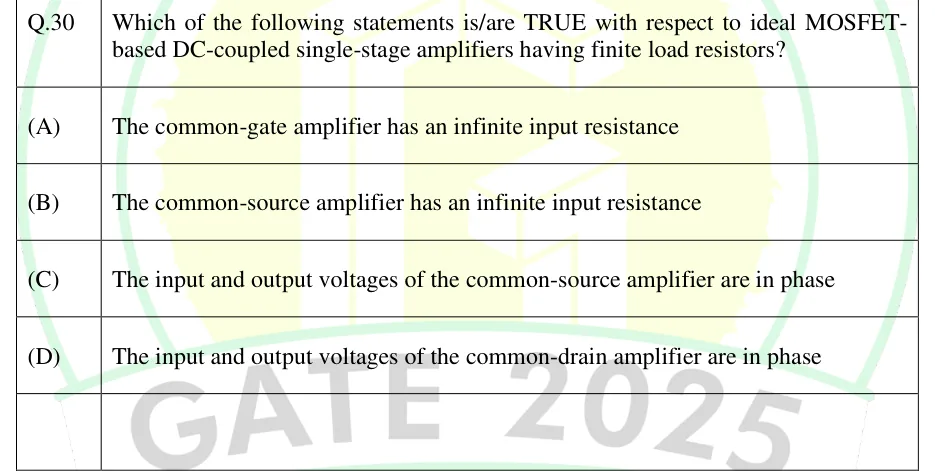
See the question in the paper

Answer and solution

ANSWER

(B) and (D) are true. The common-source stage has infinite input resistance because the gate draws no current, and the common-drain (source follower) gain is positive, so its output is in phase with its input.

Official answer: B, DSource: Official answer key, GATE 2025 EC (IIT Roorkee)

  1. Model and assumptions. The MOSFET is ideal, so the gate draws no current (), and body effect is neglected. Small-signal model: a controlled current source from drain to source, with the gate an open circuit. The load resistor ( at the drain, or at the source for the follower) is finite. The amplifier is DC-coupled, so there is no bias divider at the gate.

  2. (A) Common gate. The gate is at signal ground () and the signal drives the source, so . The channel current leaves the transistor at the source, so KCL at the source node gives . Hence This is small and finite (with a source resistor it becomes , still finite). (A) is FALSE.

  3. (B) Common source. The signal drives the gate. Since and a DC-coupled stage has no gate bias resistors, (B) is TRUE.

  4. (C) Common-source phase. With the source grounded, . The drain current flows from the drain terminal through the transistor to ground, so it is drawn out of the output node through : The minus sign is a phase shift: the common-source stage inverts. (C) is FALSE.

  5. (D) Common-drain (source follower) phase. The drain is at signal ground and the output is taken across at the source: with . Solving, This gain is positive (and just under 1), so input and output are in phase. (D) is TRUE.

  6. Result. The true statements are (B) and (D).

KEY IDEA

Look at which terminal the signal enters. If it enters at the gate (common source or common drain), the input resistance is infinite because an ideal gate draws no current. If it enters at the source (common gate), the input resistance is only . For phase, look at the sign of the gain: common source gives (inverting), while common drain gives and common gate gives (both non-inverting).

WATCH OUT FOR

Assuming every MOSFET amplifier has infinite input resistance because the gate is insulated. In the common-gate stage the signal enters at the source, not the gate, and the whole channel current flows through the input, so . A second slip is treating the common-source stage as non-inverting. Its gain carries a phase shift.

From the GATE 2025 EC paper. Every question of this paper · Download the full paper · All 20 Amplifiers questions, with notes

More Amplifiers questions