
IAE Academy

GATE 2022 EC Q.59: solution and answer

GATE 2022 · ECQ.59 · 2 marks · NAT

Consider the circuit shown with an ideal long channel MOSFET (enhancement-mode, substrate is connected to the source). The transistor is appropriately biased in the saturation region with and such that it acts as a linear amplifier. is the small-signal ac input voltage. and represent the small-signal voltages at the nodes A and B, respectively. The value of is ________ (rounded off to one decimal place).
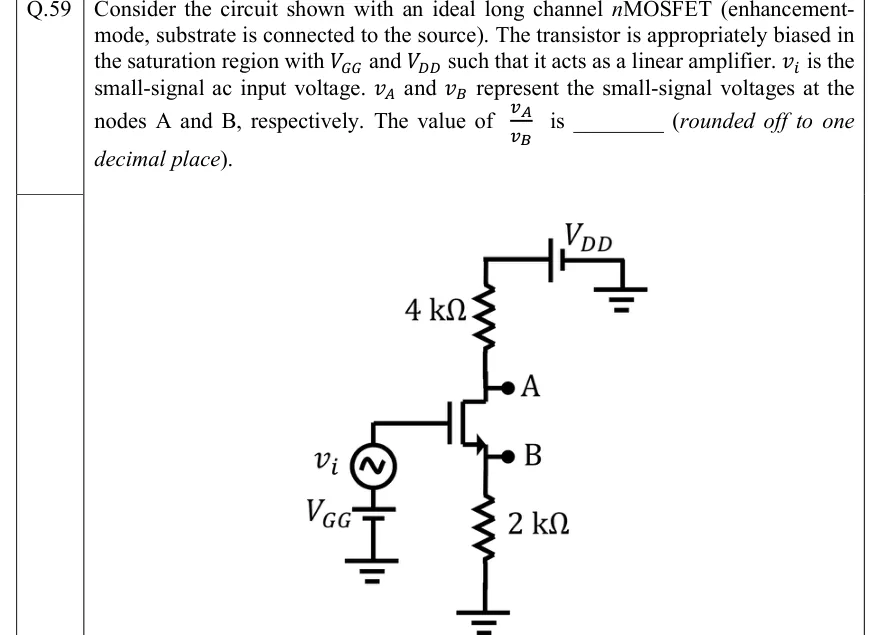
GATE 2022 EC question 59: Enhancement-mode n-channel MOSFET, body tied to source.Tap to open full size
Figure from the GATE 2022 EC paper. It is part of the question.
Figure description

Enhancement-mode n-channel MOSFET, body tied to source. Gate is driven by an ac source v_i in series with a dc battery V_GG whose negative terminal is grounded (v_i on top, connected to the gate; V_GG below, to ground). Drain connects through a 4 kΩ resistor up to the positive terminal of a dc supply V_DD whose other terminal is grounded. The drain node is labelled A. The source node is labelled B and connects through a 2 kΩ resistor to ground. Nodes: A = drain, B = source.

Answer and solution

ANSWER

.

Official answer: -2.1 to -1.9Source: Official answer key, GATE 2022 EC (IIT Kharagpur)

  1. Assumptions: the MOSFET is in saturation. It is an ideal long-channel device, so (no channel-length modulation). The body is tied to the source, so and there is no body effect (). The small-signal model is then a single dependent current source from drain to source, with the gate open. and are dc sources, so both are ac ground.

  2. The gate draws no current and there is no path, so the same small-signal current flows down through the drain resistor, through the channel, and down through the source resistor.

  3. Node A (drain): flows from the ac-grounded rail into A through . By Ohm's law, .

  4. Node B (source): the same flows from B to ground through , so .

  5. Take the ratio. cancels, and with it and :

  6. Check with the individual gains. With and , we get . So and . Their ratio is at any bias point, as long as the device stays in saturation.

KEY IDEA

With and no body effect, one small-signal current flows through both and . The drain voltage is (current flows into the node from ac ground) and the source voltage is (current flows out of the node to ground). So the drain-to-source voltage ratio is simply . You don't need , the bias point or .

WATCH OUT FOR

Answering by dropping the sign: the drain (common-source output) is inverted and the source (source-follower output) is not, so the ratio is negative. Another mistake is working out or separately and getting stuck because is not given. It cancels in the ratio. Adding an or a body-effect term also breaks the single-current argument, but the question rules both out ('ideal long channel', 'substrate connected to the source').

From the GATE 2022 EC paper. Every question of this paper · Download the full paper · All 20 Amplifiers questions, with notes

More Amplifiers questions