
IAE Academy

GATE 2020 EE Q.53: solution and answer

GATE 2020 · EEQ.53 · 2 marks · NAT

The temperature of the coolant oil bath for a transformer is monitored using the circuit shown. It contains a thermistor with a temperature-dependent resistance, , where is the temperature in . The temperature coefficient, , is . Circuit parameters: , , . The error in the output signal (in V, rounded off to 2 decimal places) at is ________.
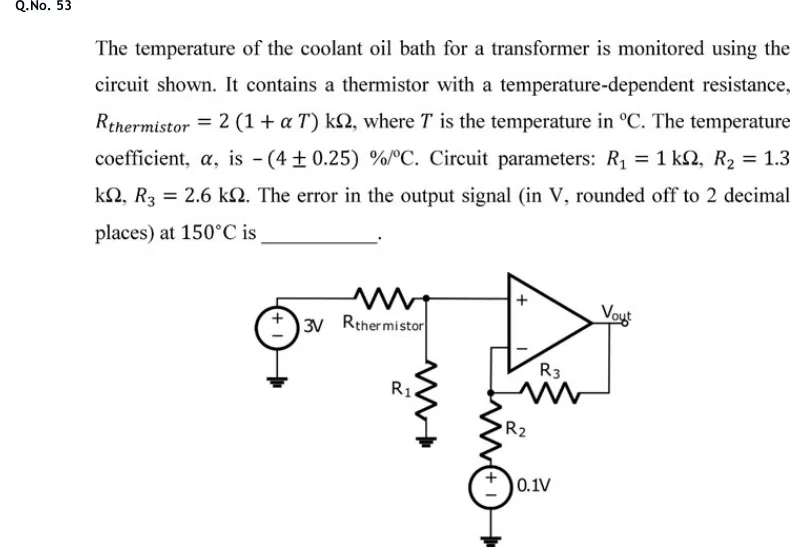
GATE 2020 EE question 53: Op-amp circuit.Tap to open full size
Figure from the GATE 2020 EE paper. It is part of the question.
Figure description

Op-amp circuit. On the left, a 3 V DC source with + terminal at the top and - terminal grounded. From the + terminal, a resistor labelled R_thermistor runs right to a node that connects to the non-inverting (+) input of the op-amp; a resistor R1 goes from that same node down to ground (so R_thermistor and R1 form a divider of the 3 V source feeding the + input). The inverting (-) input connects to a node from which R3 runs to the output V_out (feedback resistor), and R2 runs down to the + terminal of a 0.1 V DC source whose - terminal is grounded. The op-amp output is labelled V_out.

Answer and solution

ANSWER

Marks were awarded to all candidates. Taken at face value, the printed data give a limiting error in the output of about ±0.08 V at 150 °C. That operating point is impossible, though: the printed thermistor model gives R = −10 kΩ at 150 °C.

Official answer: marks to all candidatesSource: Official answer key, GATE 2020 EE (IIT Delhi)

  1. Assumptions. The op-amp is ideal: no input current, a virtual short so , and it stays out of saturation (no supply rails are given). The nominal coefficient is and its tolerance is . All resistances are in and all voltages in .

  2. Non-inverting input (voltage divider). No current flows into the input, so and form a plain divider across the 3 V source:

  3. KCL at the inverting node. because and .

  4. Output as a function of . With we get , so

  5. The printed data do not describe a physical circuit. With , is zero at and negative at every higher temperature. At , and . A thermistor cannot have a negative resistance, and a resistive divider fed from cannot give . This is the most likely reason marks were awarded to all candidates. The rest of the solution takes the printed formula and numbers at face value, which is all a candidate in the exam hall could do. The error-propagation method is standard, but the number it gives does not describe any real circuit.

  6. Nominal output at .

  7. Sensitivity to . Differentiate the expression from step 4:

  8. Limiting (first-order) error.

  9. Check at the end points. At : , so . At : , so . Half the spread is , which agrees with the first-order result. The spread is not symmetric about the nominal value, because is not linear in : the deviations are and . The conventional limiting error is therefore . Quoting the larger one-sided deviation instead would give .

KEY IDEA

Write the output as a closed-form function of the uncertain parameter. Here that is V_out = 9/(3 + 2αT) − 0.2, from a divider followed by a non-inverting stage with an offset. Differentiate with respect to α and multiply by Δα to get the limiting error. Always check the operating point first: in this question the printed α makes the thermistor resistance negative above 25 °C.

WATCH OUT FOR

Using the tolerance in percent, Δα = 0.25 instead of 0.0025 per °C, which inflates the error a hundredfold. Quoting the full spread (about 0.17 V) instead of the ± error. Not noticing that the printed α gives a negative thermistor resistance at 150 °C, which is why the question could not be keyed.

From the GATE 2020 EE paper. Every question of this paper · Download the full paper · All 36 Op-amps questions, with notes

More Op-amps questions