
IAE Academy

GATE 2020 EC Q.18: solution and answer

GATE 2020 · ECQ.18 · 1 mark · NAT

In the circuit shown below, all the components are ideal. If is , the current sourced by the op-amp is ________ mA.
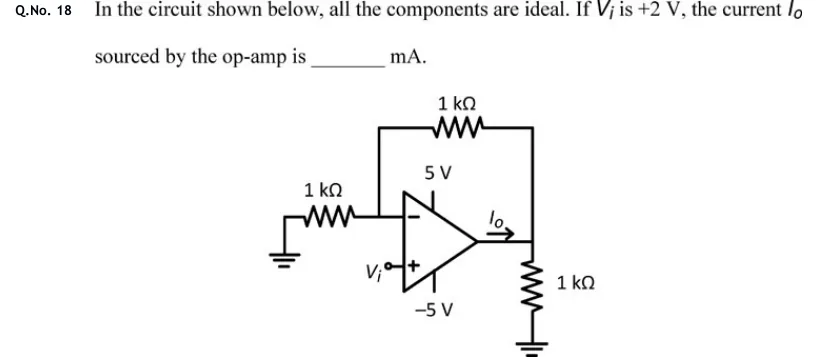
GATE 2020 EC question 18: Non-inverting op-amp amplifier.Tap to open full size
Figure from the GATE 2020 EC paper. It is part of the question.
Figure description

Non-inverting op-amp amplifier. The op-amp is powered from +5 V (top rail) and -5 V (bottom rail). The input V_i is applied directly to the non-inverting (+) input. The inverting (-) input is connected to ground through a 1 kΩ resistor, and to the op-amp output through a 1 kΩ feedback resistor. The output node is connected to ground through a 1 kΩ load resistor. An arrow labelled I_o points out of the op-amp output terminal toward the output node, before it splits between the feedback resistor and the load resistor.

Answer and solution

ANSWER

The op-amp sources : goes into the 1 k load and goes through the feedback resistor.

Official answer: 6Source: Official answer key, GATE 2020 EC (IIT Delhi)

  1. Assumptions: the op-amp is ideal (infinite input resistance and infinite open-loop gain), so no current flows into either input terminal. With negative feedback present, the inputs are at the same potential as long as the output stays within the supply rails.

  2. Virtual short: .

  3. Current in the 1 k resistor from the inverting input to ground: . No current enters the inverting input, so the same must come from the output through the 1 k feedback resistor: .

  4. Output voltage (non-inverting amplifier): . This is inside the rails, so the op-amp is not saturated and the virtual-short assumption holds. Check: .

  5. Load current: .

  6. KCL at the output node: the op-amp output feeds both the load and the feedback path, so

KEY IDEA

In an ideal op-amp, no current enters the input terminals, but the output terminal can source any current. The output current is the sum of all the currents leaving the output node, which here means the load current plus the feedback-network current. First use the virtual short to find , then check that it lies inside the rails.

WATCH OUT FOR

Counting only the load current, , and forgetting that the output also drives the feedback divider (). Another slip is taking the op-amp's zero input current to mean the output current is zero too.

From the GATE 2020 EC paper. Every question of this paper · Download the full paper · All 36 Op-amps questions, with notes

More Op-amps questions