
IAE Academy

GATE 2023 EE Q.28: solution and answer

GATE 2023 · EEQ.28 · 1 mark · MSQ

The bus admittance () matrix of a 3-bus power system is given below (rows and columns ordered 1, 2, 3):

Considering that there is no shunt inductor connected to any of the buses, which of the following can NOT be true?

  1. (A)

    Line charging capacitor of finite value is present in all three lines

  2. (B)

    Line charging capacitor of finite value is present in line 2-3 only

  3. (C)

    Line charging capacitor of finite value is present in line 2-3 only and shunt capacitor of finite value is present in bus 1 only

  4. (D)

    Line charging capacitor of finite value is present in line 2-3 only and shunt capacitor of finite value is present in bus 3 only
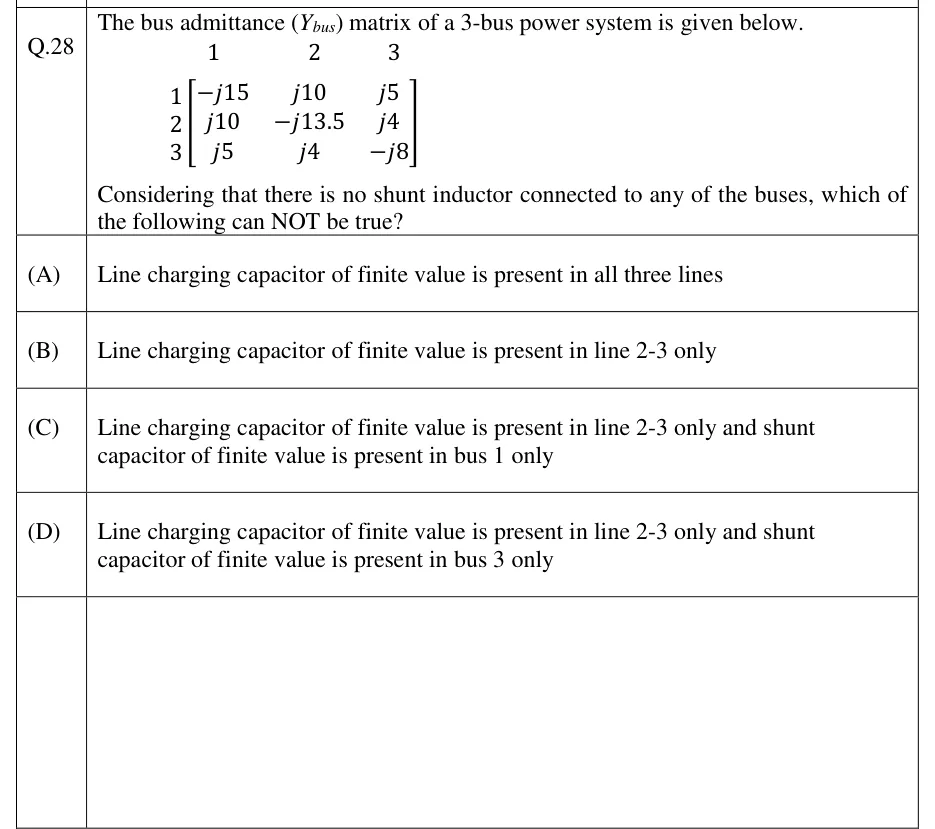
See the question in the paper

Answer and solution

ANSWER

(A) and (C) can NOT be true.

Official answer: A, CSource: Official answer key, GATE 2023 EE (IIT Kanpur)

  1. Read the series line admittances from the off-diagonal entries, : All three are inductive, as series line admittances should be.

  2. Each diagonal entry is the sum of the series admittances of the lines at that bus plus the total shunt admittance there: In the nominal- model, is half the charging susceptance of every line at bus , plus any shunt element connected at bus .

  3. Bus 1: and , so .

  4. Bus 2: and , so .

  5. Bus 3: and , so .

  6. No shunt inductor is connected anywhere, so every shunt element (line-charging halves and bus capacitors) has a positive susceptance and they can only add up; nothing can cancel. At bus 1 the total is , so lines 1-2 and 1-3 have no charging and bus 1 has no shunt capacitor.

  7. (A) Charging on all three lines would put with a positive imaginary part at bus 1. This contradicts , so (A) can NOT be true.

  8. (C) A shunt capacitor at bus 1 would make positive, which contradicts . (Separately, with charging on line 2-3 only and no other bus shunt, buses 2 and 3 would get equal halves, but they need and .) So (C) can NOT be true.

  9. (D) Line 2-3 charging with gives at bus 2 and at bus 3. A shunt capacitor of at bus 3 makes bus 3's total . Bus 1 gets . This matches the matrix exactly, so (D) can be true.

  10. (B) says only that line 2-3 is the one line with charging. It says nothing about bus shunt capacitors, and the arrangement in (D) has line charging on line 2-3 only. So (B) is consistent with the matrix: it can be true.

  11. The statements that can NOT be true are (A) and (C).

KEY IDEA

Subtract the series admittances (from the off-diagonal entries) from each diagonal entry to get the net shunt admittance at each bus: , and at buses 1, 2 and 3. With no shunt inductors, every shunt element is capacitive and they can only add. A zero net shunt at bus 1 therefore rules out any charging on lines 1-2 and 1-3 and any capacitor at bus 1.

WATCH OUT FOR

Reading (B) as 'line 2-3 charging and nothing else'. Option (B) restricts only the line charging and says nothing about bus shunt capacitors. Charging on line 2-3 plus a capacitor at bus 3, which is exactly (D), satisfies (B), so (B) can be true. Students who add 'no bus shunts' to (B) mark A, B, C.

From the GATE 2023 EE paper. Every question of this paper · Download the full paper · All 10 Per unit & load flow questions, with notes

More Per unit & load flow questions