IAE Academy

GATE 2020 EE Q.11: solution and answer

GATE 2020 · EEQ.11 · 1 mark · MCQ

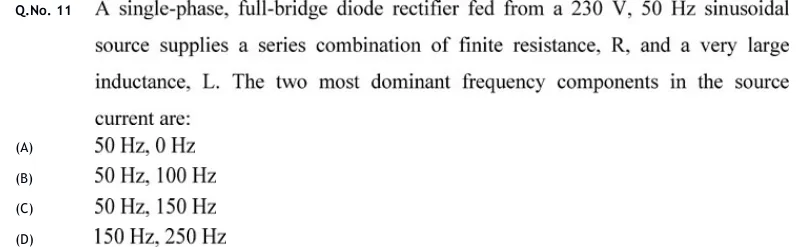
A single-phase, full-bridge diode rectifier fed from a 230 V, 50 Hz sinusoidal source supplies a series combination of finite resistance, R, and a very large inductance, L. The two most dominant frequency components in the source current are:

  1. (A)

    50 Hz, 0 Hz

  2. (B)

    50 Hz, 100 Hz

  3. (C)

    50 Hz, 150 Hz

  4. (D)

    150 Hz, 250 Hz

See the question in the paper

Answer and solution

ANSWER

The two most dominant frequency components of the source current are 50 Hz and 150 Hz, which is option (C).

Official answer: CSource: Official answer key, GATE 2020 EE (IIT Delhi)

  1. Very large : the dc-side current is essentially constant, , with negligible ripple, because the inductor will not let the load current change appreciably within a cycle.

  2. The bridge is built from uncontrolled diodes, so the firing angle is (no commutation overlap is assumed, since the source inductance is not given). The source current is while D1, D2 conduct (positive half-cycle of ) and while D3, D4 conduct (negative half-cycle). So is a square wave of amplitude at the supply frequency, in phase with .

  3. A square wave with half-wave symmetry, , has zero average value and no even harmonics. Only odd harmonics are present.

  4. Fourier series: so the peak of the th harmonic is for odd .

  5. The largest component is the fundamental, , at . The next largest is , at , with amplitude of the fundamental. The component (250 Hz) is only of the fundamental, which is smaller.

  6. 0 Hz is absent because the source current is alternating with zero average, and 100 Hz is an even harmonic and is absent. Hence the two most dominant components are and : option (C).

KEY IDEA

With a very large load inductance, a single-phase diode bridge draws a square-wave source current. That wave has only odd harmonics, with amplitude , so the two largest are the fundamental (50 Hz) and the third harmonic (150 Hz).

WATCH OUT FOR

Treating the load as resistive and thinking of the output ripple at 100 Hz. The 100 Hz component belongs to the dc-side voltage and current, not to the source current. The source current has no dc term and no even harmonics because of its half-wave symmetry.

From the GATE 2020 EE paper. Every question of this paper · Download the full paper · All 6 Harmonics & PF questions, with notes

More Harmonics & PF questions