
IAE Academy

GATE 2024 IN Q.54: solution and answer

GATE 2024 · INQ.54 · 2 marks · NAT

Consider the figure shown. For zero deflection in the galvanometer, the required value of resistor is ____ (rounded off to nearest integer).
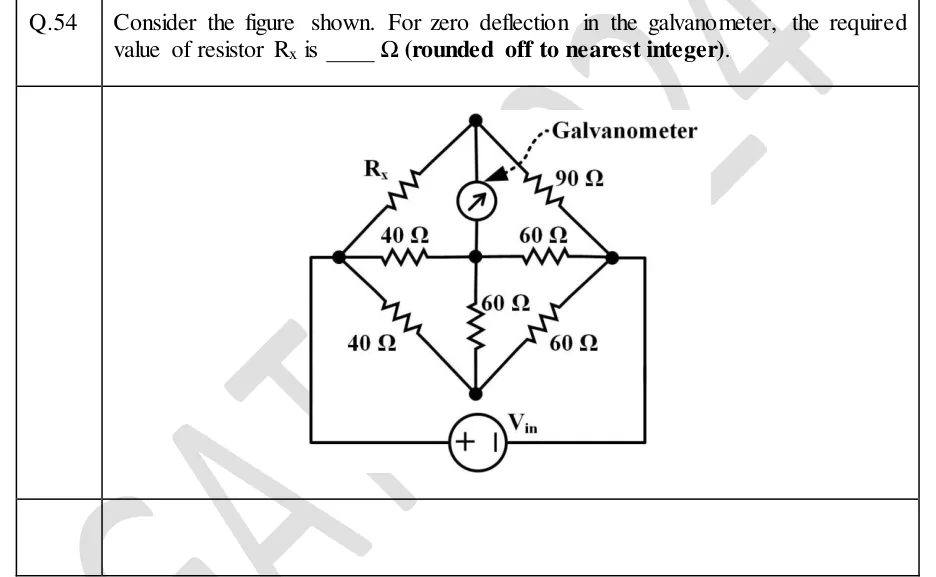
GATE 2024 IN question 54: A diamond-shaped bridge with five nodes: top node T, left node L, centre node C, right node R and bottom node B.Tap to open full size
Figure from the GATE 2024 IN paper. It is part of the question.
Figure description

A diamond-shaped bridge with five nodes: top node T, left node L, centre node C, right node R and bottom node B. Upper-left arm: resistor R_x from L to T. Upper-right arm: 90 Ω from T to R. Galvanometer: vertical, from T down to C. Horizontal middle line: 40 Ω from L to C, then 60 Ω from C to R. Lower-left arm: 40 Ω from L to B. Centre vertical: 60 Ω from C to B. Lower-right arm: 60 Ω from R to B. Source V_in: a wire goes from L down the left side and along the bottom to a voltage source (+ terminal on the left) and on to the right side, rising to R. So V_in is connected between L (+) and R (−). Node B is not connected to the source directly.

Answer and solution

ANSWER

Official answer: 58 to 62Source: Official answer key, GATE 2024 IN (IISc Bengaluru)

  1. Label the nodes: top , left , centre , right , bottom . The source is connected between (+) and (−). Take , so .

  2. Zero galvanometer deflection means no current in the galvanometer branch –, so . Because that branch carries no current, treat it as open when you find the node voltages.

  3. Look at the lower network. and each connect to through and to through . That is a balanced bridge of its own, so and the resistor between and carries no current. (Check: with that resistor removed, both nodes sit at , so it really does carry no current, and the solution is unique.)

  4. Voltage divider along ––:

  5. Voltage divider along –– (no current leaves through the galvanometer):

  6. Balance condition : This is the usual Wheatstone ratio .

KEY IDEA

With zero galvanometer current, nodes and are at the same potential. The lower network ( and from to through both and ) is itself balanced, so the resistor from to carries no current. is then just the divider, and the balance reduces to the ratio .

WATCH OUT FOR

Setting up the ratio with the arms swapped, for example , which gives . Another mistake is assuming the bottom node is wired to the source, or trying to solve the full five-node network when the – resistor carries no current. The arms that must be in the same ratio are the ones that meet at the source terminals: and both touch , and and both touch .

From the GATE 2024 IN paper. Every question of this paper · Download the full paper · All 25 Laws & node/mesh questions, with notes

More Laws & node/mesh questions