
IAE Academy

GATE 2022 EC Q.13: solution and answer

GATE 2022 · ECQ.13 · 1 mark · MCQ

The current in the circuit shown is ________.
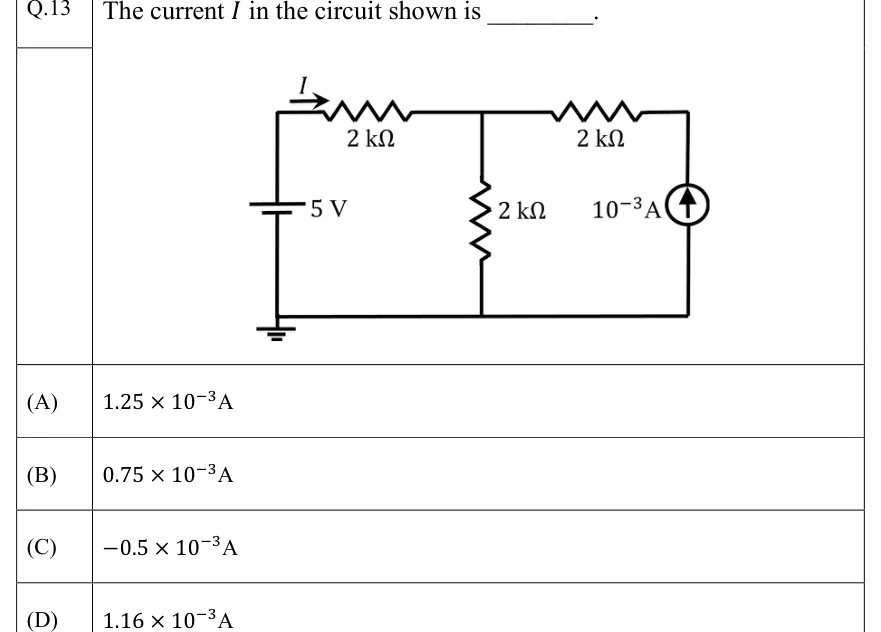
GATE 2022 EC question 13: Three-mesh ladder circuit with a common bottom (ground) wire.Tap to open full size
Figure from the GATE 2022 EC paper. It is part of the question.
Figure description

Three-mesh ladder circuit with a common bottom (ground) wire. Left branch: a 5 V DC source (battery symbol, longer plate i.e. positive terminal at the top) connected vertically between the top-left node and the bottom wire; the bottom wire is connected to ground (ground symbol under the left branch). Top wire: from the top-left node a 2 kΩ resistor runs right to a middle node A; an arrow labelled I above the left end of this resistor points to the right (current I flows from the source's positive terminal through the 2 kΩ toward node A). Middle branch: a 2 kΩ resistor from node A down to the bottom wire. From node A a second 2 kΩ resistor runs right along the top to the top-right corner. Right branch: an independent current source of 10^-3 A connected vertically between the bottom wire and the top-right corner, arrow pointing up (current delivered upward into the top-right node, i.e. toward node A through the right 2 kΩ).

  1. (A)

  2. (B)

  3. (C)

  4. (D)

Answer and solution

ANSWER

, option (B).

Official answer: BSource: Official answer key, GATE 2022 EC (IIT Kharagpur)

  1. Take the bottom wire as the reference (0 V). The source's longer plate (its positive terminal) is on top, so the top-left node is at . Let be the voltage of the middle node, where the three 2 kΩ resistors meet.

  2. The right-hand 2 kΩ is in series with an ideal current source, so it carries exactly into node A whatever its resistance. Its value does not affect .

  3. Write KCL at node A, with current into the node equal to current out of it:

  4. Multiply through by :

  5. Then

  6. Check by superposition. With the 5 V source acting alone (current source open-circuited), the right-hand 2 kΩ carries no current and the source drives two 2 kΩ resistors in series: . With the 1 mA source acting alone (5 V source short-circuited), node A sees two equal 2 kΩ paths to ground, so each takes 0.5 mA. The one through the left resistor flows against the arrow for , so .

  7. Adding the two: , which confirms option (B).

KEY IDEA

A resistor in series with an ideal current source has no effect on the rest of the circuit, because the source fixes the branch current at 1 mA whatever the resistor's value. That leaves a single unknown node voltage. One KCL equation at node A gives , and . Superposition gives the same answer: 1.25 mA from the voltage source minus 0.5 mA pushed back by the current source.

WATCH OUT FOR

Using only the 5 V source's contribution (5 V across 4 kΩ = 1.25 mA, option A), or only the current source's share (−0.5 mA, option C), instead of adding the two. Another mistake is putting the right-hand 2 kΩ in parallel with the middle resistor. It is in series with the current source, so it carries exactly 1 mA and can be ignored when finding .

From the GATE 2022 EC paper. Every question of this paper · Download the full paper · All 25 Laws & node/mesh questions, with notes

More Laws & node/mesh questions