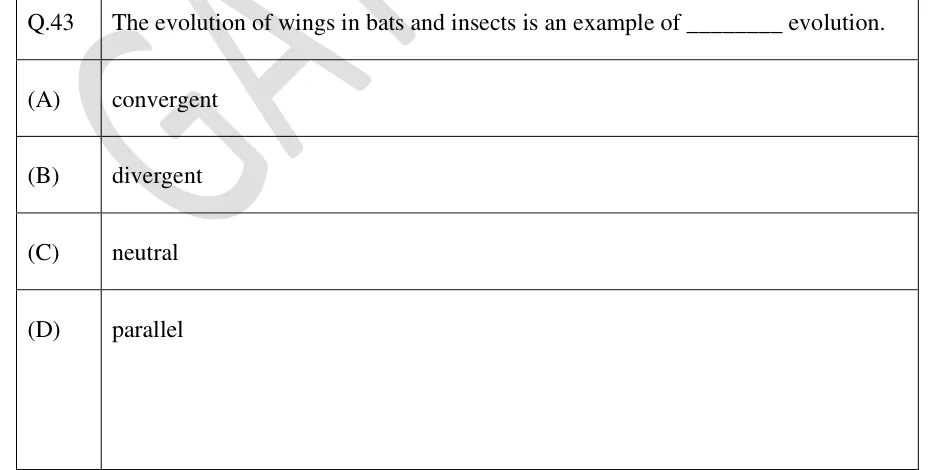
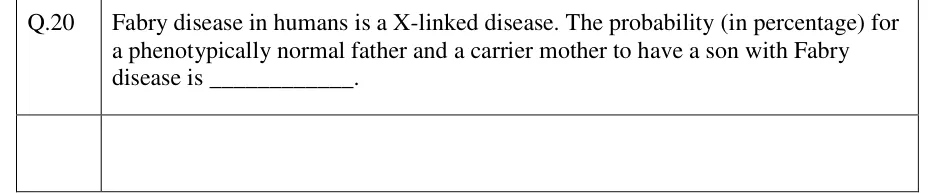
IAE Academy

GATE BT

Population genetics and evolution

Chromosomal variation, genetic disorders, population genetics and evolution

This unit covers genetics at the level of chromosomes and of populations. It starts with changes in chromosome number and structure: euploidy, aneuploidy, polyploidy, deletions, duplications, inversions and translocations. It then shows how these and single-gene defects cause human genetic disorders, traced through pedigrees; how sex is determined in different organisms; and how epigenetic marks control gene expression without changing the DNA sequence (DNA methylation, histone modification, imprinting, X-inactivation and dosage compensation). The population part uses Hardy-Weinberg equilibrium as the no-evolution baseline. It then adds selection, mutation, migration, drift and inbreeding, quantitative inheritance, adaptive versus neutral evolution, and the ways new species form.

11 previous-year questions · 11 solved · 8 practice questions

Chromosomal Variation

Chromosomal variation is any change in chromosome number or structure relative to the normal chromosome complement of a species. It arises from errors in meiosis or mitosis (nondisjunction, anaphase lag, breakage and faulty rejoining). It is a major cause of genetic disorders and sterility, and a source of evolutionary novelty. Variation is either numerical (euploidy changes, aneuploidy) or structural (deletion, duplication, inversion, translocation).

Numerical chromosomal variation

Type

Definition

Example/Note

Euploidy

Change in the number of complete chromosome sets: monoploid (), diploid (), triploid (), tetraploid (), …

Haploid number = chromosomes in a gamete; monoploid (basic) number = chromosomes in one set. They coincide in diploids but not in polyploids: hexaploid bread wheat is , so and .

Aneuploidy

Loss or gain of one or a few chromosomes, not whole sets (, , …)

Arises mainly from nondisjunction in meiosis I or II (or in mitosis, giving mosaics)

Trisomy

One extra chromosome ()

e.g., trisomy 21, 18 and 13 in humans. Tetrasomy = (an extra pair of one homolog); double trisomy = (two different chromosomes each present in three copies)

Monosomy

One chromosome missing ()

Generally more harmful than the corresponding trisomy: every gene on that chromosome is at half dosage, and any recessive allele on the remaining homolog is unmasked. In humans the only full monosomy compatible with live birth is 45,X.

Nullisomy

Both members of a homologous pair missing ()

Lethal in diploids; tolerated in some polyploid plants (e.g., nullisomics of hexaploid wheat), where homoeologous chromosomes compensate

Autopolyploidy

More than two chromosome sets, all from the SAME species (, , …)

Arises from unreduced gametes or somatic doubling (e.g., by colchicine); common in plants. Odd-numbered autopolyploids (e.g., triploids) are largely sterile because the sets cannot be shared equally at meiosis, which is why triploid banana and watermelon are seedless.

Allopolyploidy (amphidiploidy)

Chromosome sets from TWO DIFFERENT species combined and doubled

Makes a sterile interspecific hybrid fertile again, because every chromosome now has a pairing partner

Nondisjunction is the failure of homologous chromosomes (meiosis I) or sister chromatids (meiosis II or mitosis) to separate. It is the principal source of aneuploid gametes.

  • Nondisjunction at meiosis I: all four gametes are abnormal, two and two .
  • Nondisjunction at meiosis II (in one of the two secondary cells): two normal (), one and one gamete.
  • Nondisjunction in a mitotic division after fertilisation gives a mosaic, an individual with two or more cell lines of different chromosome number.

Structural chromosomal aberrations

Type

Description

Consequence

Deletion

Loss of a chromosome segment (terminal or interstitial)

Loss of the genes in the segment. Large or homozygous deletions are often lethal. Can unmask recessive alleles on the homolog (pseudodominance). In a heterozygote the normal homolog forms an unpaired deletion loop at pachytene.

Duplication

A chromosome segment present more than once (tandem or reverse tandem)

Extra gene dosage; a source of new gene copies from which gene families evolve

Inversion

A segment is excised, turned through 180° and reinserted

Paracentric = does not include the centromere; pericentric = includes it (and can change the arm ratio). No gene is lost, but gene order is reversed. In a heterozygote the chromosomes pair by forming an inversion loop. Crossing over inside the loop does occur, but the recombinant chromatids are unbalanced. Paracentric: a dicentric bridge and an acentric fragment at anaphase I. Pericentric: duplication-deficiency chromatids. Recombinant offspring are therefore rarely recovered, so an inversion acts as an apparent crossover suppressor.

Reciprocal translocation

Segments exchanged between two NON-homologous chromosomes

A balanced carrier is usually phenotypically normal. At meiosis the four chromosomes pair as a cross-shaped quadrivalent. Alternate segregation gives balanced gametes. Adjacent-1 and adjacent-2 segregation give duplication-deficiency (unbalanced) gametes. The result is reduced fertility (semisterility in plants) and a risk of unbalanced offspring.

Robertsonian translocation

Fusion of the long arms of two acrocentric chromosomes at or near the centromere (in humans: 13, 14, 15, 21, 22); the short arms are lost

The carrier has 45 chromosomes but is usually normal, because the lost short arms carry repeated rRNA genes present on other acrocentrics. A carrier of a 14;21 fusion can have a child with translocation Down syndrome.

EXAM TIP

Distinguish balanced from unbalanced. A balanced rearrangement (an inversion or a reciprocal or Robertsonian translocation) changes gene ORDER or LOCATION but not gene DOSAGE, so the carrier is usually normal. The risk shows up in the carrier's gametes and offspring.

Sex Determination Systems

Sex determination mechanisms differ between organisms. Sex can be fixed by a sex-determining chromosome (the Y in mammals), by the ratio of X chromosomes to autosome sets, by ploidy, or by environment.

Sex-determination systems

System

Constitution

Example

Key mechanism

XY

Male XY (heterogametic); female XX (homogametic)

Mammals including humans; Drosophila also has XX/XY but determines sex by genic balance (below)

In mammals the SRY gene on the Y chromosome triggers testis development, so the Y is male-determining

ZW

Female ZW (heterogametic); male ZZ (homogametic)

Birds, butterflies and moths, some fish and reptiles

The reverse of XY: the female carries the two different sex chromosomes

XO

Female XX; male has a single X and no second sex chromosome (XO)

Grasshoppers and many other insects; C. elegans (XX hermaphrodite, XO male)

Sex is set by the number of X chromosomes; there is no Y

Genic balance

Sex is set by the ratio of X chromosomes to autosome sets (X:A), not by the Y

Drosophila melanogaster

X:A = 1.0 → female; X:A = 0.5 → male; intermediate values (e.g., 2X:3A = 0.67) → intersex; X:A ≥ 1.5 → metafemale; X:A ≤ 0.33 → metamale. XXY flies are fertile females and XO flies are sterile males: the Y is needed for male fertility, not for maleness.

Haplodiploidy

Male haploid; female diploid

Hymenoptera (bees, wasps, ants)

Unfertilised eggs develop into haploid males; fertilised eggs develop into diploid females

Environmental (temperature-dependent)

No sex chromosomes; sex fixed by incubation temperature during a sensitive period of development

Crocodilians, many turtles, some lizards

The temperature experienced by the embryo sets gonad development

In humans, the SRY gene (Sex-determining Region Y) on the Y chromosome encodes a transcription factor that switches the bipotential gonad onto the testis pathway. Without SRY, the gonad develops as an ovary. So 47,XXY individuals (Klinefelter) are phenotypically male (SRY present) and 45,X individuals (Turner) are phenotypically female (no Y, no SRY). Rare exceptions confirm this: XX males carry SRY moved onto an X (by abnormal exchange in paternal meiosis), and some XY females have lost or mutated SRY.

EXAM TIP

A common trap: 'more X chromosomes = female' is only true in genic-balance systems such as Drosophila. In mammals, what matters is whether the Y-linked SRY gene is present, not how many X chromosomes there are. An XXY human is male; an XXY fly is female.

Human Genetic Disorders and Pedigree Analysis

Human genetic disorders are studied with pedigrees, diagrams that track a trait through several generations, to infer its mode of inheritance. A typical question gives a pedigree and asks you to identify the inheritance pattern or to find the probability of a genotype or phenotype in a child. The rules below assume a single gene with full penetrance.

Rules for reading a pedigree by inheritance pattern

  1. Autosomal recessive: affected individuals usually have unaffected carrier parents (). The trait can skip generations and affects both sexes about equally. It is more likely in consanguineous matings. Two affected parents with a mutation in the same gene have only affected children.

  2. Autosomal dominant: every affected individual has at least one affected parent, so there is no skipping of generations (except for new mutations or reduced penetrance). Both sexes are affected about equally, and male-to-male transmission occurs. Two unaffected parents do not have affected children (barring a new mutation).

  3. X-linked recessive: many more males than females are affected, because males are hemizygous and a single shows. An affected father never passes the trait to his sons (they get his Y). All his daughters receive the allele: they are carriers, or affected if the mother also transmits . Affected males are usually born to carrier mothers, so the trait appears to skip generations through females.

  4. X-linked dominant: both sexes are affected, females more often than males. An affected father passes the trait to ALL daughters and NO sons. A heterozygous affected mother passes it to half of her children of either sex.

  5. Y-linked (holandric): passes only from father to all sons; never to daughters, and never through the mother.

  6. Mitochondrial (maternal): an affected mother passes the trait to all her children of either sex, and an affected father to none. Severity can vary among the children because cells carry mixtures of mutant and normal mtDNA (heteroplasmy).

Common human chromosomal and single-gene disorders

Disorder

Chromosomal/genetic basis

Key feature

Down syndrome

Trisomy 21 (47,+21)

The most common autosomal trisomy among live births. Risk rises with maternal age. Most cases are free trisomy from nondisjunction, mainly in maternal meiosis I; a minority come from a Robertsonian translocation (can be familial) or from mosaicism.

Edwards syndrome

Trisomy 18 (47,+18)

Severe; most affected infants do not survive the first year

Patau syndrome

Trisomy 13 (47,+13)

Severe; most affected infants do not survive the first year

Klinefelter syndrome

47,XXY (or 48,XXXY and other variants)

Phenotypically male, usually infertile; one Barr body in 47,XXY

Turner syndrome

45,X (monosomy X)

Phenotypically female, short stature, usually infertile (gonadal dysgenesis); no Barr body

Cri-du-chat syndrome

Deletion of part of the short arm of chromosome 5 (5p−)

Cat-like cry in infants; a classic deletion syndrome

Sickle-cell anaemia

Autosomal recessive; point mutation in the β-globin gene (GAG → GTG, so glutamate → valine at position 6)

Heterozygotes (sickle trait) are resistant to falciparum malaria: an example of heterozygote advantage (balanced polymorphism)

Phenylketonuria (PKU)

Autosomal recessive; deficiency of phenylalanine hydroxylase

Phenylalanine builds up; managed by a low-phenylalanine diet from birth

Cystic fibrosis

Autosomal recessive; mutations in CFTR, a chloride channel

Thick secretions in lungs and pancreas

Huntington disease

Autosomal dominant; expansion of a CAG repeat in the HTT gene

Late onset; anticipation (earlier onset in later generations as the repeat expands)

Haemophilia A

X-linked recessive; clotting factor VIII deficiency

Affected males; carrier females; no father-to-son transmission

Duchenne muscular dystrophy

X-linked recessive; mutations in the dystrophin gene

Progressive muscle degeneration in boys

Red-green colour blindness

X-linked recessive

Much more common in males than in females

WORKED EXAMPLE · WORKED PEDIGREE EXAMPLE

An unaffected man and an unaffected woman have an affected daughter. The disorder is caused by a single fully penetrant gene. What is the most likely mode of inheritance? What fraction of their future children is expected to be affected? If they have an unaffected child, what is the probability that this child is a carrier?

Solution
  1. Two unaffected parents have an affected child, so the trait is recessive and both parents carry the allele. A dominant trait would need at least one affected parent.

  2. The affected child is a daughter. Under X-linked recessive inheritance she would need from both parents, which would make the father and therefore affected. He is unaffected, so the gene is autosomal.

  3. Both parents are therefore heterozygous: .

  4. Offspring: , so of children are expected to be affected, regardless of sex.

  5. An unaffected child is or (3 of the 4 equally likely outcomes), and 2 of those 3 are . So .

Answer: Autosomal recessive. 1/4 (25%) of future children are expected to be affected, and an unaffected child has a 2/3 probability of being a carrier.

Epigenetics and Dosage Compensation

Epigenetics is the study of heritable changes in gene expression that do not change the DNA sequence. The marks are passed on through mitosis (and sometimes through meiosis). They are central to development, X-inactivation and genomic imprinting. Most marks are erased and reset in the germline and early embryo (epigenetic reprogramming). This is why an imprint is re-established according to the sex of the parent transmitting it.

Major epigenetic mechanisms

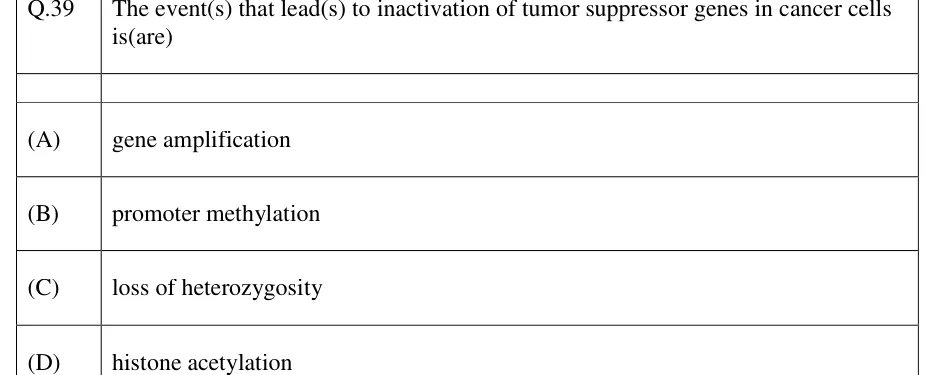
  1. DNA methylation: a methyl group is added to carbon 5 of cytosine, mostly at CpG dinucleotides, giving 5-methylcytosine. De novo methyltransferases (DNMT3A/3B) lay down new patterns; the maintenance methyltransferase (DNMT1) copies existing patterns onto the new strand after replication. Methylated promoter CpG islands are usually transcriptionally silent.

  2. Histone modification: covalent marks on histone tails change chromatin packing. Acetylation (by HATs) loosens chromatin and is associated with active transcription; deacetylation (by HDACs) compacts it and represses transcription. The effect of histone methylation depends on the residue: H3K4me3 marks active promoters, while H3K9me3 and H3K27me3 mark silent chromatin.

  3. Genomic imprinting: a gene's expression depends on which parent it came from; one parental allele is silenced. This is set chiefly by DNA methylation at imprinting control regions laid down in the germline. Example: loss of paternally expressed genes at 15q11–q13 (paternal deletion or maternal uniparental disomy) causes Prader-Willi syndrome. Loss of the maternally expressed UBE3A in the same region (maternal deletion or paternal uniparental disomy) causes Angelman syndrome.

  4. X-chromosome inactivation (placental mammals): early in female development one X in each somatic cell is chosen at random and inactivated. The choice is stable through later divisions, so females are mosaics. The XIST non-coding RNA, transcribed from the X to be inactivated, coats it in cis and it condenses into a Barr body. Genes in the pseudoautosomal regions and some others escape inactivation. Number of Barr bodies = number of X chromosomes − 1 (e.g., 47,XXY → 1; 47,XXX → 2; 45,X → 0).

Dosage compensation (equalising X-linked gene output between the sexes)

Organism

Mechanism

Placental mammals

One X is inactivated at random in each female somatic cell

Drosophila

The single X in males is transcribed about twice as much (hypertranscription by the MSL complex)

C. elegans

Both X chromosomes in XX hermaphrodites are down-regulated by about half

EXAM TIP

Do not confuse 'epigenetic' with 'genetic'. An epigenetic mark changes WHETHER a gene is read, never the DNA bases themselves. For imprinted genes, the same allele can be expressed or silenced depending only on which parent passed it on.

Population Genetics — Hardy-Weinberg Equilibrium

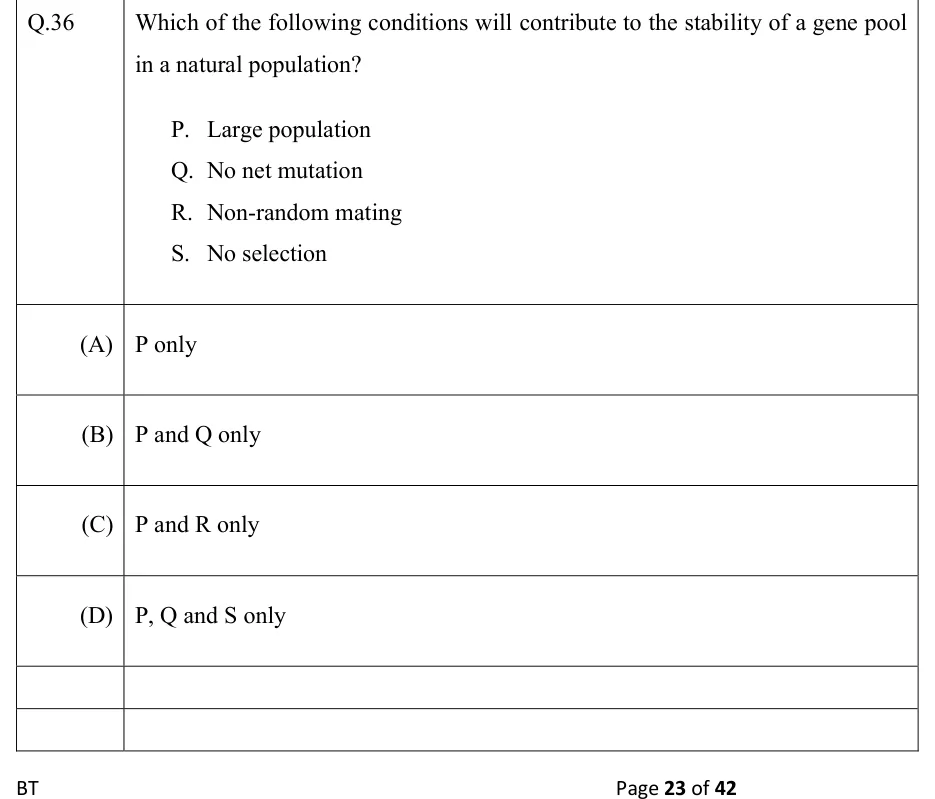
Population genetics studies allele and genotype frequencies in a population and how they change over generations. The Hardy-Weinberg principle is the null model. It gives the genotype frequencies expected when a population is NOT evolving at a locus, and a significant departure from them shows that one of its assumptions is broken. Convention: for two alleles and , = frequency of and = frequency of , with .

Assumptions of Hardy-Weinberg equilibrium

  1. Diploid organism, sexual reproduction, non-overlapping generations.

  2. Very large (effectively infinite) population, so no genetic drift.

  3. Random mating at the locus: no assortative mating, no inbreeding.

  4. No mutation at the locus.

  5. No migration (gene flow) into or out of the population.

  6. No natural selection: all genotypes have equal fitness.

  7. Allele frequencies are equal in males and females. For an autosomal locus under these conditions, Hardy-Weinberg genotype proportions are reached after a single generation of random mating. If the frequencies differ between the sexes, it takes two generations. An X-linked locus approaches equilibrium gradually, with the male and female frequencies oscillating.

ALLELE FREQUENCY SUM (TWO ALLELES)

= frequency of allele , = frequency of allele in the gene pool.

ALLELE FREQUENCIES FROM GENOTYPE FREQUENCIES

Valid whether or not the population is in Hardy-Weinberg equilibrium: each heterozygote carries one copy of each allele.

HARDY-WEINBERG GENOTYPE FREQUENCIES

At equilibrium: = frequency of , = frequency of , = frequency of .

THREE ALLELES (E.G., ABO)

Homozygote frequencies are the squares; each heterozygote frequency is twice the product of its two allele frequencies.

X-LINKED LOCUS AT EQUILIBRIUM

The fraction of males showing an X-linked recessive trait estimates directly. The fraction of affected females is , which is why such traits are far more frequent in males.

CHI-SQUARE TEST FOR HARDY-WEINBERG EQUILIBRIUM

Expected counts come from , , , using and estimated from the same data, which costs one degree of freedom. With two alleles, df = 1 (critical value 3.84 at the 5% level).

GENOTYPE FREQUENCIES WITH INBREEDING

= inbreeding coefficient (the probability that the two alleles in an individual are identical by descent). Inbreeding raises homozygosity without changing allele frequencies. .

WORKED EXAMPLE · WORKED HARDY-WEINBERG EXAMPLE

In a population of 10,000 people at Hardy-Weinberg equilibrium, 9 have a rare autosomal recessive disorder. Estimate the number of unaffected carriers (heterozygotes).

Solution
  1. Frequency of affected () individuals:

  2. Carrier frequency

  3. Number of carriers

Answer: About 582 of the 10,000 people are expected to be unaffected carriers, about 65 times the number of affected people. For a rare recessive allele, most copies are hidden in heterozygotes ( when is small).

Forces That Change Allele Frequencies; Selection and Inheritance

When any Hardy-Weinberg assumption is broken, allele or genotype frequencies change. A change in allele frequencies in a population across generations is the operational definition of evolution. Inbreeding and non-random mating change genotype frequencies but not allele frequencies.

Evolutionary forces

Force

Mechanism

Typical effect on population

Natural selection

Genotypes differ in survival and reproduction (fitness)

Systematic, directional change towards the fitter allele. It can maintain a polymorphism when the heterozygote is fittest (overdominance, e.g., sickle-cell trait where malaria is common) or under negative frequency-dependent selection.

Mutation

Heritable change in DNA sequence that creates new alleles

The ultimate source of new variation, but on its own it changes allele frequency very slowly because mutation rates per generation are low

Migration (gene flow)

Movement of alleles between populations

Makes populations more alike in allele frequency, counteracting differences built up by drift or local selection

Genetic drift

Random sampling of gametes from one generation to the next in a finite population

Random change; its variance per generation is , so it is strongest in SMALL populations. It can fix or lose alleles regardless of fitness and reduces heterozygosity within a population. Special cases: the founder effect (a new population started by a few individuals) and the bottleneck effect (a sudden, drastic reduction in population size).

Modes of selection on a trait

Mode

What is favoured

Effect

Directional

One extreme phenotype

The trait mean shifts in that direction

Stabilising

Intermediate phenotypes

The mean stays the same and the variance falls

Disruptive (diversifying)

Both extremes over the intermediate

Variance rises; can maintain a polymorphism and may start divergence

Balancing

More than one allele kept in the population

Maintains polymorphism: heterozygote advantage, negative frequency-dependent selection

Fitness convention: relative fitness is the reproductive success of a genotype relative to the fittest genotype (). The selection coefficient is .

SELECTION AGAINST A RECESSIVE HOMOZYGOTE

Fitnesses , , . Selection is slow when is small, because almost all copies of are hidden in heterozygotes.

COMPLETE SELECTION AGAINST A RECESSIVE (RECESSIVE LETHAL, S = 1)

From , each generation adds 1 to . is the number of generations to go from to .

EQUILIBRIUM UNDER HETEROZYGOTE ADVANTAGE

Fitnesses , , ; = frequency of . The equilibrium is stable. The allele whose homozygote pays the larger cost stays rarer.

MUTATION–SELECTION BALANCE

= mutation rate per generation towards the deleterious allele; = selection coefficient against the affected genotype. These approximations hold when .

MIGRATION (ONE-WAY GENE FLOW)

= fraction of the recipient population's genes that come from migrants each generation; = allele frequency among migrants.

LOSS OF HETEROZYGOSITY BY DRIFT

= effective population size; = generations. The smaller , the faster variation is lost.

EFFECTIVE POPULATION SIZE WITH UNEQUAL SEX RATIO

, = numbers of breeding males and females. is always ≤ the census number of breeders, and is dominated by the rarer sex.

HERITABILITY AND RESPONSE TO SELECTION (BREEDER'S EQUATION)

= selection differential (mean of selected parents − population mean); = response (mean of offspring − population mean). = narrow-sense heritability (additive variance / phenotypic variance); = broad-sense heritability (total genetic variance / phenotypic variance). Only predicts the response to selection.

EXAM TIP

Selection changes allele frequency in a directional, fitness-driven way. Drift changes it randomly, and its effect grows as population size shrinks. Inbreeding changes genotype frequencies (more homozygotes) without changing allele frequencies.

Adaptive and Neutral Evolution, Species and Speciation

Not every change in allele frequency is an adaptation. Adaptive evolution is driven by natural selection acting on variants that affect fitness. The neutral theory of molecular evolution holds that most of the differences fixed between species at the molecular level, and much of the polymorphism within species, are selectively neutral or nearly so. Examples are many synonymous substitutions and changes in non-functional DNA. Such variants spread or are lost by genetic drift, not by selection. Strongly deleterious mutations are still removed by purifying selection, so they rarely become fixed differences.

NEUTRAL MUTATIONS: FIXATION PROBABILITY AND SUBSTITUTION RATE

In a diploid population of individuals, new neutral mutations arise per generation, and each is eventually fixed with probability . The neutral substitution rate therefore equals the neutral mutation rate , independent of population size. This is the basis of the molecular clock.

DETECTING SELECTION IN PROTEIN-CODING GENES

= non-synonymous substitutions per non-synonymous site; = synonymous substitutions per synonymous site. : purifying (negative) selection; : neutral evolution; : positive (adaptive) selection.

Under the biological species concept, a species is a group of actually or potentially interbreeding natural populations that is reproductively isolated from other such groups. The concept cannot be applied to asexual organisms or fossils, where morphological or phylogenetic species concepts are used instead. Speciation is the origin of new species, usually through the build-up of genetic differences between populations until reproductive isolation is complete.

Modes of speciation and reproductive isolation

Mode/mechanism

Description

Allopatric speciation

A geographic barrier separates populations and stops gene flow; they diverge by selection and drift

Peripatric speciation

A form of allopatric speciation in which a small population is isolated at the edge of the range; founder effect and drift speed up divergence

Parapatric speciation

Divergence of adjacent populations with limited gene flow across a shared boundary (hybrid zone), often along an environmental gradient

Sympatric speciation

Speciation within the same geographic range. Examples: polyploidy in plants (immediate reproductive isolation from the parental species) and strong host or habitat specialisation

Prezygotic isolation

Barriers that prevent mating or fertilisation: habitat, temporal, behavioural, mechanical or gametic isolation

Postzygotic isolation

Barriers that act after fertilisation: hybrid inviability, hybrid sterility (e.g., the mule), or hybrid breakdown in later generations

EXAM TIP

Polyploidy can create a new species in a single generation. A tetraploid crossed back to its diploid parent gives triploid offspring, which are largely sterile, so the tetraploid is at once reproductively isolated from its parent.

PREVIOUS-YEAR QUESTIONS

11 questions from the BT papers

Try each question first, then open the answer. We placed each question under a topic ourselves; the exam paper does not label topics.

See these papers in full: GATE BT 2026 · GATE BT 2024 · GATE BT 2023 · GATE BT 2022 · GATE BT 2020

GATE 2026 BT Q.38

GATE 2026 · BTQ.38 · 2 marks · MCQ

Match the genetic disorders in Column I to the corresponding underlying cause in Column II.

Column I:
P. Klinefelter Syndrome
Q. Turner syndrome
R. Bloom syndrome
S. Xeroderma pigmentosum

Column II:
1. X-chromosome insufficiency
2. DNA helicase mutations
3. Nucleotide excision repair defects
4. Extra X chromosome(s) in a male
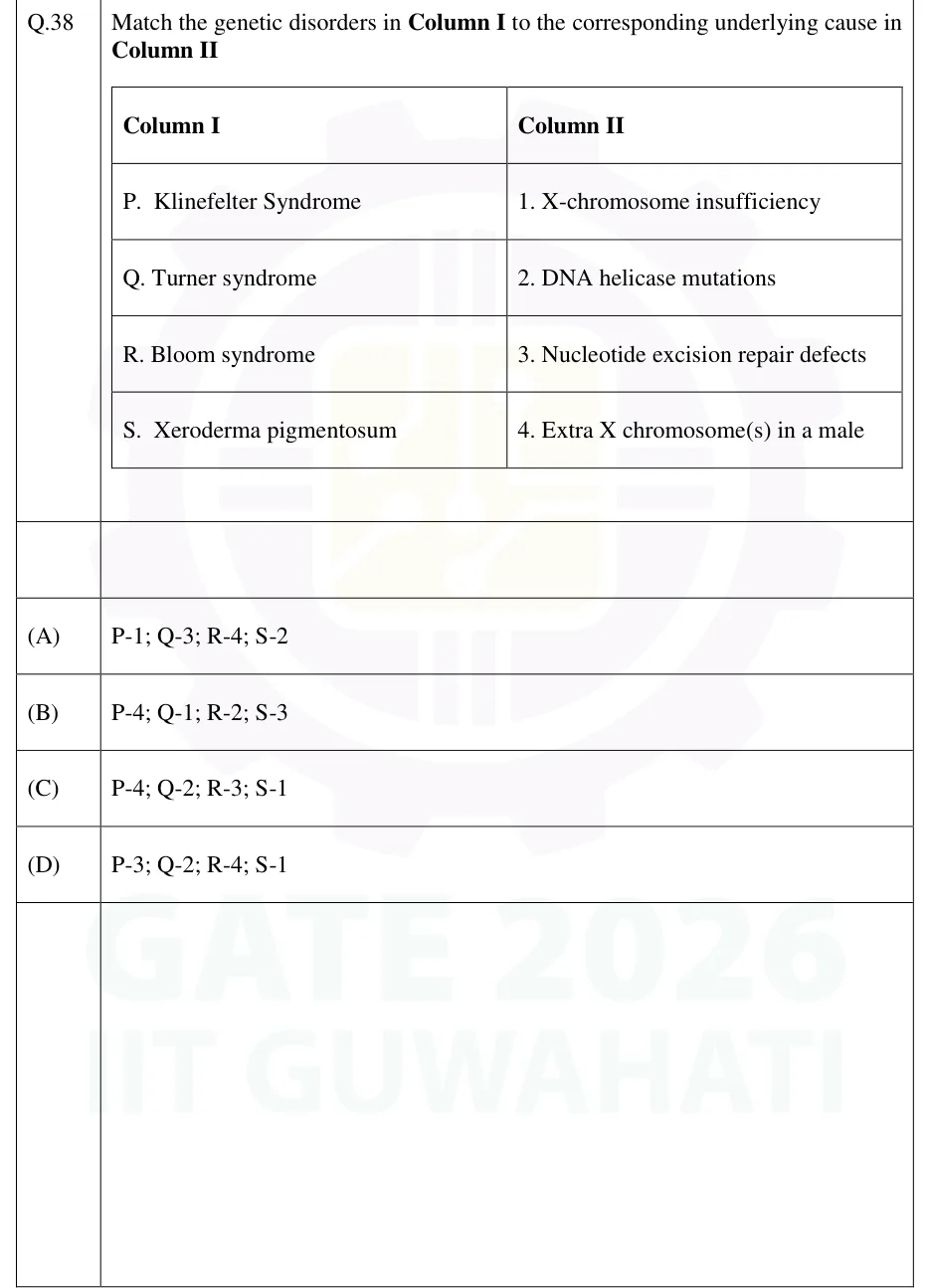
GATE 2026 BT question 38: A 4-row, 2-column matching table.Tap to open full size
Figure from the GATE 2026 BT paper. It is part of the question.
Figure description

A 4-row, 2-column matching table. Column I header, rows P-S list the four disorders (Klinefelter Syndrome, Turner syndrome, Bloom syndrome, Xeroderma pigmentosum). Column II header, rows 1-4 list the four causes (X-chromosome insufficiency, DNA helicase mutations, Nucleotide excision repair defects, Extra X chromosome(s) in a male). No graphical figure, purely a text matching table.

  1. (A)

    P-1; Q-3; R-4; S-2

  2. (B)

    P-4; Q-1; R-2; S-3

  3. (C)

    P-4; Q-2; R-3; S-1

  4. (D)

    P-3; Q-2; R-4; S-1

Answer and solution
GATE 2026 BT Q.38: answer and solution

GATE 2024 BT Q.42

GATE 2024 · BTQ.42 · 2 marks · MCQ

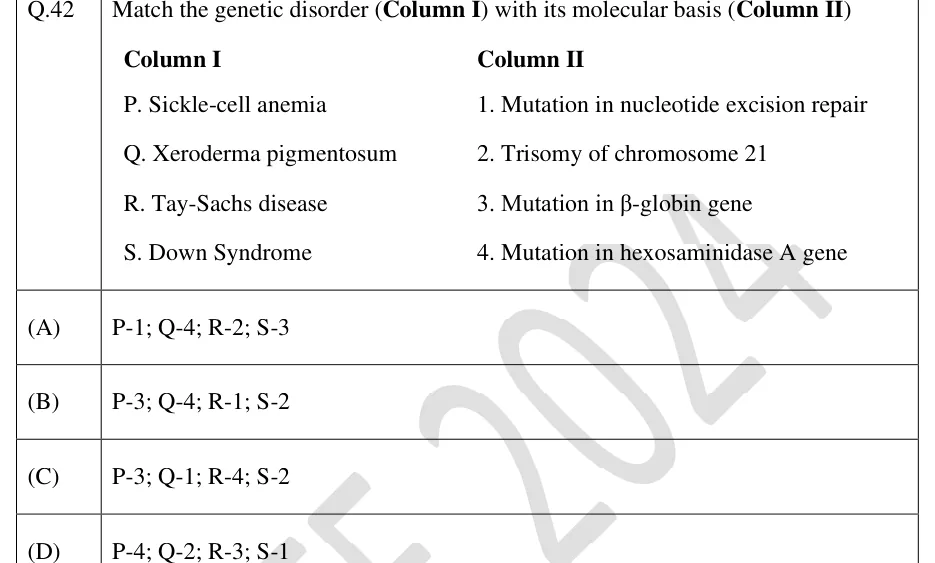
Match the genetic disorder (Column I) with its molecular basis (Column II)

Column I
P. Sickle-cell anemia
Q. Xeroderma pigmentosum
R. Tay-Sachs disease
S. Down Syndrome

Column II
1. Mutation in nucleotide excision repair
2. Trisomy of chromosome 21
3. Mutation in β-globin gene
4. Mutation in hexosaminidase A gene

  1. (A)

    P-1; Q-4; R-2; S-3

  2. (B)

    P-3; Q-4; R-1; S-2

  3. (C)

    P-3; Q-1; R-4; S-2

  4. (D)

    P-4; Q-2; R-3; S-1

Answer and solution
See the question in the paper
GATE 2024 BT Q.42: answer and solution

GATE 2023 BT Q.14

GATE 2023 · BTQ.14 · 1 mark · MCQ

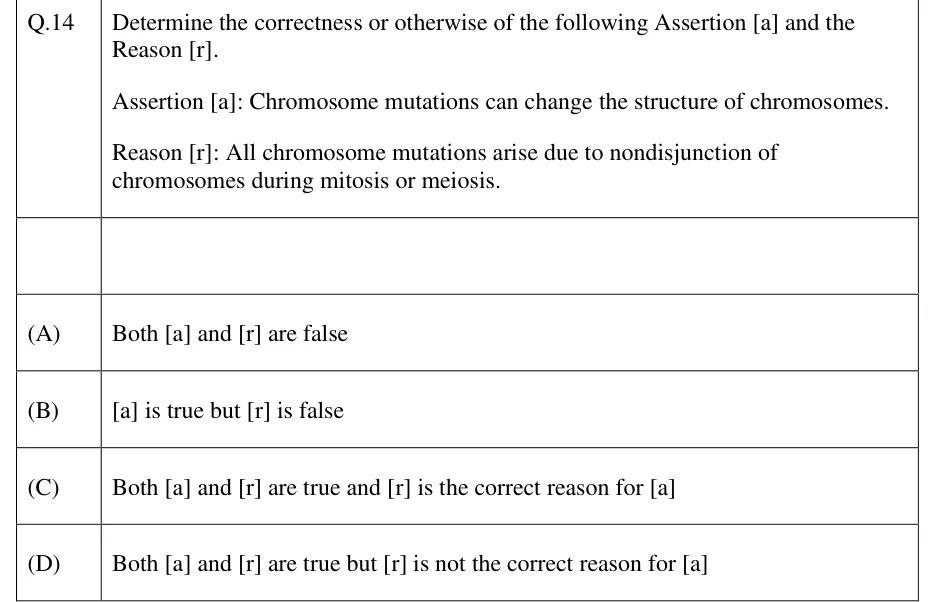
Determine the correctness or otherwise of the following Assertion [a] and the Reason [r].

Assertion [a]: Chromosome mutations can change the structure of chromosomes.

Reason [r]: All chromosome mutations arise due to nondisjunction of chromosomes during mitosis or meiosis.

  1. (A)

    Both [a] and [r] are false

  2. (B)

    [a] is true but [r] is false

  3. (C)

    Both [a] and [r] are true and [r] is the correct reason for [a]

  4. (D)

    Both [a] and [r] are true but [r] is not the correct reason for [a]

Answer and solution
See the question in the paper
GATE 2023 BT Q.14: answer and solution

GATE 2022 BT Q.52

GATE 2022 · BTQ.52 · 2 marks · MSQ

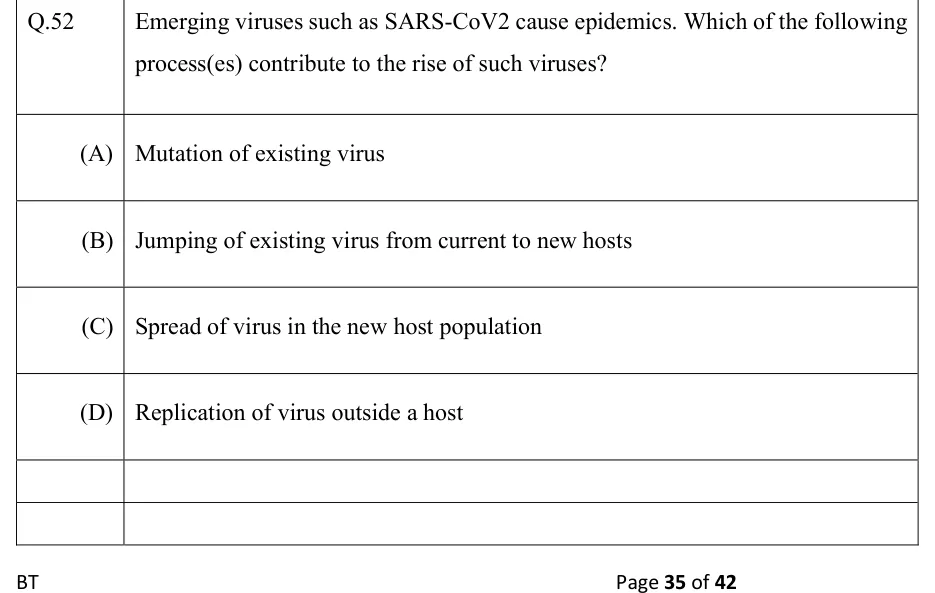
Emerging viruses such as SARS-CoV2 cause epidemics. Which of the following process(es) contribute to the rise of such viruses?

  1. (A)

    Mutation of existing virus

  2. (B)

    Jumping of existing virus from current to new hosts

  3. (C)

    Spread of virus in the new host population

  4. (D)

    Replication of virus outside a host

Answer and solution
See the question in the paper
GATE 2022 BT Q.52: answer and solution

GATE 2020 BT Q.3

GATE 2020 · BTQ.3 · 1 mark · MCQ

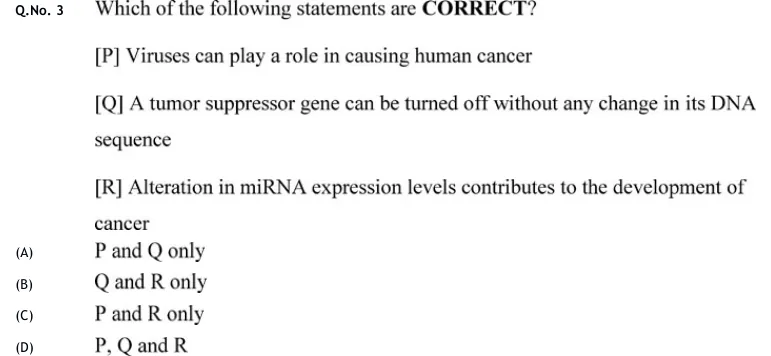
Which of the following statements are CORRECT?

[P] Viruses can play a role in causing human cancer

[Q] A tumor suppressor gene can be turned off without any change in its DNA sequence

[R] Alteration in miRNA expression levels contributes to the development of cancer

  1. (A)

    P and Q only

  2. (B)

    Q and R only

  3. (C)

    P and R only

  4. (D)

    P, Q and R

Answer and solution
See the question in the paper
GATE 2020 BT Q.3: answer and solution

GATE 2020 BT Q.15

GATE 2020 · BTQ.15 · 1 mark · MCQ

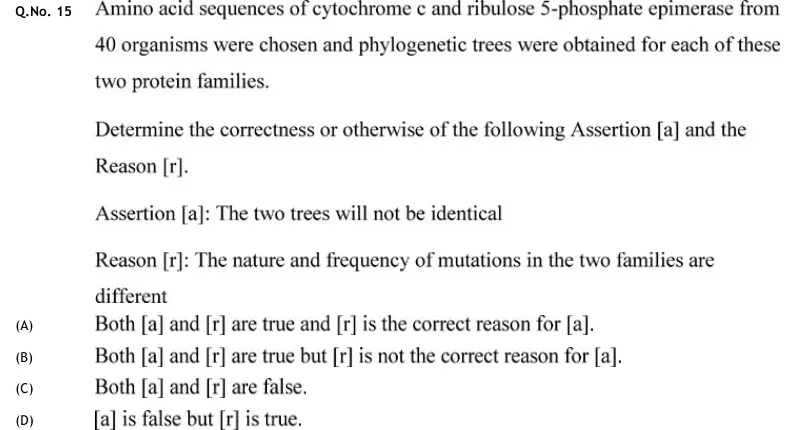
Amino acid sequences of cytochrome c and ribulose 5-phosphate epimerase from 40 organisms were chosen and phylogenetic trees were obtained for each of these two protein families.

Determine the correctness or otherwise of the following Assertion [a] and the Reason [r].

Assertion [a]: The two trees will not be identical

Reason [r]: The nature and frequency of mutations in the two families are different

  1. (A)

    Both [a] and [r] are true and [r] is the correct reason for [a].

  2. (B)

    Both [a] and [r] are true but [r] is not the correct reason for [a].

  3. (C)

    Both [a] and [r] are false.

  4. (D)

    [a] is false but [r] is true.

Answer and solution
See the question in the paper
GATE 2020 BT Q.15: answer and solution

GATE 2020 BT Q.33

GATE 2020 · BTQ.33 · 2 marks · MCQ

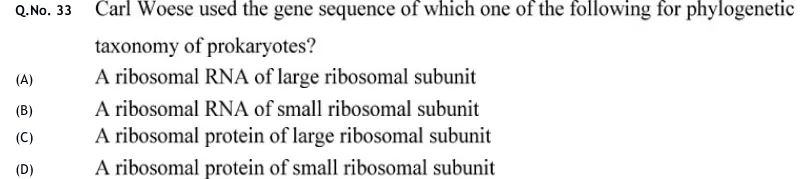
Carl Woese used the gene sequence of which one of the following for phylogenetic taxonomy of prokaryotes?

  1. (A)

    A ribosomal RNA of large ribosomal subunit

  2. (B)

    A ribosomal RNA of small ribosomal subunit

  3. (C)

    A ribosomal protein of large ribosomal subunit

  4. (D)

    A ribosomal protein of small ribosomal subunit

Answer and solution
See the question in the paper
GATE 2020 BT Q.33: answer and solution

PRACTICE

8 questions to test yourself

PRACTICE 11 mark · MCQ

How many Barr bodies are expected in the somatic cells of a human with the karyotype 48,XXXY?

  1. (A)

    0

  2. (B)

    1

  3. (C)

    2

  4. (D)

    3

Answer and solution

Answer: (C)

  1. In placental mammals all X chromosomes except one are inactivated in each somatic cell.

  2. Number of Barr bodies = number of X chromosomes − 1 = 3 − 1 = 2.

  3. The Y chromosome (with SRY) makes the individual phenotypically male, but the Y does not affect the Barr-body count.

PRACTICE 21 mark · NAT

In a population at Hardy-Weinberg equilibrium for an autosomal locus with alleles and , 16% of individuals show the recessive phenotype (). What percentage of the population are heterozygous carriers ()? (Answer as a number, e.g. 38 for 38%)

Answer and solution

Answer: (accepted range )

  1. Heterozygote frequency

  2. As a percentage: 48%

PRACTICE 32 marks · MCQ

A cross between a plant species with 2n = 24 and a related species with 2n = 20 produces a sterile hybrid. Doubling the hybrid's chromosome number with colchicine restores fertility. The resulting fertile polyploid is best described as:

  1. (A)

    An autopolyploid

  2. (B)

    An allopolyploid (amphidiploid)

  3. (C)

    An aneuploid

  4. (D)

    A monosomic

Answer and solution

Answer: (B)

  1. The gametes carry 12 and 10 chromosomes, so the hybrid has 22 chromosomes: one set from each species. These are not homologous and cannot pair properly at meiosis, so the hybrid is sterile.

  2. Doubling gives chromosomes (two complete sets from each parent, ), so every chromosome now has a homologous partner.

  3. A polyploid built from the chromosome sets of two different species is an allopolyploid (amphidiploid). It is fertile because each chromosome pairs with its own homolog.

  4. Autopolyploidy means multiplying the sets of a single species. Aneuploids and monosomics differ from the normal number by single chromosomes, not whole sets.

PRACTICE 42 marks · MSQ

Which of the following statements about human chromosomal disorders are CORRECT?

  1. (A)

    Down syndrome (trisomy 21) commonly results from nondisjunction in maternal meiosis I

  2. (B)

    Klinefelter syndrome (47,XXY) individuals are phenotypically male due to the presence of SRY on the Y chromosome

  3. (C)

    Turner syndrome (45,X) individuals are monosomic for the X chromosome

  4. (D)

    A balanced reciprocal translocation carrier always shows an abnormal phenotype

Answer and solution

Answer: (A), (B), (C)

  1. A: Free trisomy 21 arises mainly from nondisjunction of chromosome 21, most often in maternal meiosis I. TRUE.

  2. B: 47,XXY individuals are phenotypically male because the Y carries SRY, which triggers testis development whatever the number of X chromosomes. TRUE.

  3. C: 45,X individuals have a single X and no second sex chromosome, i.e., monosomy X. TRUE.

  4. D: A balanced reciprocal translocation carrier has lost or gained no genetic material and is usually phenotypically normal; the risk lies in unbalanced gametes. FALSE.

PRACTICE 51 mark · NAT

In a large, randomly mating population, the frequency of allele is 0.7 and of allele is 0.3 at an autosomal locus, and these frequencies are the same in both sexes. There is no selection, mutation, migration or drift. After one generation of random mating, what is the expected frequency of the heterozygote ? (Give your answer as a decimal, e.g. 0.25)

Answer and solution

Answer: (accepted range )

  1. With equal allele frequencies in both sexes, one generation of random mating gives Hardy-Weinberg proportions .

  2. ,

  3. Heterozygote frequency

PRACTICE 61 mark · MCQ

A small population of 20 individuals is founded from a much larger mainland population by a chance colonisation event. Over the following generations one allele becomes fixed purely by chance, even though selection does not favour it. This is best described as an example of:

  1. (A)

    Natural selection

  2. (B)

    Genetic drift

  3. (C)

    Gene flow (migration)

  4. (D)

    Recurrent mutation

Answer and solution

Answer: (B)

  1. The clues are a small population and fixation purely by chance, with no fitness advantage.

  2. Genetic drift is random change in allele frequency caused by sampling gametes in a finite population. Its variance per generation is , so it is largest in small populations, where alleles are fixed or lost by chance.

  3. A few founders sampling alleles from a larger source is the founder effect, a special case of genetic drift. It is not listed as an option, and the mechanism that fixes the allele is drift.

  4. Natural selection would need the allele to be fitter (ruled out). Gene flow needs continuing migration, not a one-time founding. Recurrent mutation is far too slow to fix an allele in this way.

PRACTICE 71 mark · NAT

A trait is caused by an X-linked recessive allele. In a population at Hardy-Weinberg equilibrium, with equal allele frequencies in both sexes, 8% of males show the trait. What percentage of females are expected to show it? (Answer as a number, e.g. 1.5 for 1.5%)

Answer and solution

Answer: (accepted range )

  1. Males are hemizygous, so the fraction of affected males equals the allele frequency: .

  2. Females need two copies: affected females .

  3. As a percentage: 0.64%.

PRACTICE 82 marks · NAT

A recessive lethal allele ( individuals never reproduce; and have equal fitness) has a frequency of 0.1 in a large, randomly mating population. Ignoring mutation, migration and drift, how many generations of selection are needed to reduce its frequency to 0.01?

Answer and solution

Answer:

  1. With complete selection against : , so .

  2. After generations: , so .

  3. generations.

OFFICIAL GATE 2027 SYLLABUS WORDING

Copied from the GATE 2027 syllabus; see all 2027 syllabi.

GATE BT

Chromosomal variation; Sex Determination; Genetic disorders; Population genetics; Epigenetics; Selection and inheritance; Adaptive and neutral evolution; Genetic drift; Species and speciation

Preparing in Kolkata? IAE Academy's course for GATE BT.