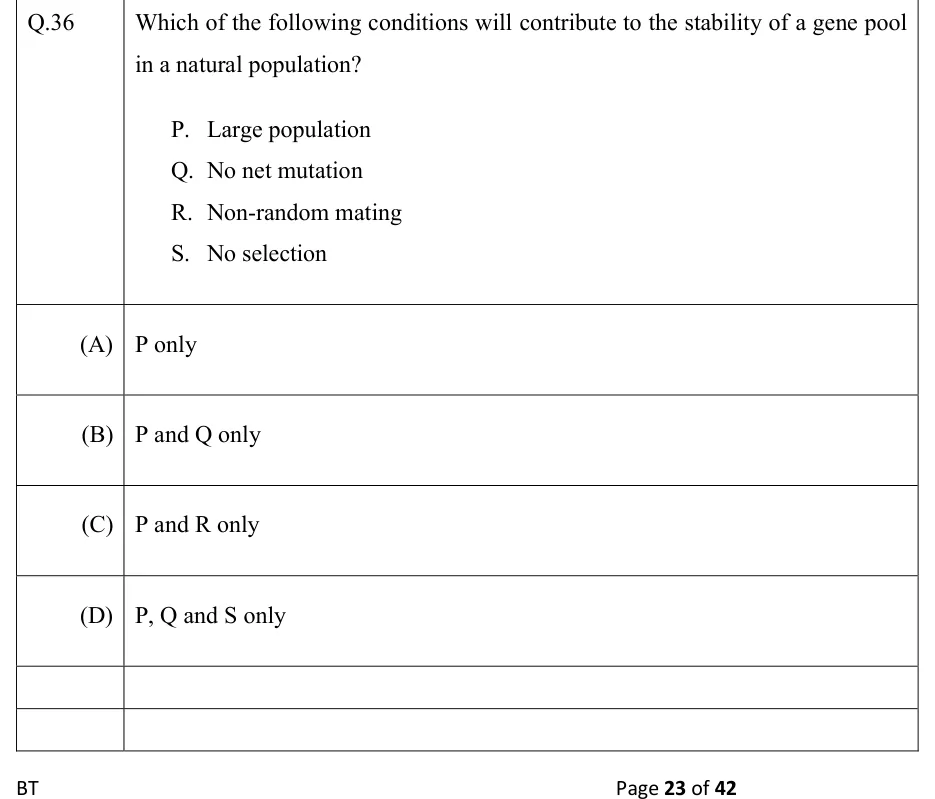
Which of the following conditions will contribute to the stability of a gene pool in a natural population?
P. Large population
Q. No net mutation
R. Non-random mating
S. No selection
- (A)
P only
- (B)
P and Q only
- (C)
P and R only
- (D)
P, Q and S only

Which of the following conditions will contribute to the stability of a gene pool in a natural population?
P. Large population
Q. No net mutation
R. Non-random mating
S. No selection
P only
P and Q only
P and R only
P, Q and S only
ANSWER
The correct answer is (D) P, Q and S only.
Official answer: DSource: Official answer key, GATE 2022 BT (IIT Kharagpur)
Gene pool (allele frequency) stability across generations is defined by the Hardy-Weinberg equilibrium, which holds only when a specific set of disturbing forces is absent or negligible.
P — Large population: contributes to stability. A large population size minimizes genetic drift (random, sampling-driven fluctuations in allele frequency that are pronounced in small populations), so it supports a stable gene pool.
Q — No net mutation: contributes to stability. Mutation is a source of new alleles and allele-frequency change; its absence is one of the Hardy-Weinberg conditions that keeps the gene pool stable.
R — Non-random mating: does NOT contribute to stability. Hardy-Weinberg equilibrium specifically requires RANDOM mating. Non-random mating (e.g., assortative mating or inbreeding) changes genotype frequencies across generations and is one of the classical forces that can disturb equilibrium, so it is excluded from the stabilizing set.
S — No selection: contributes to stability. Natural selection changes allele frequencies through differential survival and reproduction; its absence is required for the gene pool to remain stable.
The conditions contributing to gene pool stability are therefore P, Q and S only; R does not belong, since non-random mating is a disturbing force rather than a stabilizing one.
This matches option (D): P, Q and S only.
KEY IDEA
A gene pool (its allele frequencies) stays stable across generations only under Hardy-Weinberg conditions: an infinitely large (in practice, sufficiently large) population, no mutation, random mating, and no selection (also no migration/gene flow).
WATCH OUT FOR
Assuming random mating and non-random mating are interchangeable, or forgetting that Hardy-Weinberg equilibrium requires RANDOM mating specifically — so "non-random mating" (R) is a disturbing force, not a stabilizing condition, and must be excluded.
From the GATE 2022 BT paper. Every question of this paper · Download the full paper · All 11 Population & evolution questions, with notes