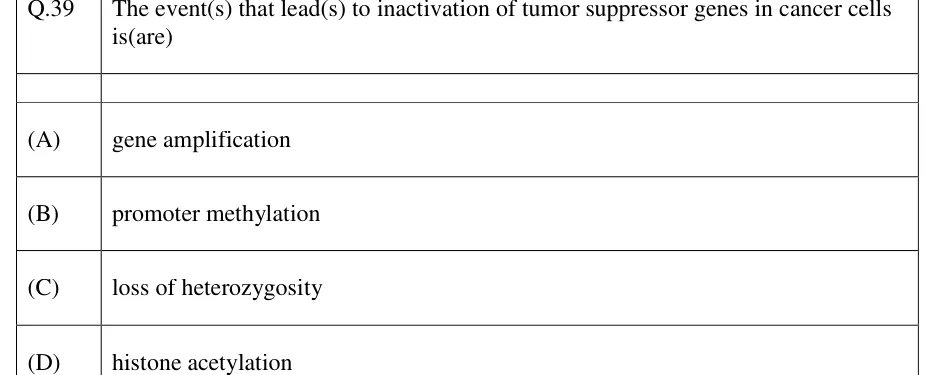
The event(s) that lead(s) to inactivation of tumor suppressor genes in cancer cells is(are)
- (A)
gene amplification
- (B)
promoter methylation
- (C)
loss of heterozygosity
- (D)
histone acetylation

The event(s) that lead(s) to inactivation of tumor suppressor genes in cancer cells is(are)
gene amplification
promoter methylation
loss of heterozygosity
histone acetylation
ANSWER
The events that lead to inactivation of tumor suppressor genes are (B) promoter methylation and (C) loss of heterozygosity.
Official answer: B, CSource: Official answer key, GATE 2023 BT (IIT Kanpur)
Apply Knudson's two-hit hypothesis: a tumor suppressor gene must lose function on BOTH alleles to be fully inactivated in a cell.
(A) Gene amplification raises a gene's copy number and expression; this is the standard mechanism of ONCOGENE activation (e.g., HER2, MYC), not tumor suppressor inactivation — eliminate A.
(B) Promoter methylation: hypermethylation of CpG islands in a tumor suppressor's promoter recruits repressive methyl-binding complexes and silences transcription of that allele — a recognized 'second hit' mechanism (e.g., BRCA1, MLH1, p16) — include B.
(C) Loss of heterozygosity: after one allele is already mutated, loss of the remaining wild-type allele (via deletion, mitotic recombination, or chromosome loss) removes the last functional copy — the classic second hit in the Knudson model (e.g., RB1) — include C.
(D) Histone acetylation neutralizes histone charge, opens chromatin, and generally ACTIVATES transcription — the opposite of gene silencing; silencing is instead associated with histone DEacetylation (HDACs) — eliminate D.
Therefore the events leading to tumor suppressor gene inactivation are promoter methylation and loss of heterozygosity: options B and C.
KEY IDEA
Tumor suppressor genes are inactivated by loss-of-function events on both alleles (Knudson's two-hit hypothesis): genetic hits such as loss of heterozygosity (deletion, mitotic recombination, or chromosome loss of the remaining wild-type allele) and epigenetic hits such as promoter hypermethylation, which silences transcription. Oncogenes, by contrast, are activated (not tumor suppressors inactivated) by gene amplification, and gene silencing is generally associated with histone deacetylation, not acetylation.
WATCH OUT FOR
Confusing gene amplification (an oncogene-activation mechanism, e.g. HER2/MYC copy number gain) with tumor suppressor inactivation, or confusing histone acetylation (which opens chromatin and activates transcription) with histone deacetylation (which is the actual silencing mechanism associated with HDACs).
From the GATE 2023 BT paper. Every question of this paper · Download the full paper · All 11 Population & evolution questions, with notes