IAE Academy

GATE 2020 BT Q.15: solution and answer

GATE 2020 · BTQ.15 · 1 mark · MCQ

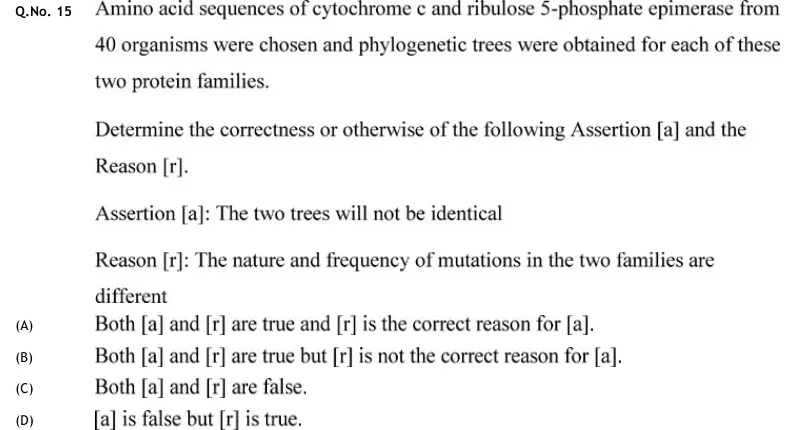
Amino acid sequences of cytochrome c and ribulose 5-phosphate epimerase from 40 organisms were chosen and phylogenetic trees were obtained for each of these two protein families.

Determine the correctness or otherwise of the following Assertion [a] and the Reason [r].

Assertion [a]: The two trees will not be identical

Reason [r]: The nature and frequency of mutations in the two families are different

  1. (A)

    Both [a] and [r] are true and [r] is the correct reason for [a].

  2. (B)

    Both [a] and [r] are true but [r] is not the correct reason for [a].

  3. (C)

    Both [a] and [r] are false.

  4. (D)

    [a] is false but [r] is true.

See the question in the paper

Answer and solution

ANSWER

Both Assertion [a] and Reason [r] are true, and [r] is the correct explanation for [a] — Option A.

Official answer: ASource: Official answer key, GATE 2020 BT (IIT Delhi)

  1. Assertion [a]: A tree inferred from a given protein's sequences reflects that particular protein's own accumulated substitution history, not automatically a single universal species tree shared by every gene.

  2. Cytochrome c (small, highly conserved, central to electron transport) and ribulose 5-phosphate epimerase (a metabolic enzyme with different structural/functional constraints) are functionally very different proteins, so different sites in each are free to vary at different rates.

  3. Reason [r]: Because of these different functional constraints, each protein family has accumulated mutations of its own characteristic nature and frequency (in effect, its own molecular clock rate/pattern) — this is a well-documented feature of molecular evolution (rate heterogeneity among proteins).

  4. Since the two proteins carry independent, differently-paced substitution histories, trees inferred separately from each will generally differ in branch lengths and can differ in topology/resolution even though the same 40 organisms are used — so [a] is TRUE.

  5. [r] is TRUE and is exactly the reason [a] holds: it is the differing nature/frequency of mutations between the two protein families that causes the sequence-based trees to diverge.

  6. Therefore both [a] and [r] are true and [r] is the correct explanation for [a] — Option A.

KEY IDEA

Different proteins in the same set of organisms accumulate substitutions at different rates and patterns because they are under different functional/structural constraints — this is why phylogenetic trees built from different protein families for the same taxa need not be identical, and often are not.

WATCH OUT FOR

Assuming that because the same 40 organisms are used, a "true" underlying species tree must force identical gene/protein trees regardless of which molecule is sequenced — ignoring that each protein's own mutation rate and pattern (its own effective molecular clock) independently shapes the inferred tree, so different proteins can legitimately give different topologies/branch lengths for the same species.

From the GATE 2020 BT paper. Every question of this paper · Download the full paper · All 11 Population & evolution questions, with notes

More Population & evolution questions