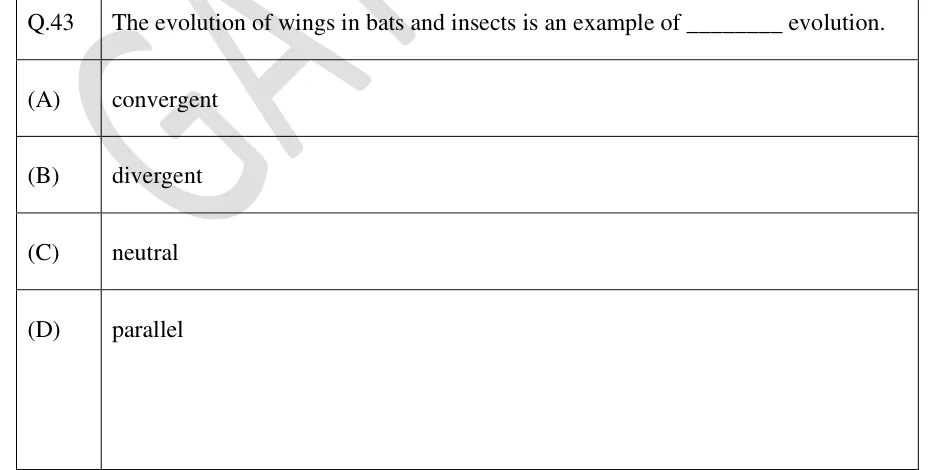
The evolution of wings in bats and insects is an example of ________ evolution.
- (A)
convergent
- (B)
divergent
- (C)
neutral
- (D)
parallel

The evolution of wings in bats and insects is an example of ________ evolution.
convergent
divergent
neutral
parallel
ANSWER
The evolution of wings in bats and insects is convergent evolution (option A) — two evolutionarily unrelated lineages independently evolved analogous flight structures from different anatomical origins in response to similar functional (locomotor) pressures.
Official answer: ASource: Official answer key, GATE 2024 BT (IISc Bengaluru)
Bats (phylum Chordata, class Mammalia) and insects (phylum Arthropoda) belong to lineages that diverged long before either group evolved flight; they share no winged common ancestor.
Bat wings are modified tetrapod forelimbs, homologous to the forelimbs of other vertebrates; insect wings develop as outgrowths of the body wall/exoskeleton (cuticle) — a completely different anatomical and developmental origin.
Despite this different origin, both structures serve the same function (powered flight) and are superficially similar in role — this is the definition of analogous structures.
Convergent evolution is defined as unrelated or distantly related organisms independently evolving similar (analogous) traits/structures to adapt to similar functional demands — exactly the bat/insect wing case. Hence (A) convergent is correct.
(B) Divergent evolution describes homologous structures in related lineages evolving into different forms/functions (e.g., the vertebrate forelimb becoming an arm, flipper, or wing) — the reverse of what is described here, so (B) is wrong.
(C) Neutral evolution refers to changes fixed by genetic drift with no adaptive significance; it is irrelevant to the clearly adaptive, function-driven similarity of wings, so (C) is wrong.
(D) Parallel evolution involves related lineages with a similar ancestral starting point independently evolving similar traits under similar pressures; bats and insects are not closely related and did not share a similar pre-wing ancestral structure, so (D) is a common distractor but is not correct here.
KEY IDEA
Convergent evolution = unrelated/distantly related lineages independently evolving analogous (not homologous) structures under similar selective pressure — the hallmark being different developmental/anatomical origin but similar function. Bat wings (modified tetrapod forelimb) and insect wings (exoskeletal/cuticular outgrowth) are the classic textbook pair illustrating exactly this.
WATCH OUT FOR
Confusing convergent evolution with parallel evolution: parallel evolution requires related lineages that started from a similar ancestral structure/genetic background and then evolved similar traits independently under similar pressures, whereas convergent evolution involves distantly related lineages with fundamentally different starting structures (homology absent) converging on a similar function. Since bats (chordates) and insects (arthropods) share no winged common ancestor and their wings arise from entirely different tissues, this is convergence, not parallelism — a distinction students often blur.
From the GATE 2024 BT paper. Every question of this paper · Download the full paper · All 11 Population & evolution questions, with notes