
IAE Academy

GATE 2023 EE Q.59: solution and answer

GATE 2023 · EEQ.59 · 2 marks · NAT

The Zener diode in circuit has a breakdown voltage of 5 V. The current gain of the transistor in the active region in 99. Ignore base-emitter voltage drop . The current through the 20 resistance in milliamperes is ________ (Round off to 2 decimal places).
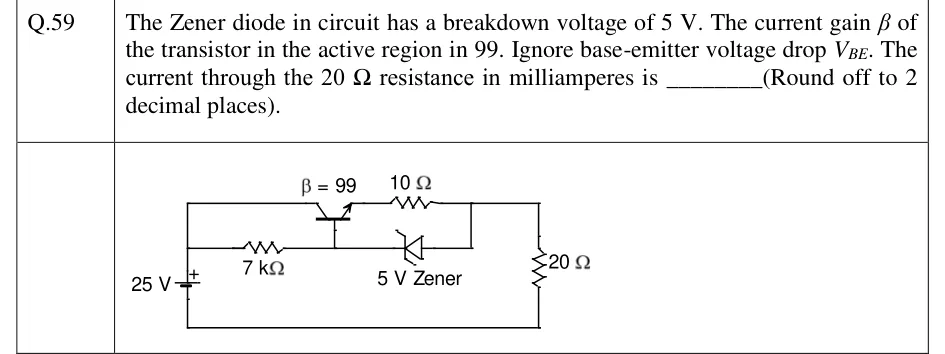
GATE 2023 EE question 59: A 25 V battery (+ terminal at top) on the left.Tap to open full size
Figure from the GATE 2023 EE paper. It is part of the question.
Figure description

A 25 V battery (+ terminal at top) on the left. From the + terminal a vertical wire rises to a top rail that goes right to the collector of an NPN transistor (β = 99), drawn horizontally: collector on the left, emitter (outward arrow) on the right, base pointing down. The emitter connects through a 10 Ω resistor to a right-hand node (call it L). A second wire leaves the + terminal through a 7 k Ω resistor to the base node B. From B a 5 V Zener diode runs right to node L, with its cathode (bar) at B and its anode (triangle base) at L, so the triangle points toward the base. Node L continues right and down through a 20 Ω resistor to the bottom wire, which returns to the battery's − terminal (ground).

Answer and solution

ANSWER

The current through the 20 Ω resistor is 250.00 mA. The Zener stays below breakdown (only 2.5 V across it), so the whole emitter current of 250 mA flows through the 20 Ω resistor.

Official answer: 245 to 255Source: Official answer key, GATE 2023 EE (IIT Kanpur)

  1. Assumptions: the NPN transistor is in the active region and , so and . Call the right-hand end of the 10 resistor node L. L is also the top of the 20 resistor. The Zener has its cathode at the base B and its anode at L. Because , the Zener sits directly across the 10 emitter resistor: . So the Zener can never be forward biased. It is either in breakdown or off.

  2. Try breakdown first. Then , which gives and . Take the Zener current as flowing from cathode to anode (B to L). KCL at B gives . KCL at L gives . With and , the 7 k current is . Substituting for : , so and .

  3. The Zener current would then be . Breakdown current must flow from cathode to anode, so it cannot be negative. The breakdown assumption fails, and the Zener is OFF ().

  4. With the Zener open, all of the 7 k current is base current. Apply KVL from the 25 V rail through the 7 k resistor, the base-emitter junction ( V), and the 10 and 20 resistors, which both carry :

  5. Check the Zener: . It is below breakdown, so it is off, as assumed. Check the active region: and , so . The transistor is active.

  6. With , the only current into node L is the emitter current. So . As a check, and , which matches the drop across the 10 resistor.

KEY IDEA

With , the Zener is connected straight across the 10 emitter resistor and is reverse biased by . Assume one Zener state, solve the emitter-follower bias with the emitter resistance reflected into the base loop as , then check the assumption. Here breakdown gives a negative Zener current, so the Zener is off. That leaves and .

WATCH OUT FOR

Seeing a 5 V Zener and assuming it is in breakdown. That puts 5 V across the 10 Ω resistor, so and (or 500 mA if the Zener current is ignored), and the Zener current comes out negative, which is impossible. Always check a Zener's state after solving. Other slips: leaving out the factor on the 20 Ω resistor in the base loop, and reporting instead of as the current in the 20 Ω resistor.

From the GATE 2023 EE paper. Every question of this paper · Download the full paper · All 13 Biasing questions, with notes

More Biasing questions