
IAE Academy

GATE 2026 EC Q.18: solution and answer

GATE 2026 · ECQ.18 · 1 mark · MCQ

Consider the circuit shown in the Figure with and .

Assume and for the BJT.

Which of the following options is the correct value of the current ?
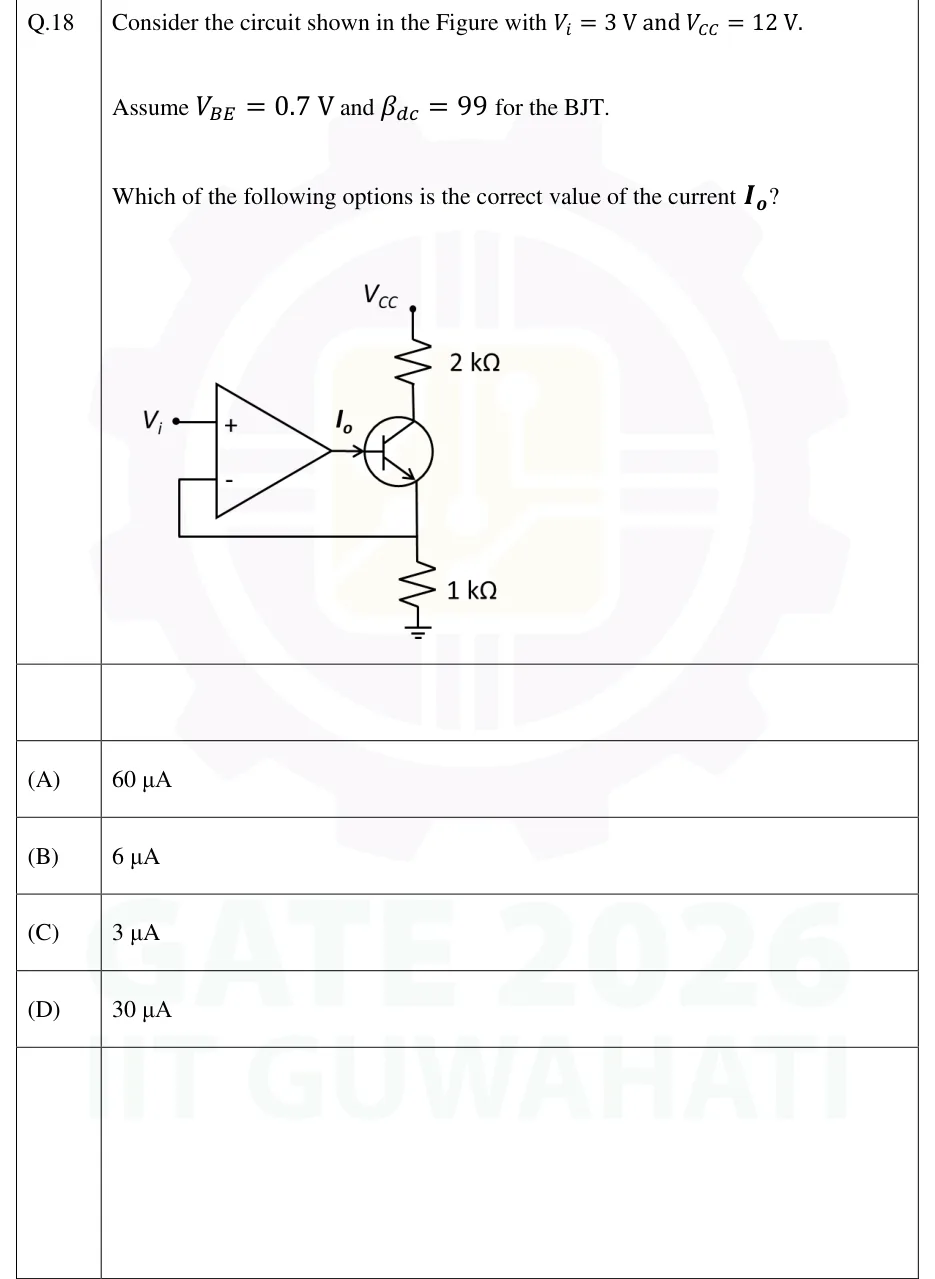
GATE 2026 EC question 18: An op-amp whose non-inverting (+) input is driven by the input voltage V_i and whose inverting (−) input is tied by a wire…Tap to open full size
Figure from the GATE 2026 EC paper. It is part of the question.
Figure description

An op-amp whose non-inverting (+) input is driven by the input voltage V_i and whose inverting (−) input is tied by a wire to the emitter of an NPN BJT. The op-amp output drives the BJT base directly; the current flowing out of the op-amp output into the base is labelled I_o (arrow pointing into the base). The BJT collector connects through a 2 k Ω resistor to the supply V_CC. The BJT emitter connects through a 1 k Ω resistor to ground, and the same emitter node is fed back to the op-amp's inverting input.

  1. (A)

  2. (B)

  3. (C)

  4. (D)

Answer and solution

ANSWER

, which is option (D).

Official answer: DSource: Official answer key, GATE 2026 EC (IIT Guwahati)

  1. Assume an ideal op-amp: it draws no input current, and its gain is large enough to hold both inputs at the same voltage. The emitter is wired back to the inverting input. If the emitter voltage rises, the op-amp output (the base) falls and pulls the emitter back down, so this is negative feedback and the virtual short holds: .

  2. The inverting input draws no current, so all of the emitter current flows through the resistor. By Ohm's law, .

  3. is the current from the op-amp output into the base, so . In the active region , which gives

  4. Check that the BJT really is in the active region. . KVL on the collector side gives .

  5. The op-amp output sits at (the ideal op-amp is assumed able to reach this level). Then , so the collector-base junction is reverse biased, and is well above . The transistor is in the active region, so was valid.

  6. So , which is option (D).

KEY IDEA

This is an op-amp driving a BJT, the standard voltage-to-current converter. Negative feedback through the emitter forces . The op-amp raises its output to , which cancels . So the emitter current is set only by , whatever or are. The op-amp only has to supply the base current, . The collector resistor and play no part in ; they matter only for checking that the transistor stays active.

WATCH OUT FOR

The first mistake is to treat the circuit as a plain emitter follower and write . The feedback loop puts the base at , so the emitter sits at exactly . The second is to take as the emitter or collector current (about ) rather than the base current the op-amp supplies. The third is to divide by instead of : that gives , which is close but not exact. With , gives exactly .

From the GATE 2026 EC paper. Every question of this paper · Download the full paper · All 13 Biasing questions, with notes

More Biasing questions