
IAE Academy

GATE 2026 IN Q.22: solution and answer

GATE 2026 · INQ.22 · 1 mark · MCQ

In the circuit shown, the BJT has a of 100. The base-emitter junction voltage is 0.65 V. The quiescent collector current, is _______ mA.
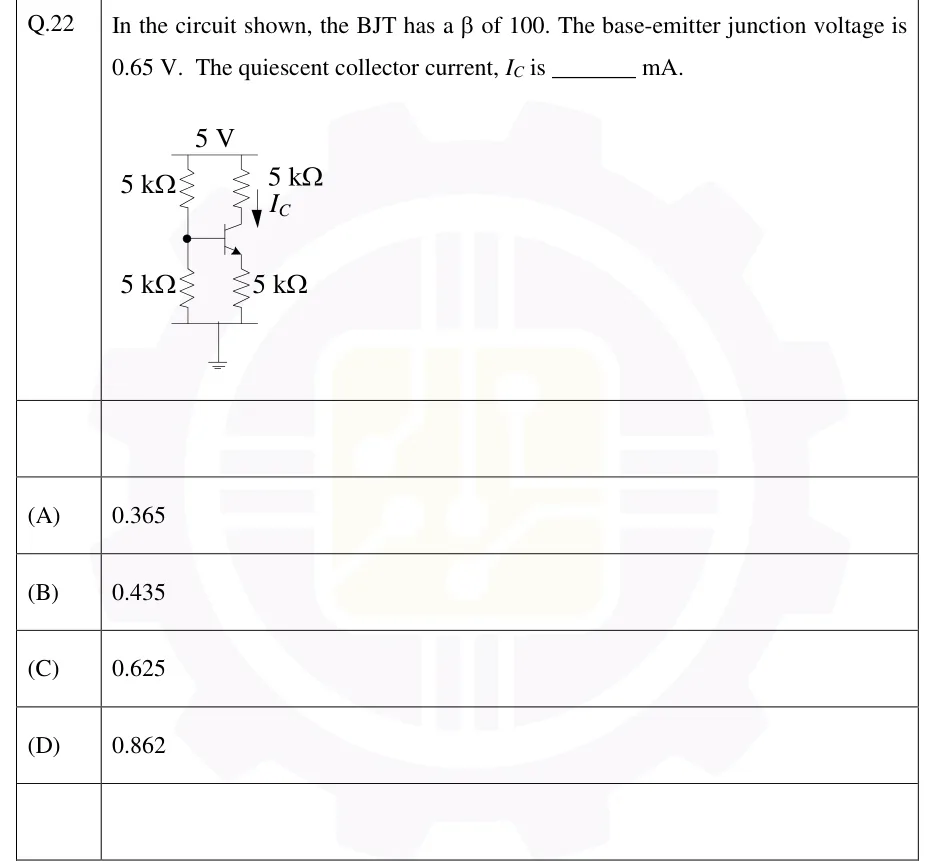
GATE 2026 IN question 22: Voltage-divider bias of an NPN BJT from a single 5 V supply.Tap to open full size
Figure from the GATE 2026 IN paper. It is part of the question.
Figure description

Voltage-divider bias of an NPN BJT from a single 5 V supply. A 5 V rail at the top; ground at the bottom. Left branch: a 5 kΩ resistor from the 5 V rail down to the base node (marked with a dot), and a 5 kΩ resistor from the base node down to ground. The base node connects horizontally to the base of an NPN transistor (emitter arrow pointing outward, downward). Collector (top) connects through a 5 kΩ resistor to the 5 V rail; a downward arrow beside this resistor is labelled I_C (current flowing from the rail into the collector). Emitter (bottom) connects through a 5 kΩ resistor to ground.

  1. (A)

    0.365

  2. (B)

    0.435

  3. (C)

    0.625

  4. (D)

    0.862

Answer and solution

ANSWER

, option (A).

Official answer: ASource: Official answer key, GATE 2026 IN (IIT Guwahati)

  1. Assume the BJT is in forward-active mode, so and , with . We check this assumption at the end.

  2. Replace the base divider with its Thevenin equivalent: and .

  3. Write KVL around the base-emitter loop, with : .

  4. Solve for the base current (working in V, k and mA):

  5. Collector current: .

  6. Check the active-mode assumption. , so and . Also . Then , which is well above , and , so the base-collector junction is reverse biased. The transistor is in forward-active mode, so the assumption holds. The answer is , option (A).

KEY IDEA

This is voltage-divider bias. Replace the divider with its Thevenin equivalent (, ). The emitter resistor looks times larger from the base, so , and then . Always confirm active mode afterwards: .

WATCH OUT FOR

One common slip is treating the divider as stiff: ignoring and taking . That is close but is not one of the options. Another is forgetting the factor that reflects into the base loop, which gives a base current, and so a collector current, that is much too large.

From the GATE 2026 IN paper. Every question of this paper · Download the full paper · All 13 Biasing questions, with notes

More Biasing questions