
IAE Academy

GATE 2025 IN Q.22: solution and answer

GATE 2025 · INQ.22 · 1 mark · MCQ

Match the following sensors with their most suitable applications.

Sensors: P Rotary Variable Differential Transformer; Q Thermocouple; R Ionization Gauge; S Strain Gauge.
Applications: I Vacuum measurement; II Force measurement; III Angular displacement measurement; IV Temperature measurement.
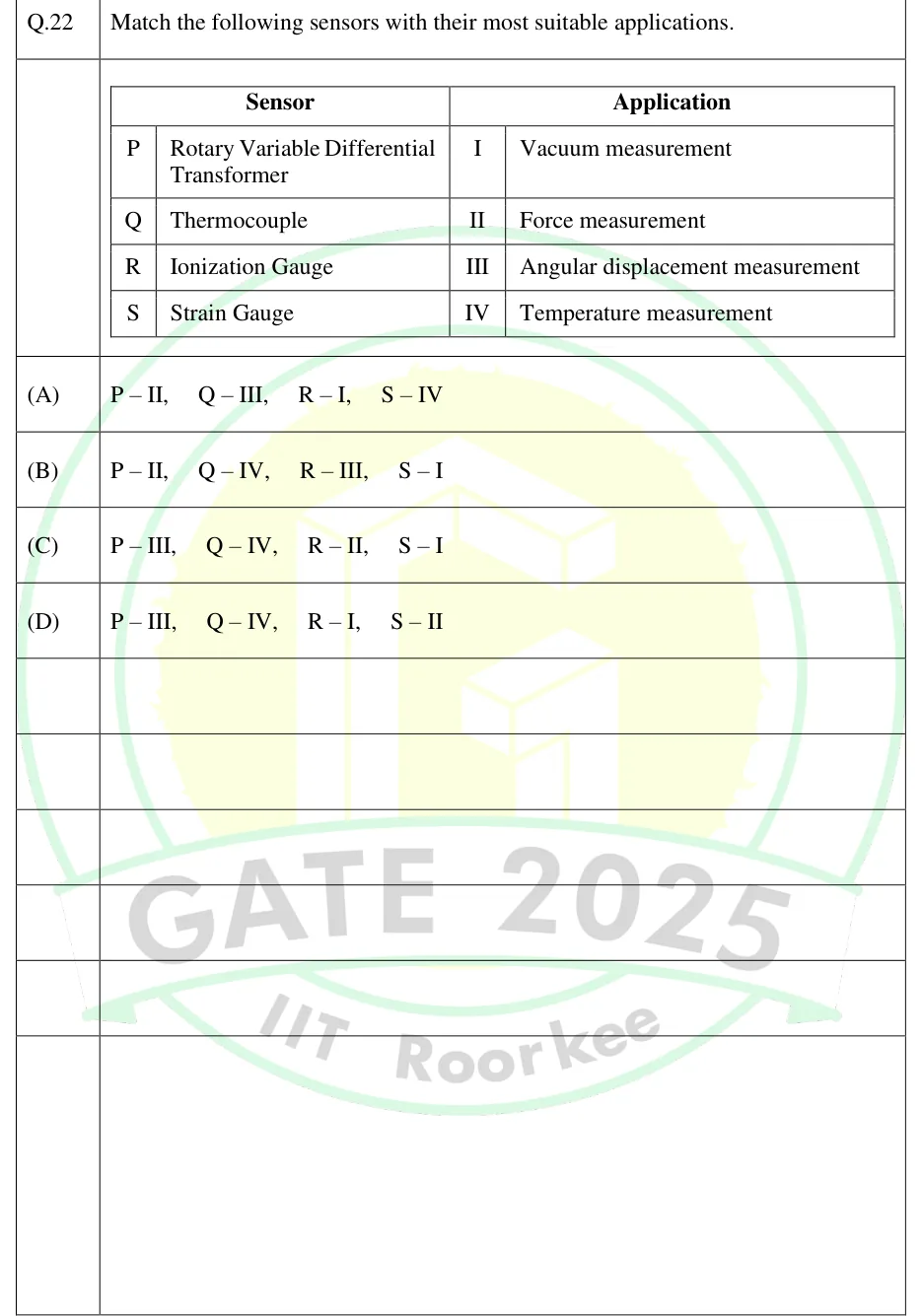
GATE 2025 IN question 22: A two-part table.Tap to open full size
Figure from the GATE 2025 IN paper. It is part of the question.
Figure description

A two-part table. The left part is headed 'Sensor' and lists P: Rotary Variable Differential Transformer, Q: Thermocouple, R: Ionization Gauge, S: Strain Gauge. The right part is headed 'Application' and lists I: Vacuum measurement, II: Force measurement, III: Angular displacement measurement, IV: Temperature measurement.

  1. (A)

    P – II, Q – III, R – I, S – IV

  2. (B)

    P – II, Q – IV, R – III, S – I

  3. (C)

    P – III, Q – IV, R – II, S – I

  4. (D)

    P – III, Q – IV, R – I, S – II

Answer and solution

ANSWER

Option (D): P–III, Q–IV, R–I, S–II.

Official answer: DSource: Official answer key, GATE 2025 IN (IIT Roorkee)

  1. Match each sensor with the quantity its working principle measures.

  2. P, the Rotary Variable Differential Transformer, is the rotary form of an LVDT. Its core turns inside the windings, and over a limited angle the output voltage is proportional to the core's angular position. So P matches III, angular displacement measurement.

  3. Q, the thermocouple, works on the Seebeck effect. The emf depends on the difference between the measuring-junction and reference-junction temperatures. So Q matches IV, temperature measurement.

  4. R, the ionization gauge, uses electrons to ionize the gas molecules. At very low pressure the collected ion current is proportional to the gas pressure. So R matches I, vacuum measurement.

  5. S, the strain gauge, changes resistance with strain according to . On an elastic member such as a load cell, the strain is proportional to the applied force. So S matches II, force measurement.

  6. The combination is P–III, Q–IV, R–I, S–II, which is option (D).

KEY IDEA

Match each sensor to the physical quantity its principle directly responds to. An RVDT gives angle, a thermocouple gives temperature, an ionization gauge gives low gas pressure (vacuum), and a strain gauge on an elastic member gives force.

WATCH OUT FOR

Pairing the strain gauge with vacuum, or the RVDT with force, because both are loosely thought of as mechanical sensors. A strain gauge senses strain, which becomes force only through an elastic member. An RVDT senses rotation of its core, not force.

From the GATE 2025 IN paper. Every question of this paper · Download the full paper · All 19 Sensing principles questions, with notes

More Sensing principles questions