
IAE Academy

GATE 2024 IN Q.14: solution and answer

GATE 2024 · INQ.14 · 1 mark · MCQ

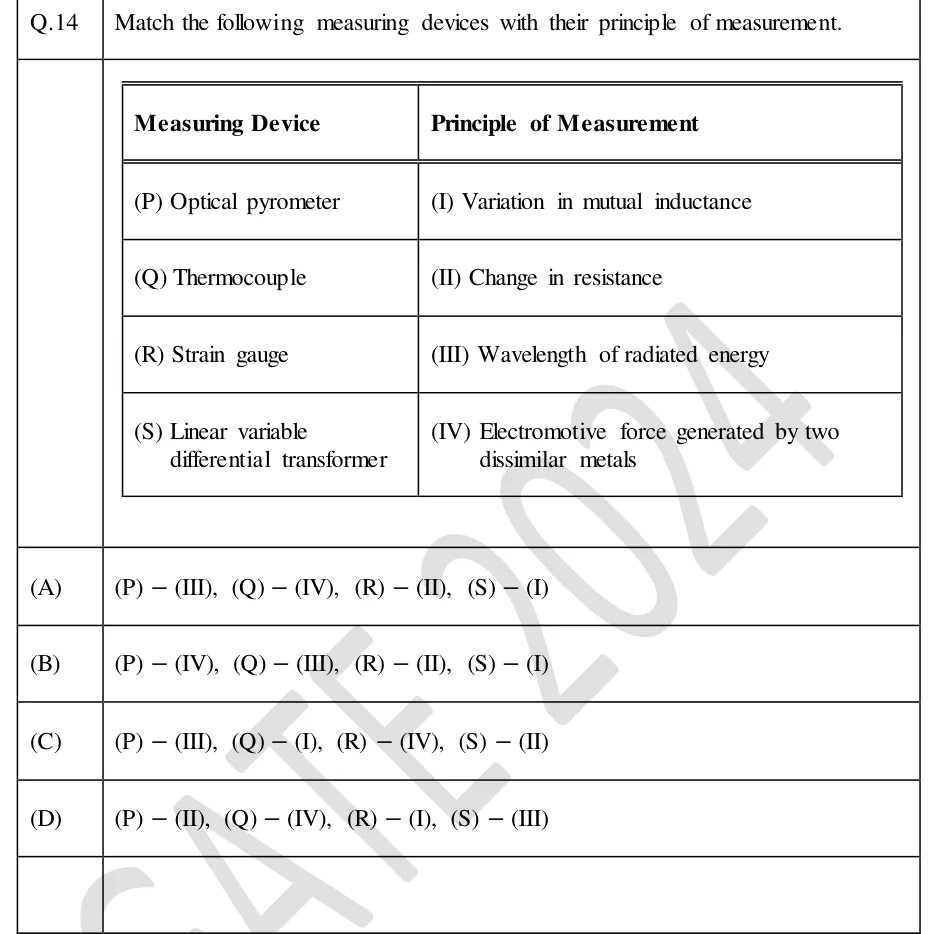
Match the following measuring devices with their principle of measurement.

Measuring Device: (P) Optical pyrometer; (Q) Thermocouple; (R) Strain gauge; (S) Linear variable differential transformer.
Principle of Measurement: (I) Variation in mutual inductance; (II) Change in resistance; (III) Wavelength of radiated energy; (IV) Electromotive force generated by two dissimilar metals.
GATE 2024 IN question 14: A two-column table.Tap to open full size
Figure from the GATE 2024 IN paper. It is part of the question.
Figure description

A two-column table. Left column 'Measuring Device' lists (P) Optical pyrometer, (Q) Thermocouple, (R) Strain gauge, (S) Linear variable differential transformer. Right column 'Principle of Measurement' lists (I) Variation in mutual inductance, (II) Change in resistance, (III) Wavelength of radiated energy, (IV) Electromotive force generated by two dissimilar metals.

  1. (A)

    (P) − (III), (Q) − (IV), (R) − (II), (S) − (I)

  2. (B)

    (P) − (IV), (Q) − (III), (R) − (II), (S) − (I)

  3. (C)

    (P) − (III), (Q) − (I), (R) − (IV), (S) − (II)

  4. (D)

    (P) − (II), (Q) − (IV), (R) − (I), (S) − (III)

Answer and solution

ANSWER

The correct option is (A): (P)-(III), (Q)-(IV), (R)-(II), (S)-(I).

Official answer: ASource: Official answer key, GATE 2024 IN (IISc Bengaluru)

  1. Optical pyrometer (P): a non-contact temperature instrument that compares the brightness or colour (wavelength) of the radiation from a hot body with that of a calibrated reference filament. So (P) matches (III), wavelength of radiated energy.

  2. Thermocouple (Q): the Seebeck effect. Two dissimilar metals joined at a junction generate an electromotive force that depends on the temperature difference between the measuring junction and the reference junction. So (Q) matches (IV).

  3. Strain gauge (R): a strain changes the resistance of the gauge wire, with gauge factor . So (R) matches (II), change in resistance.

  4. Linear variable differential transformer (S): the core position changes the mutual inductance between the primary and the two secondary windings, so the differential output voltage is proportional to the core displacement. So (S) matches (I).

  5. The pairing is (P)-(III), (Q)-(IV), (R)-(II), (S)-(I), which is option (A). Option (B) puts (P) with (IV) and (Q) with (III). Option (C) puts (Q) with (I) and (R) with (IV). Option (D) puts (P) with (II), (R) with (I) and (S) with (III). Each of these breaks at least one pairing above, so all three are wrong.

KEY IDEA

Match each sensor to the physical quantity it actually converts. A pyrometer reads radiated energy, a thermocouple produces a Seebeck EMF, a strain gauge changes its resistance, and an LVDT changes the mutual inductance between its windings.

WATCH OUT FOR

Pairing the thermocouple with a wavelength or the pyrometer with an EMF, because both are temperature sensors. Another slip is pairing the strain gauge with mutual inductance, when it is a resistive sensor and the LVDT is the inductive one.

From the GATE 2024 IN paper. Every question of this paper · Download the full paper · All 19 Sensing principles questions, with notes

More Sensing principles questions