
IAE Academy

GATE 2023 IN Q.54: solution and answer

GATE 2023 · INQ.54 · 2 marks · NAT

Four strain gauges R_A, R_B, R_C and R_D, each with nominal resistance R, are connected in a bridge configuration. When a force is applied, R_A and R_D increase by ΔR and R_B and R_C decrease by ΔR as shown. A potentiometer with total resistance R_v is connected as shown. If R = 100 Ω, and ΔR = 1 Ω, the minimum value of resistance R_v required to balance the bridge is ______ Ω (rounded off to two decimal places).
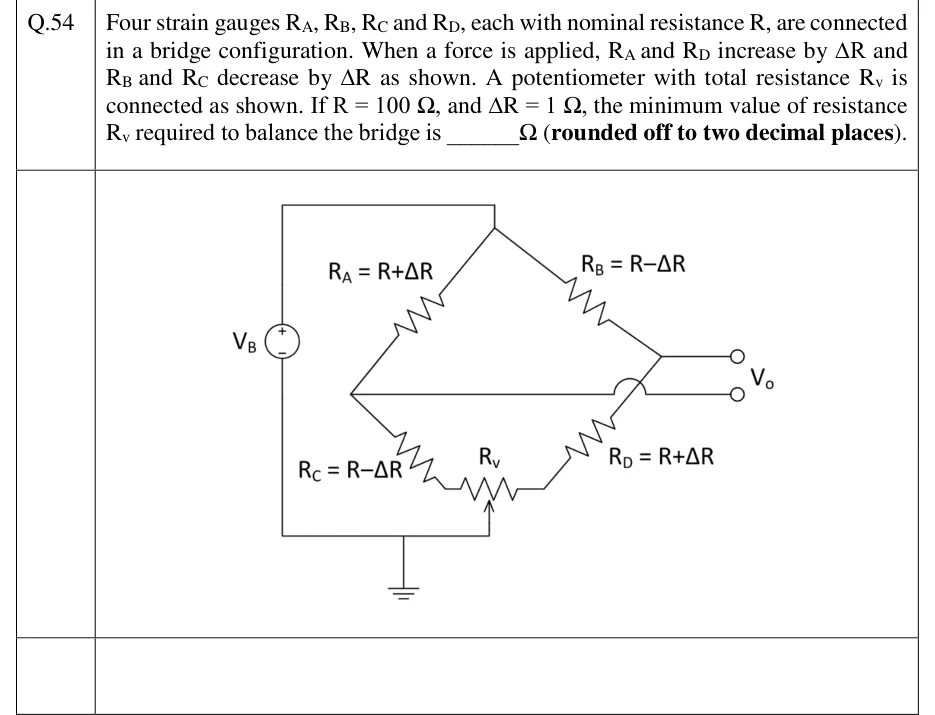
GATE 2023 IN question 54: Wheatstone bridge excited by source V_B (plus terminal up) across the top node and ground.Tap to open full size
Figure from the GATE 2023 IN paper. It is part of the question.
Figure description

Wheatstone bridge excited by source V_B (plus terminal up) across the top node and ground. Left arm: R_A = R+ΔR from the top node to the left node, then R_C = R−ΔR from the left node down to the left end of the potentiometer R_v. Right arm: R_B = R−ΔR from the top node to the right node, then R_D = R+ΔR from the right node down to the right end of the potentiometer R_v. The potentiometer's wiper (arrow) is connected to ground, which is also the negative side of V_B. The output V_o is taken between the left node and the right node (the wire from the left node runs horizontally and jumps over the R_D wire to the lower output terminal).

Answer and solution

ANSWER

The minimum pot resistance needed to balance the bridge is .

Official answer: 4.00 to 4.10Source: Official answer key, GATE 2023 IN (IIT Kanpur)

  1. Circuit: the sensors are in all four arms of a full bridge. The supply drives the top node. Left arm: then then the left part of the potentiometer, down to the grounded wiper. Right arm: then then the right part of the potentiometer, down to the same ground. The output is taken between the left node (between and ) and the right node (between and ). With and : and . The wiper splits the pot as , with .

  2. Left node voltage (potential divider):

  3. Right node voltage:

  4. Balance requires , so

  5. Expand. The terms cancel: which gives

  6. Put : , so

  7. Since (the wiper cannot go past the end of the pot), is smallest when the wiper sits at the end stop, .

  8. Then , so

KEY IDEA

Write the two arm voltages as potential dividers to the grounded wiper. Balance gives the linear condition . The pot's total resistance is smallest when the wiper is at one end stop, so .

WATCH OUT FOR

Treating the grounded wiper as a simple series trim in one arm, or ignoring that the pot is shared between both arms. Another slip is balancing with (wiper at the centre) and getting a larger , instead of finding the smallest pot that can reach balance, which puts the wiper at the end stop.

From the GATE 2023 IN paper. Every question of this paper · Download the full paper · All 19 Sensing principles questions, with notes

More Sensing principles questions