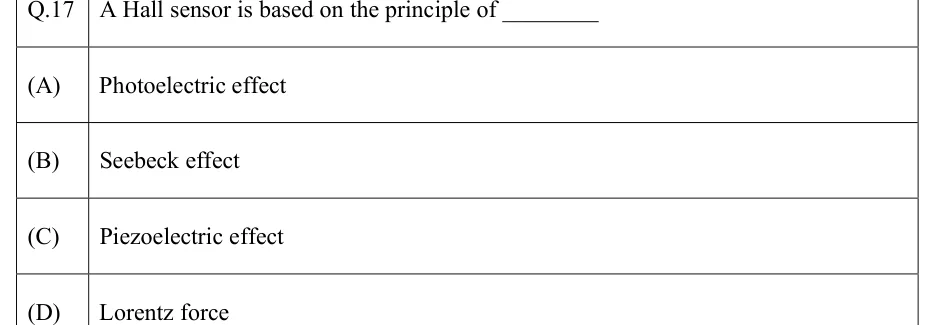
A Hall sensor is based on the principle of ________
- (A)
Photoelectric effect
- (B)
Seebeck effect
- (C)
Piezoelectric effect
- (D)
Lorentz force

A Hall sensor is based on the principle of ________
Photoelectric effect
Seebeck effect
Piezoelectric effect
Lorentz force
ANSWER
The Hall sensor is based on the Lorentz force, option (D).
Official answer: DSource: Official answer key, GATE 2022 IN (IIT Kharagpur)
A Hall sensor is a thin slab of semiconductor carrying a bias current , with a magnetic flux density applied perpendicular to the current.
The moving charge carriers (velocity ) feel the magnetic force . This is the Lorentz force.
The force pushes the carriers toward one side of the slab. Charge builds up there until the transverse electric force balances .
The transverse Hall voltage is , where is the Hall coefficient and is the slab thickness. It is proportional to .
Compare the options. The photoelectric effect is electron emission driven by light. The Seebeck effect is a thermoelectric voltage from a temperature difference. The piezoelectric effect is charge from mechanical stress. None of these involves a magnetic field.
Only the Lorentz force explains the Hall voltage, so the answer is (D).
KEY IDEA
A magnetic field deflects moving charge carriers through the Lorentz force . The resulting sideways charge build-up is the Hall voltage, which is proportional to , so a Hall sensor measures magnetic flux density.
WATCH OUT FOR
Choosing the piezoelectric or Seebeck effect because all three are common sensor principles. Only the Lorentz force involves a magnetic field, which is what a Hall sensor responds to.
From the GATE 2022 IN paper. Every question of this paper · Download the full paper · All 19 Sensing principles questions, with notes