
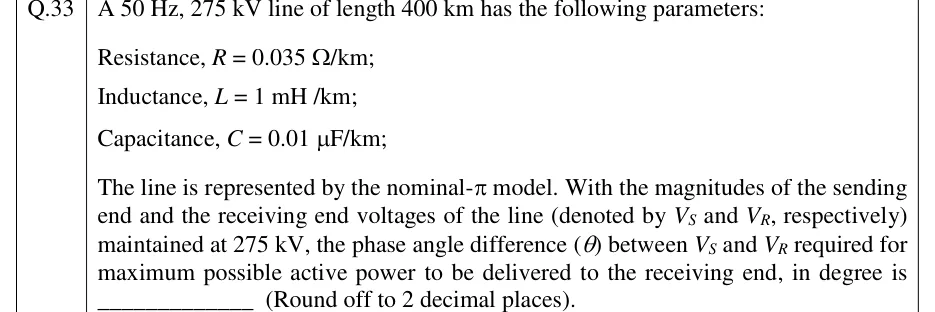
A 50 Hz, 275 kV line of length 400 km has the following parameters: Resistance, R = 0.035 Ω/km; Inductance, L = 1 mH/km; Capacitance, C = 0.01 μF/km. The line is represented by the nominal-π model. With the magnitudes of the sending end and the receiving end voltages of the line (denoted by V_S and V_R, respectively) maintained at 275 kV, the phase angle difference (θ) between V_S and V_R required for maximum possible active power to be delivered to the receiving end, in degree is ______ (Round off to 2 decimal places).
GATE 2023 EE Q.33: solution and answer
Answer and solution
ANSWER
.
Official answer: 83 to 84Source: Official answer key, GATE 2023 EE (IIT Kanpur)
For a nominal- line, with (the series arm) and .
The receiving-end active power is , where , and is the angle by which leads .
and are both held at , so only the first term depends on . It is largest when , that is .
Total series resistance: .
Total series reactance: .
.
The shunt capacitance appears only in , which enters the second term. That term does not depend on , so the capacitance does not change the angle. Hence .
KEY IDEA
With both end voltages fixed, received power is greatest when the power angle equals the angle of the line's series impedance (the constant). The shunt capacitance of the nominal- model sits in and does not move that angle.
WATCH OUT FOR
Using the maximum-power angle of from the lossless-line formula, or including the capacitive admittance in the impedance angle. The line has resistance, so the angle is of the series arm alone.
From the GATE 2023 EE paper. Every question of this paper · Download the full paper · All 6 Transmission & distribution questions, with notes
More Transmission & distribution questions
- GATE 2020 EE Q.47 · NAT · 2 marksBus 1 with voltage magnitude V_1 = 1.1 pu is sending reactive power Q_12 towards bus 2 with voltage…
- GATE 2026 EE Q.54 · MSQ · 2 marksFor the balanced 3-phase transmission line shown, consider the following cases: Case-1: |V_1| = 1.1 p.u…
- GATE 2025 EE Q.32 · NAT · 1 markConsider a distribution feeder, with R/X ratio of 5. At the receiving end, a 350 kVA load is connected.