
IAE Academy

GATE 2020 EE Q.47: solution and answer

GATE 2020 · EEQ.47 · 2 marks · NAT

Bus 1 with voltage magnitude pu is sending reactive power towards bus 2 with voltage magnitude pu through a lossless transmission line of reactance . Keeping the voltage at bus 2 fixed at 1 pu, magnitude of voltage at bus 1 is changed, so that the reactive power sent from bus 1 is increased by 20%. Real power flow through the line under both the conditions is zero. The new value of the voltage magnitude, , in pu (rounded off to 2 decimal places), at bus 1 is ______.
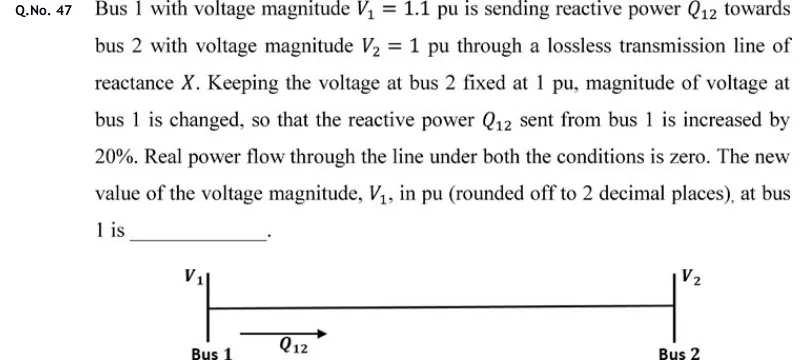
GATE 2020 EE question 47: Single-line diagram: a horizontal line joining Bus 1 (left, voltage V_1) and Bus 2 (right, voltage V_2), with an arrow…Tap to open full size
Figure from the GATE 2020 EE paper. It is part of the question.
Figure description

Single-line diagram: a horizontal line joining Bus 1 (left, voltage V_1) and Bus 2 (right, voltage V_2), with an arrow below the line near Bus 1 labelled Q_12 pointing from bus 1 towards bus 2.

Answer and solution

ANSWER

The new value of is about pu.

Official answer: 1.11 to 1.13Source: Official answer key, GATE 2020 EE (IIT Delhi)

  1. The line is lossless, so . Real power flow is zero in both conditions, so and in both.

  2. The reactive power sent from bus 1 is . With and pu this becomes .

  3. Initial case, pu: .

  4. is increased by 20%, so the new value is . The reactance and are unchanged.

  5. Equate the new to the formula: , which gives .

  6. Solve the quadratic: , with .

  7. The negative root gives a negative voltage magnitude, which is not physical, so reject it. Then pu, which is pu to 2 decimal places.

KEY IDEA

With zero real power flow the angle is zero, so reactive power is . A 20% increase in gives a quadratic in . Take its positive root.

WATCH OUT FOR

Using a 20% rise in voltage instead of a 20% rise in reactive power. Another is treating as linear in . depends on , so rises by only about 1.6%, not 20%.

From the GATE 2020 EE paper. Every question of this paper · Download the full paper · All 6 Transmission & distribution questions, with notes

More Transmission & distribution questions