
IAE Academy

GATE 2026 CS2 GA Q.7: solution and answer

GATE 2026 · CS2GA Q.7 · 2 marks · MCQ

Two tiles are missing in Panel I. Which one of the options in Panel II is the appropriate choice for the missing tiles?
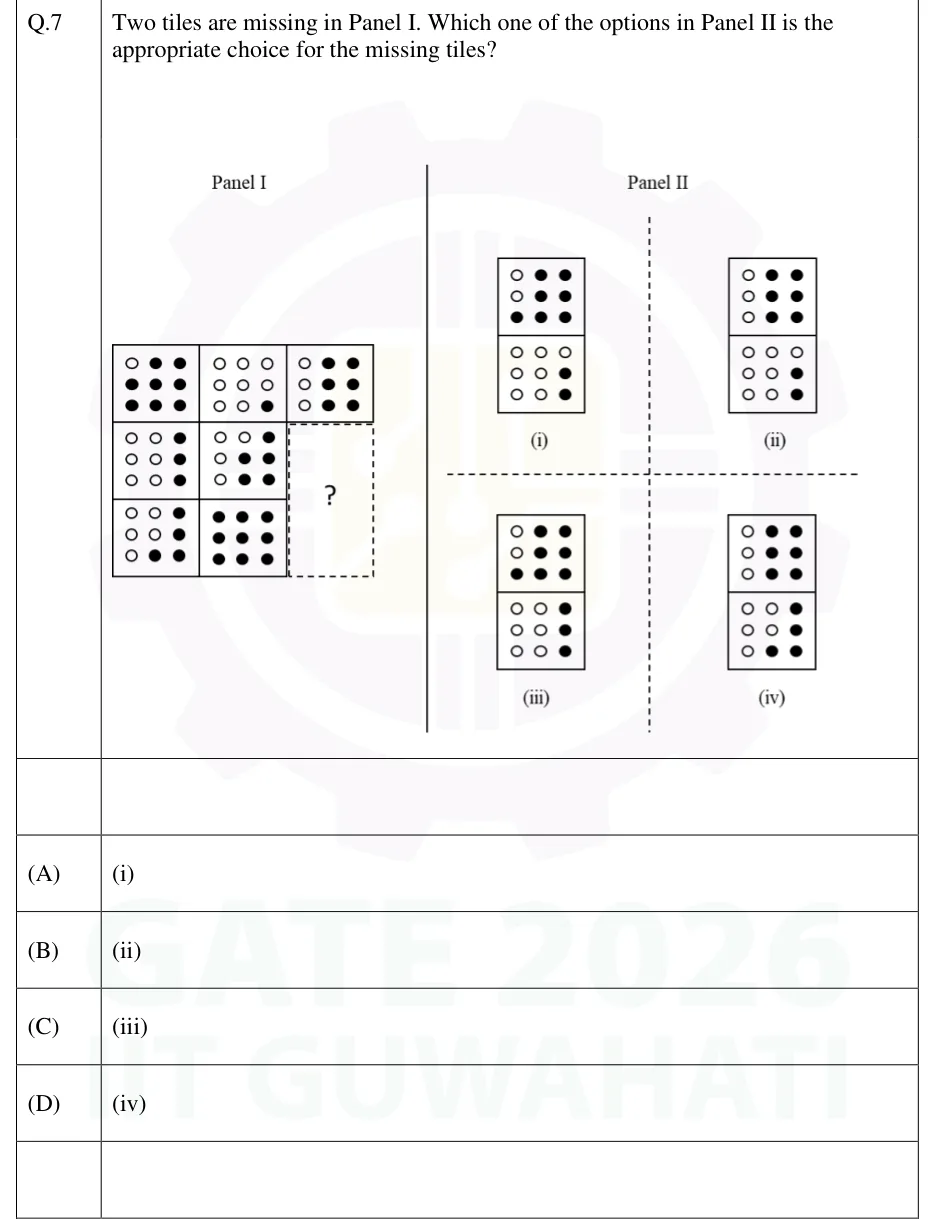
GATE 2026 CS2 GA question 7: Panel I is a 3x3 grid of square tiles, each tile holding a 3x3 array of dots (open circle = empty, filled circle =…Tap to open full size
Figure from the GATE 2026 CS2 paper. It is part of the question.
Figure description

Panel I is a 3x3 grid of square tiles, each tile holding a 3x3 array of dots (open circle = empty, filled circle = filled). The bottom two cells of the right-hand column (row 2 column 3 and row 3 column 3) are missing, drawn as a dashed box with a '?'. Tiles, written row by row with o = open and x = filled: Row 1: tile (1,1) = [o x x / x x x / x x x]; tile (1,2) = [o o o / o o o / o o x]; tile (1,3) = [o x x / o x x / o x x]. Row 2: tile (2,1) = [o o x / o o x / o o x]; tile (2,2) = [o o x / o x x / o x x]; tile (2,3) missing. Row 3: tile (3,1) = [o o x / o o x / o x x]; tile (3,2) = [x x x / x x x / x x x]; tile (3,3) missing. Panel II shows four options, each a vertical pair of two tiles (top tile above bottom tile). (i): top [o x x / o x x / x x x], bottom [o o o / o o x / o o x]. (ii): top [o x x / o x x / o x x], bottom [o o o / o o x / o o x]. (iii): top [o x x / o x x / x x x], bottom [o o x / o o x / o o x]. (iv): top [o x x / o x x / o x x], bottom [o o x / o o x / o x x].

  1. (A)

    (i)

  2. (B)

    (ii)

  3. (C)

    (iii)

  4. (D)

    (iv)

Answer and solution

ANSWER

The missing tiles are the 7-dot tile above the 2-dot tile, which is option (i), so the answer is A.

Official answer: ASource: Official answer key, GATE 2026 CS2 (IIT Guwahati)

  1. Count the filled dots in each tile of Panel I. Row 1: 8, 1, 6. Row 2: 3, 5, missing. Row 3: 4, 9, missing.

  2. The counts 8, 1, 6, 3, 5, 4, 9 are seven of the numbers 1 to 9, each used once. The only unused numbers are 2 and 7, so the two missing tiles hold 2 and 7 dots in some order.

  3. The known lines suggest a magic square, all sums equal to 15: row 1 is , column 1 is , and column 2 is .

  4. Column 3 must also sum to 15, so and . Row 2 gives , so . Row 3 gives , so . The top missing tile has 7 filled dots and the bottom one has 2.

  5. Count the filled dots in Panel II. (i): top 7, bottom 2. (ii): top 6, bottom 2. (iii): top 7, bottom 3. (iv): top 6, bottom 4. Only (i) gives 7 on top and 2 below.

  6. Cross-check with the filling order of the tiles. Each tile is filled column by column from the right, and each column is filled from the bottom upward. So 1 is the bottom-right dot, 3 is the whole right column, 6 is the right and middle columns, and 7 adds the bottom-left dot. The 2-dot tile is the bottom two dots of the right column. Option (i) shows exactly these two tiles.

  7. The answer is (i), option A.

KEY IDEA

Count the filled dots in each tile. The counts form a magic square of 1 to 9 with every row, column and diagonal summing to 15, so the missing tiles hold 7 and 2 dots.

WATCH OUT FOR

Comparing how the dots look instead of counting them, or taking the missing tiles in the wrong order (2 above 7). Row 2 needs 7 and row 3 needs 2, so the 7-dot tile goes on top.

From the GATE 2026 CS2 paper. Every question of this paper · Download the full paper · All 48 Spatial questions, with notes

More Spatial questions