
IAE Academy

GATE 2026 EC GA Q.3: solution and answer

GATE 2026 · ECGA Q.3 · 1 mark · MCQ

The figure below has exactly three intersecting line segments with a rectangular portion WXYZ missing. Which one of the following options P, Q, R, and S is the missing portion WXYZ?
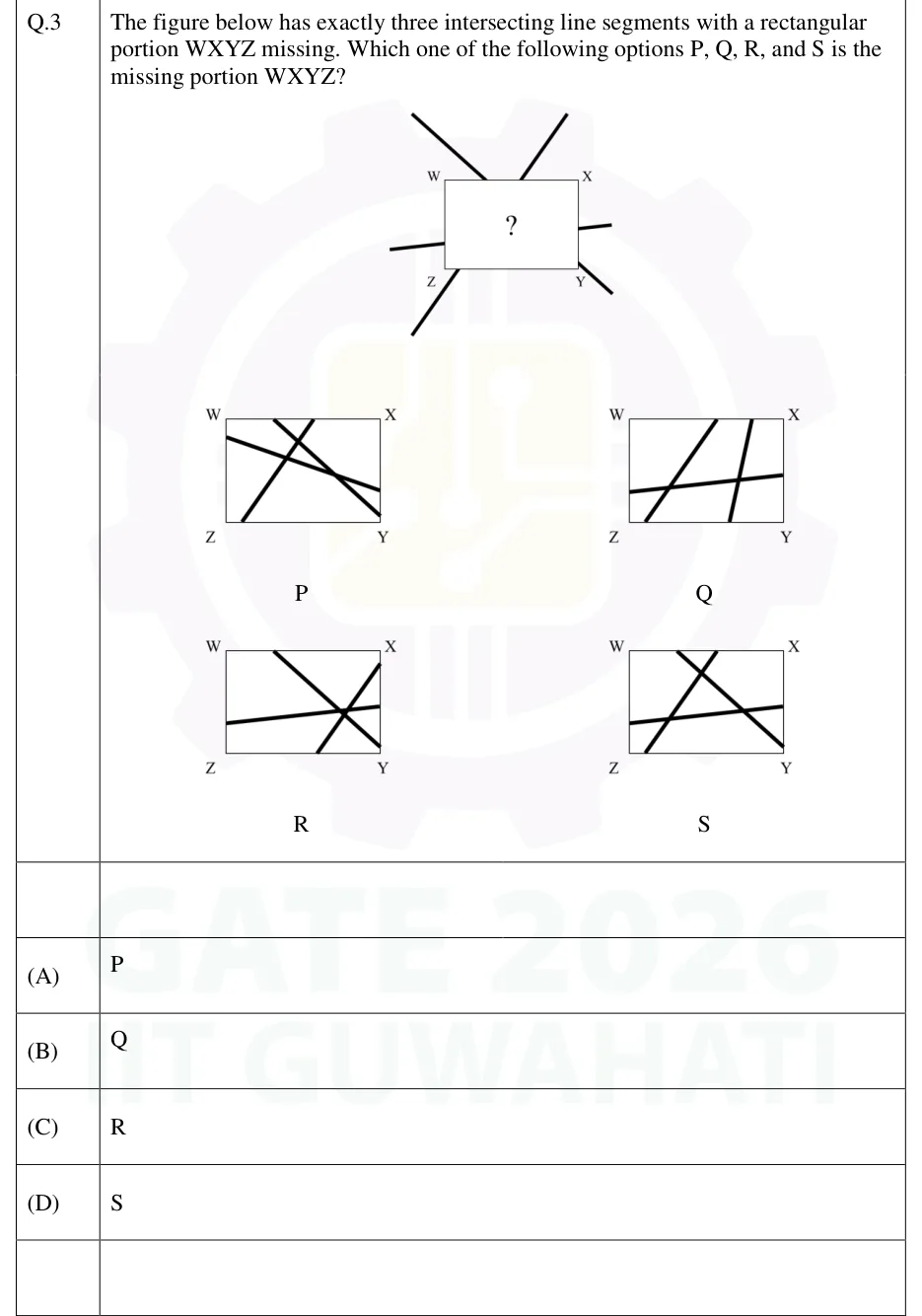
GATE 2026 EC GA question 3: MAIN FIGURE: a blank rectangle, wider than it is tall, with a "?" in its centre.Tap to open full size
Figure from the GATE 2026 EC paper. It is part of the question.
Figure description

MAIN FIGURE: a blank rectangle, wider than it is tall, with a "?" in its centre. Its corners are labelled W (top-left), X (top-right), Y (bottom-right) and Z (bottom-left). Six short thick line stubs stop at the rectangle's border. (1) Top edge, about 31% of the way from W to X: a stub comes down from the upper left, falling to the right, at roughly 40 degrees below the horizontal. (2) Top edge, about 57% of the way from W to X: a stub comes down from the upper right, rising to the right at roughly 55 degrees. (3) Left edge, about 70% of the way down from W: a nearly horizontal stub that rises slightly towards the rectangle. (4) Right edge, about 54% of the way down from X: a nearly horizontal stub that rises slightly to the right. (5) Bottom edge, about 10% of the way from Z to Y: a stub going down to the lower left, rising to the right at the same steep angle as stub 2. (6) Right edge, very close to Y (about 93% of the way down): a stub going down to the lower right, falling to the right at the same angle as stub 1. OPTIONS: four figures, each a filled-in rectangle labelled W (top-left), X (top-right), Y (bottom-right), Z (bottom-left), set out in a 2x2 grid: P top-left, Q top-right, R bottom-left, S bottom-right. P: one line falling to the right runs from the top edge at about 31% to the right edge near Y; a second line rising to the right runs from the bottom edge at about 10% to the top edge at about 57%, crossing the first just below the top edge; a third line falls to the right, from the left edge about 19% of the way down to the right edge about 69% of the way down. Q: two steep lines, both rising to the right and not crossing inside the rectangle: one from the bottom edge at about 10% to the top edge at about 57%, the other from the bottom edge at about 65% to the top edge at about 80%. A nearly horizontal line rising to the right, from the left edge about 70% of the way down to the right edge about 54% of the way down, crosses both. R: one line falling to the right runs from the top edge at about 31% to the right edge near Y; a line rising to the right runs from the bottom edge at about 60% to the right edge near X; a nearly horizontal line rising to the right runs from the left edge about 70% of the way down to the right edge about 54% of the way down. All three lines pass through one common point in the right half. S: one line falling to the right runs from the top edge at about 31% to the right edge near Y; a line rising to the right runs from the bottom edge at about 10% to the top edge at about 56%; a nearly horizontal line rising to the right runs from the left edge about 71% of the way down to the right edge about 54% of the way down. The three lines cross at three separate points, forming a small triangle.

  1. (A)

    P

  2. (B)

    Q

  3. (C)

    R

  4. (D)

    S

Answer and solution

ANSWER

The missing portion WXYZ is S, option (D).

Official answer: DSource: Official answer key, GATE 2026 EC (IIT Guwahati)

  1. Two stubs make one segment. A straight line stays straight through the gap. So each stub outside the gap must join a stub on another edge that has the same slope and lies on the same straight line.

  2. Pair the six stubs. Line 1: the top-edge stub at about 31% that falls to the right continues to the stub on the right edge next to . Line 2: the top-edge stub at about 57% that rises to the right continues to the bottom-edge stub near (about 10%). Line 3: the left-edge stub (about 70% down) continues to the right-edge stub (about 54% down), so this near-horizontal line rises slightly to the right.

  3. What the gap must show. Lines 1 and 2 enter the top edge close together and lean towards each other, so they cross just below the top edge. Line 3 stays between about 54% and 70% of the way down across the whole gap, so it cannot pass through that crossing point. It crosses line 2 in the left part of the gap and line 1 in the right part. That gives three separate crossing points, forming a small triangle.

  4. P fails. Lines 1 and 2 are right, but its third line falls to the right, from high on the left edge (about 19% down) to low on the right edge (about 69% down). The outside stubs need the opposite: low on the left, higher on the right.

  5. Q fails. Line 3 is right, but both steep lines rise to the right and never cross. No line reaches the right edge next to , and no line enters the top edge falling to the right, so line 1 is missing.

  6. R fails. Lines 1 and 3 are right, but its rising line runs from the middle of the bottom edge (about 60%) to the right edge near . The outside stubs need a line from the top edge at about 57% to the bottom edge near . R's three lines also pass through a single point, not a triangle.

  7. S matches all six edge points. Top at about 31% to near (falling), top at about 57% to bottom at about 10% (rising), and left edge about 71% down to right edge about 54% down (rising slightly). The three crossings form a triangle, as required. Answer: S, option (D).

KEY IDEA

Each line has to pass straight through the gap. Join every stub to the stub on another edge with the same slope, which gives three lines: top 31% to the right edge near Y, top 57% to the bottom edge near Z, and left 70% to right 54%. Then check each option at the edges. P, Q and R each get exactly one of the three lines wrong. Only S has all three.

WATCH OUT FOR

Choosing P because its two top-edge lines and their crossing look right, without noticing that its near-horizontal line slopes the wrong way (high on the left, low on the right). Another trap is choosing R, whose single triple crossing looks neat, without checking that its rising line leaves through the right edge near X instead of the top edge.

From the GATE 2026 EC paper. Every question of this paper · Download the full paper · All 23 Spatial questions, with notes

More Spatial questions